



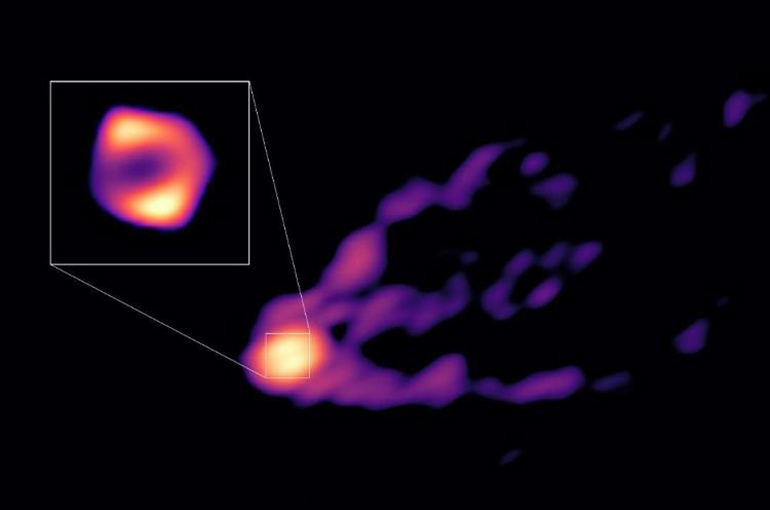
 Scientists Reveal First Image of a Black Hole Blasting Out a Jet of Matter
(Yicai Global) April 27 -- Scientists led by an expert at an astronomical observatory in Shanghai have produced the first-ever image of a black hole that shoots out a jet of matter at near-light speed, which helps the world understand how these gravitational wonders function.
Dr. Lu Rusen from the Shanghai Astronomical Observatory of the Chinese Academy of Sciences led a team of scientists around the world to generate the image that for the first time includes both the exceptional region of spacetime and the jet which spills out matter that the black hole has absorbed due to its strong gravity that even light cannot escape, according to a study published in Nature yesterday.
"We have taken a panoramic picture of the black hole together with its jet at a new wavelength," Lu said. Before this, astronomers had only separate images of the two features of the galaxy Messier 87, the first-ever black hole captured by people, separately.
The new observations were obtained by adding two observatories in Chile and Greenland to a group called the Global Millimeter VLBI Array. The process was lengthy as the photo was taken over five years ago. It takes up to 10 hours to take a photo while developing it with a theoretical explanation could require a long time, per Lu.
Future exploration involves getting color images of black holes, which are usually formed by remnants of dead stars, through new millimeter-wavelength observations, per the team.
The latest study revealed surprising insights. The ring around the black hole was 50 percent larger than expected. The material falling into the black hole produces additional emission, Lu said, adding that this gives scientists a more complete view of the physical processes near the black hole.
More puzzling details were uncovered. "The radiation from the inner region close to the black hole is broader than we expected. This could mean that there is more than just gas falling in. There could also be a wind blowing out, causing turbulence and chaos around the black hole,” according to Kazuhiro Hada from the National Astronomical Observatory of Japan.
Adding the two observatories has helped scientists gain a new perspective, according to Thomas Krichbaum at the Max Planck Institute for Radio Astronomy in Bonn. “We do indeed see the triple-ridged jet that we knew about from earlier VLBI observations.”
Editor: Emmi Laine, Xiao Yi





