



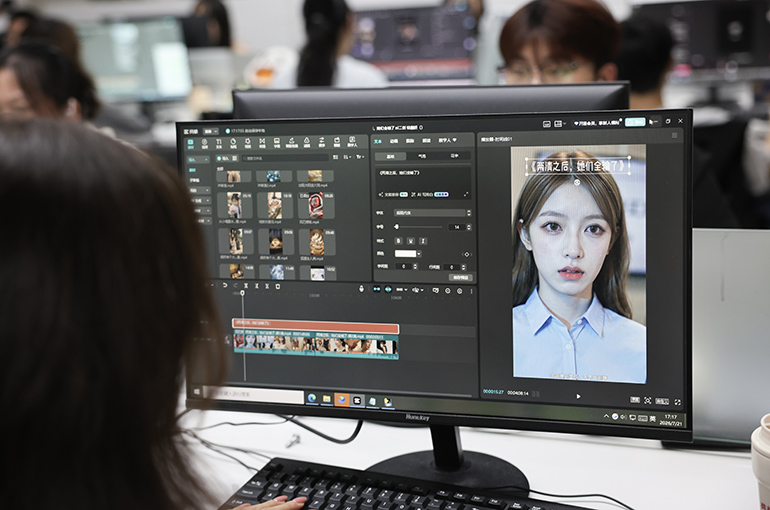
 AI Cuts Costs in USD6 Billion Overseas Short Drama Market, But Can It Win Viewers?
(Yicai) Oct. 23 -- Artificial intelligence is accelerating the overseas expansion of Chinese short dramas, driving growth in a market forecast to exceed USD6 billion this year, even as audience acceptance remains a hurdle.
The overseas micro-short drama market is expected to exceed USD6 billion this year, up about 50 percent from 2025, according to DataEye Research Institute. The research body focusing on digital entertainment raised its forecast by USD1 billion from the beginning of the year as AI-generated dramas and animated short dramas expanded content supply.
Micro-dramas, a format popularized in China, typically feature episodes lasting just a few minutes, with cliffhangers designed to keep smartphone viewers watching and paying to unlock more episodes. As the format expands overseas, TikTok and YouTube are stepping up content partnerships, further driving industry growth, DataEye said. But the rapid expansion of AI-generated content is also testing overseas audiences' appetite for the format.
AI Reshapes Overseas Competition
AI is helping established players expand while giving newer competitors room to grow.
He Yunchang, founder of micro-drama producer Maiya Media, told Yicai at a YouTube forum yesterday that AI had helped the company rise from the second tier to the top tier of the overseas market over the past two years. “In 2026, we mainly seized the opportunities brought by AI.”
Maiya Media began expanding into overseas short drama distribution in September 2024. Despite entering the market later than many competitors, its short drama platform called NetShort has attracted about 80 million monthly active users in roughly two years, according to He.
Based on numbers from DataEye, NetShort ranked second among overseas short drama apps by combined in-app purchase revenue on the two major mobile operating systems in September.
AI is helping foreign markets narrow the gap with China's more mature industry for bite-sized entertainment. The overseas short drama market previously lagged behind China's in development, but AI has become an important driver of growth this year, Nan Yapeng, vice president of Crazy Maple Studio, told Yicai. Crazy Maple runs micro-drama platform ReelShort.
Several AI-generated short dramas released on ReelShort since the second quarter have performed well, Nan said. Advances in large language models have improved production efficiency while broadening the range of themes and genres that creators can explore.
The technology also enables producers to explore content that would be difficult to bring to life through live-action filming, Nan added.
He from Maiya Media said that AI has also improved the baseline quality of scripts. While scripts written without AI assistance previously scored between 50 and 85 points, AI-assisted drafts can score at least 75, the founder of Maiya Media said, without specifying how they were evaluated. Senior editors can then further improve the drafts, he added.
Beyond helping leading platforms produce more content, AI is also lowering barriers to entry, allowing newcomers to compete.
VibeShort and StoryReel, two platforms specializing in AI-generated short dramas, both ranked among the top 15 overseas micro-short drama apps by revenue in the first nine months of this year, according to the latest DataEye figures.
Both apps launched in the first half of this year and reached the industry's first tier within about six months, highlighting how quickly newcomers can gain ground.
Audience Acceptance Remains a Challenge
But while producers are embracing AI, overseas audiences remain harder to convince.
Sandy Chen, YouTube's head of strategic content partnerships in China, said global audiences have not fully embraced AI-generated content, with some users explicitly expressing dissatisfaction with AI productions.
Nan also noted that overseas users are generally less receptive to AI-generated content than their counterparts in China. That leaves platforms facing a crucial test: whether lower production costs can translate into content viewers are willing to pay for.
Editor: Emmi Laine





