



 AI Restructures China's Labor Market But ‘Job Disappearance’ Is False Proposition; Composite Closed-Loop Positions Become Largest Source of New Growth, ShanghaiTech's C-O*NET Report Shows
(Yicai) July 21 -- During the 2026 WAIC, ShanghaiTech University's CEISD and its partners jointly released the report "China's Labor Market in the Age of AI: From the Theory of Job Disappearance to the Theory of Task Reorganization". Breaking through the limitations of the US's static O*NET system, which is ill-adapted to China, the report builds the dynamic Chinese C-O*NET database based on a foundation of 65,200 tasks and 1,267 detailed occupations. The team constructed a four-quadrant evaluation system of "AI Exposure Index vs. Human Complementarity" to comprehensively measure the dual effects of AI's impact and reorganization on China's job market, providing quantitative references for China's economic research and macroeconomic policy-making in the AI era.
Through data analysis of a complete online recruitment cycle across all platforms in China from late 2023 to April 2026, the report reverses the popular anxiety-inducing narrative of "AI eliminating occupations in batches." The team's research found that since the advent of ChatGPT, over a quarter of the positions in the newly added online recruitment pool have a high exposure to AI substitution. However, high substitution exposure does not necessarily mean high risk; human complementarity serves as a crucial buffer. Particularly noteworthy is that composite closed-loop positions have become the most prominent new feature of the job market. During the same period, approximately 21 million jobs in the market were generated through task reorganization, accounting for 18.6% of total recruitment positions.
Chen Qin, the project's Chief Data Scientist and Visiting Scholar at ShanghaiTech University's CEISD, stated: "Over the past few years, the entire society has fallen into 'occupational substitution anxiety.' Everyone is staring at job titles for analysis, but essentially, the scale of observation is wrong. From a statistical data perspective, China has the authoritative occupational classification system, occupational skill standard system, new occupational profiles, and labor market trend data from the Ministry of Human Resources and Social Security, but it lacks a complete occupational system database with a unified scale at the task level. The academic community has built some data systems based on the US O*NET, but they are not fully adaptable to China's national conditions. Our core objective in building the dynamic Chinese C-O*NET based on full-volume online recruitment data is to shift the unit of analysis down from 'job titles' to 'updatable job responsibilities.' In the short term, it is a structural fact that entry-level positions requiring 1-3 years of experience are under pressure, but in the long run, there is no systemic unemployment crisis. The market is currently re-screening for composite workers who 'can master AI and bear ultimate responsibility.'"
Yang Yanqing, Director of ShanghaiTech University's CEISD, stated, "Global labor economics research, especially current research on the economic impact of AI, is based on the US O*NET data system. We have created China's dynamic C-O*NET data system, which will be open-sourced in the future, hoping it will become the data infrastructure for economic research in China. The main thread of LLMs' (Large Language Models) impact on the domestic labor market is task reorganization. On an empirical level, this challenges the division of labor theory of Adam Smith and Charles Babbage that has lasted for 250 years: in the past, the division of labor relied on breaking down human tasks to reduce switching costs, whereas LLMs flatten task switching costs, shifting the logic of the division of labor from 'subdivision among humans' to a 'human-machine collaborative closed loop.' In the future, we hope more teams will join the economic research on the division of labor under 'carbon-silicon symbiosis,' providing theoretical and data support for building a new macroeconomic policy toolbox in the artificial intelligence era."
Shattering Perceptions: "Job Disappearance" is a False Proposition, Tasks are the Core Unit of AI's Impact
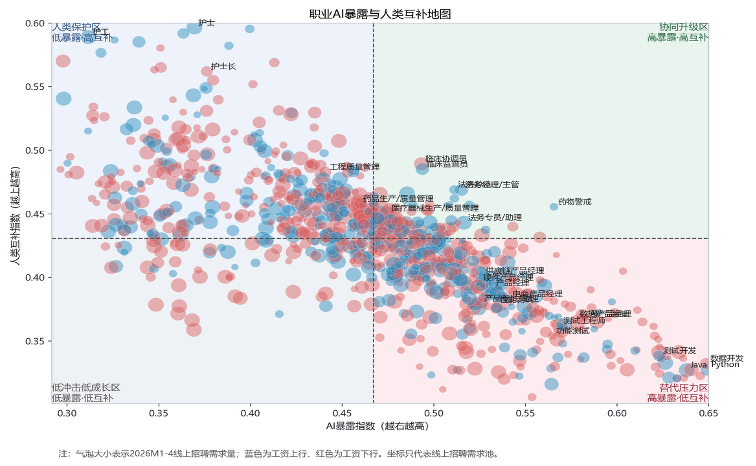
Figure 1: AI Exposure and Human Complementarity
In recent years, "lists of jobs eliminated by AI" have dominated mainstream public opinion, with positions such as accounting, customer service, copywriting, and design labeled as "high-risk for elimination," triggering widespread employment anxiety. Based on empirical research using the dynamic Chinese C-O*NET database and massive recruitment texts, the team concluded: AI will not completely eliminate any single occupation; it will only break down and rewrite individual tasks within a position. The speed at which employers adjust job responsibilities and hiring requirements (the 'res' and 'req' items in Job Descriptions) is far faster than the pace of changing job titles.
The report provides intuitive evidence by comparing Java development and telephone customer service—two roles publicly perceived as "high-exposure occupations": both have high AI exposure scores, but their situations are vastly different. For customer service positions, the entire set of scripts, work order entry, and standard Q&As can be independently completed by large models; their human complementarity score is extremely low, and recruitment scale continues to shrink. Although Java engineers can rely on AI to generate basic code and write API documentation, tasks requiring high responsibility and on-site judgment—such as architecture design, online troubleshooting, and cross-business system coordination—cannot be taken over by machines. As a result, salaries for senior technical roles continue to rise. Relying solely on occupational labels to classify risks will lead to systemic misjudgments.
The research team integrated over 700 million raw recruitment records from five major recruitment platforms between 2022 and 2026 to build a monthly-updated dynamic occupational task library. Through a ten-step engineered pipeline, LLMs were utilized in key stages such as sampling, clustering, and scoring, while the full volume of text was processed at high speed relying on a self-developed regex engine, achieving a manual verification matching rate of 0.947. This enables precise, layered, and time-segmented quantitative monitoring of all positions and majors.
Relying on the database's 13 standardized task scoring dimensions, the research constructed an "AI Exposure vs. Human Complementarity" four-quadrant coordinate system as a unified benchmark to evaluate the employment resilience of positions. A correlation "horse race" experiment across the 13 dimensions confirmed that the core driver of labor market contraction is the proportion of tasks that AI can complete independently; the two core indicators for expansion tracks are on-site reliance and embodied practical capability. Purely high AI exposure does not equate to unemployment risk; only positions that simultaneously lack human judgment and on-site fallback capabilities will experience a sharp decline in recruitment demand.
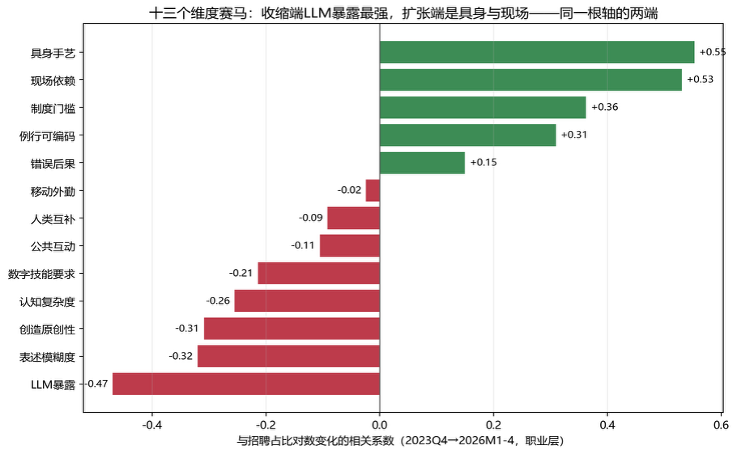
Figure 2: On the contraction end, LLM exposure is the strongest at -0.47; on the expansion end, embodied capability is +0.55, and on-site reliance is +0.53.
The Landing of AI's Impact Exposure: Targeting Workplace Newcomers, A Complete Review of the Three-Year Cycle
Using 40.01 million online recruitment demands from January to April 2026 as the measurement baseline, under a neutral statistical caliber, the report shows that 33.2% of positions belong to high AI-exposed task combinations, among which 26.6% fall into the substitution pressure zone of high exposure and low complementarity. This means that one in every four positions in the domestic online recruitment market is facing structural adjustment accelerated by AI. Stratified data by region and industry reveals structural divergence: the accelerated exposure of basic clerical and content roles in New Tier-1 and Tier-2 cities is higher than in Tier-1 cities; high-end offline service and medical positions in Tier-1 cities buffer the AI impact. On the industry dimension, demand contraction is most significant in four major sectors: basic operations, financial accounting, graphic/textual content, and telemarketing; meanwhile, demand remains stable in tracks with strong on-site requirements such as manufacturing, healthcare, offline caregiving, and equipment operation and maintenance.
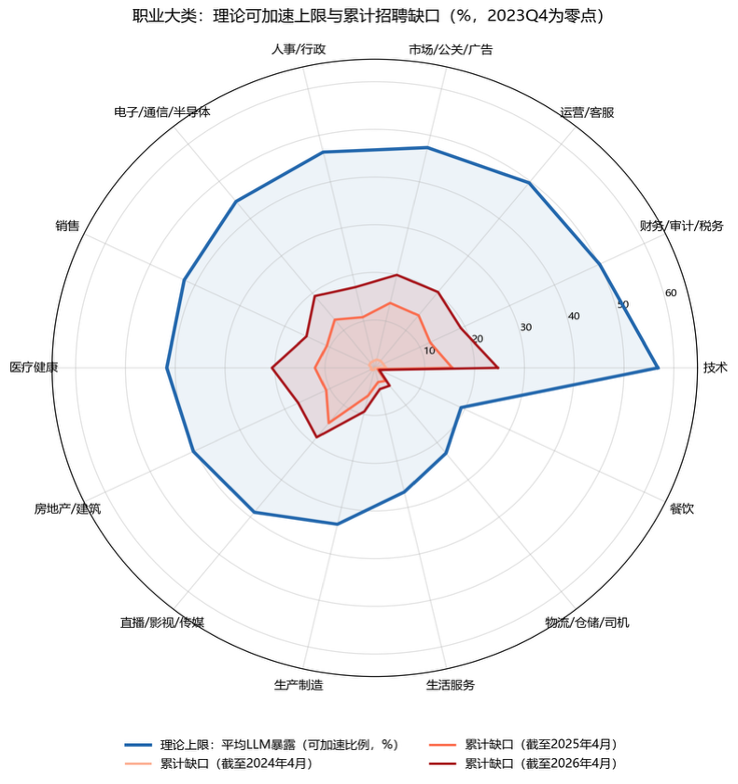
Figure 3: Major Occupational Categories: Outer circle represents theoretical upper limit, three inner circles = cumulative gap year by year.
What deserves attention is the stratified characteristic of the impact. The AI contraction effect does not evenly cover the entire workforce; instead, it is concentrated on entry-to-mid-level workers with salaries of 5k-8k RMB and 1-3 years of work experience. Regression data shows that the contraction slope for positions requiring 1-3 years of experience is -0.25, and for mid-range salary positions it is -0.31, making them the group under the most severe pressure in the entire market. In stark contrast, recruitment demand for high-paying positions above 12k RMB has fully rebounded, the recruitment proportion for senior positions above 50k RMB shows positive growth, and mature professionals with 5-10 years of experience are almost unaffected by AI. The underlying logic is very clear: in the past, enterprises relied on entry-level newcomers to complete basic training tasks such as documentation, data entry, and standardized communication. Now that large models have taken over these segments, companies no longer establish low-paying practice positions. This creates an industry-wide "entry trap," and the traditional workplace training chain for fresh graduates faces a direct rupture.
The report fully reviews the complete three-year adjustment cycle following the implementation of large models at the end of 2022, dividing it into three major stages: the current gap reflects the annual fluctuation of recruitment traffic, while the cumulative gap represents the unidirectional accumulated stock reduction. During the 2024 initiation phase, companies only piloted the tools, and demand shrank by a mere 2.6%. In 2025, the market entered a phase of panic overshooting, with the current gap soaring to 30.1% as a large number of companies stopped recruiting for clerical roles. In 2026, the market rationally stabilized, the current gap fell back to 16.9%, and the cumulative gap stood at 15.1%. The research team specifically reminds readers: this data only represents the magnitude of change in newly added online recruitment demand relative to a control group (where AI impact is negligible), and cannot be equated to the actual proportion of jobs replaced by AI. Furthermore, online samples have limitations in covering county-level areas and blue-collar workers, and therefore cannot be directly extrapolated to macroeconomic employment.
AI Does Not Create New Occupations, It Only Restructures the Division of Labor: Composite Closed-Loop Functional Packages Become the Market's Core Increment
Public opinion generally expects generative AI to spawn a large number of entirely new career tracks, but the report's data yields the opposite conclusion: between 2023 and 2026, the volume of newly added job titles was extremely small. Only large model algorithm and robotics engineer roles expanded slightly, while traditional algorithm roles in recommendation, risk control, and SLAM continued to shrink. Overall recruitment in the algorithm category experienced negative growth, indicating internal structural rotation within the AI industry without generating additional employment capacity. Meanwhile, the fastest-growing and most abundant positions across the entire market all stem from occupational reconstruction and transformation.
The report finds: although the recruitment scale for AI-exposed positions is shrinking, the work responsibilities borne by these positions have not disappeared simultaneously. A massive amount of textifiable tasks have detached from exclusive roles and diffused across industries into the entire production, technology, and sales chains, causing single-specialty roles to lose their irreplaceable value. The entropy value of intra-position responsibilities (measuring the complexity and combination degree of responsibilities) continues to rise. Enterprises are universally merging multiple processes to create "one person independently completing the whole process" composite functional packages. The highest-growth combination ranking first is "Manufacturing Optimization + Quality Closed-loop," which has appeared more than 170,000 times across the internet, covering 465 different types of occupations.
Enterprise recruitment logic has undergone a fundamental shift: they no longer assess singular professional skills, but prioritize screening candidates capable of independently navigating the full closed loop of requirement, execution, verification, and reporting. Emerging composite responsibility packages possess clear traits: the proportion of purely online standardized text work has drastically decreased, and they heavily rely on on-site operations, hands-on equipment use, and risk consequence judgment. Composite talents with strong on-site presence, strong collaborative skills, and a strong sense of responsibility will continue to benefit.
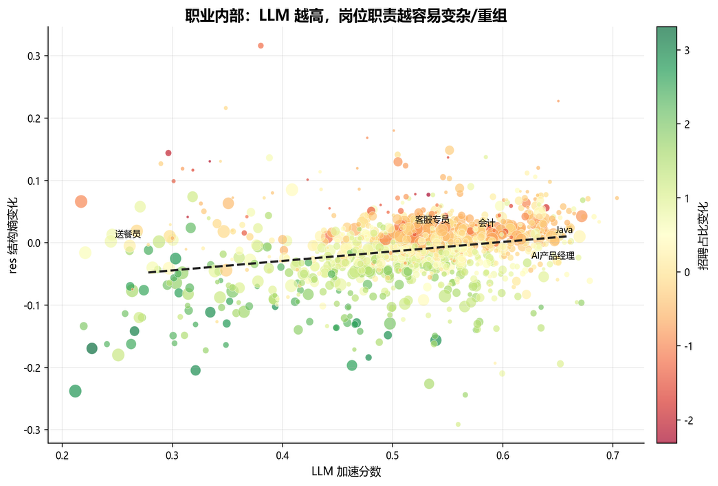
Figure 4: The higher the LLM exposure, the more likely occupational responsibilities are to broaden: from specializing in one task to one person holding multiple roles.
Four-Year Time Lag Supply-Demand Mismatch: College Entrance Examination Cutoff Scores are Insensitive to AI Exposure
Relying on bi-directional big data encompassing college entrance examination (Gaokao) admissions across more than 20 provinces nationwide and major-specific recruitment, the report reveals a dual supply-demand mismatch between the market and universities. First is a directional mismatch: the correlation coefficient between the popularity of undergraduate major admissions and market recruitment demand four years later is only 0.23. Second is a time mismatch: the undergraduate training cycle is 4 years, whereas AI can complete a full round of market restructuring in just 3 years. By the time students graduate, the occupational structure has already changed, creating cobweb-like fluctuations in supply and demand.
Over the seven years from 2019 to 2025, the difference in admission popularity between high AI-exposure majors and low-exposure majors remained stable and unchanged. Even when the AI market impact reached its peak in 2025, no adjustments were seen in candidate applications or university enrollment expansions. At the same time, the employment outlets for undergraduate majors are highly dispersed. The top five aligned occupations for a single major only account for 20% to 30% of recruitment demand, with 65% to 80% of jobs distributed across long-tail industries. However, university curricula focus on a small number of aligned jobs, showing insufficient attention to the market's mainstream demand for composite responsibilities. Data broken down by institution and region shows that Project 985 universities maintain stable enrollment scales relying on their brand reputation; meanwhile, candidates from cities with low-to-middle economic levels exhibit higher sensitivity to short-term salary popularity.
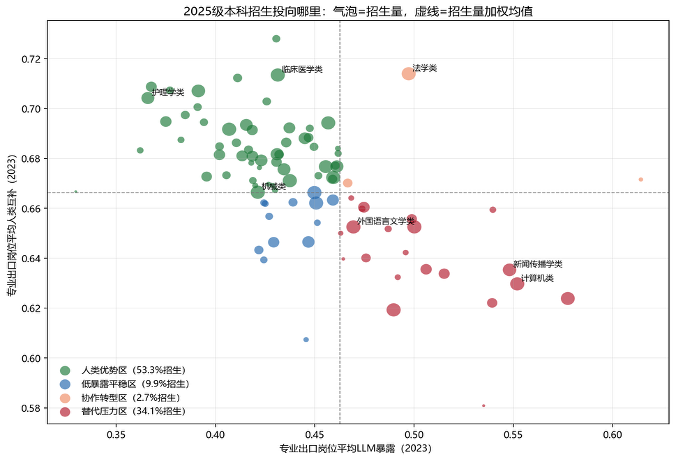
Figure 5: Over half of the 2025 undergraduate admissions are directed to the two high-exposure quadrants: Substitution Pressure and Collaborative Transformation.
To address this educational mismatch, the report attempts to bridge the complete link from market task data to university curricula. The research team "translated" the top ten high-growth composite responsibility packages in the market into course modules, distinguishing innovative solutions for five major categories of majors: engineering, business, medicine, humanities and social sciences, and on-site fields. The report proposes that a single, university-wide general AI literacy course cannot solve employment-oriented educational innovation; it must be adapted to the authentic work scenarios of different majors. The report also distills six core human capabilities that AI cannot replace: situational judgment, assuming responsibility, cross-role coordination, ethical trade-offs, on-site adaptation, and chain-of-evidence expression. Centered on employment-oriented educational innovation, the report provides a reference manual based on a data foundation for four major entities: students, universities, enterprises, and policymakers.
The team stated that the C-O*NET database is dynamically updated on a continuous monthly basis and will be open-sourced in the future, providing long-term quantitative support for economic research, university educational innovation, and the formulation of national and local macroeconomic employment policies.
Executive Summary





