



 AI, Tokenization Transform Bretton Woods System's Foundations, China's Ex-Vice Finance Minister Says
(Yicai) Nov. 11 -- The combined forces of artificial intelligence and tokenization are undermining the underlying logic of the Bretton Woods system, an international monetary regime established at the 1944 Bretton Woods Conference, according to China's former vice finance minister.
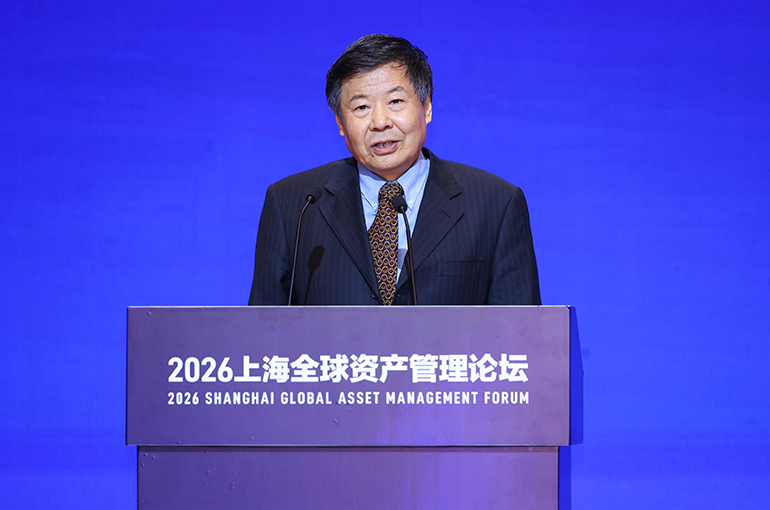
"AI paired with tokenization is transforming the very foundation of the old system," Zhu Guangyao said in his keynote speech at the Shanghai Global Asset Management Forum today, co-hosted by Yicai and Bank of China. "AI capabilities, backed by a complete industrial base and robust power supply, will be central to defining leadership within a new Bretton Woods framework."
Tokenization converts currencies, bonds, equities, commodities, receivables, and other valuable assets into digital credentials that can be programmatically recorded and executed automatically on distributed ledgers, Zhu noted. This brings fundamental changes to accounting methods, transaction speeds, and cross-border payment mechanisms, he added.
Two competing forces coexist at the monetary layer of tokenization: US-dominated stablecoins and central bank digital currencies, he pointed out. Stablecoins are issued by private entities and backed by reserve assets, while central bank digital currencies are issued directly by central banks and carry fiat-currency credibility alongside programmability, he said.
"Yet new challenges emerge, such as who issues stablecoins, what assets back their reserves, and who bears responsibility in the event of a failure," Zhu stressed. "For cross-border use of central bank digital currencies, questions remain over currency sovereignty and technical standard-setting. The old framework is simply not equipped to address these issues."
The integration of AI and tokenization into the financial system has created systemic gaps within the Bretton Woods system, as the parties bearing risks, the speed of risk transmission, the boundaries of risk, and the logic of asset pricing have all changed, he said.
Zhu laid out a four-tier blueprint for a new Bretton Woods-style system suited for the AI era. At the monetary layer, the system will shift from unipolarity to multipolarity, with the US dollar's central role weakening and multiple currencies coexisting on tokenized ledgers.
Supported by competitiveness in the intelligent economy, real trade settlement cases and independent payment networks, the Chinese yuan will become one of the major anchors within this multipolar ledger ecosystem, according to Zhu.
In addition, the new system's settlement layer will move from delayed to real-time settlement, Zhu said. Tokenized ledgers, smart contracts, and instant settlement will replace the traditional correspondent banking model, he noted, adding that regulation will shift from institution-based oversight toward governance of models, ledgers, and autonomous agents.
Global governance will be structured with the G20 setting strategic directions, the Financial Stability Board issuing standards, the International Monetary Fund monitoring, and the Bank for International Settlements running pilot experiments, Zhu added.
Editors: Tang Shihua, Martin Kadiev





