 Alibaba Launches New Qwen AI Phone Solution With Honor as First Adopter
(Yicai) Sept. 23 -- Chinese tech giant Alibaba Group Holding released Qwen Intelligence, with leading domestic smartphone maker Honor becoming the first to adopt the new solution that aims to upgrade artificial intelligence phones from being "answerers" to "doers" of user requests.
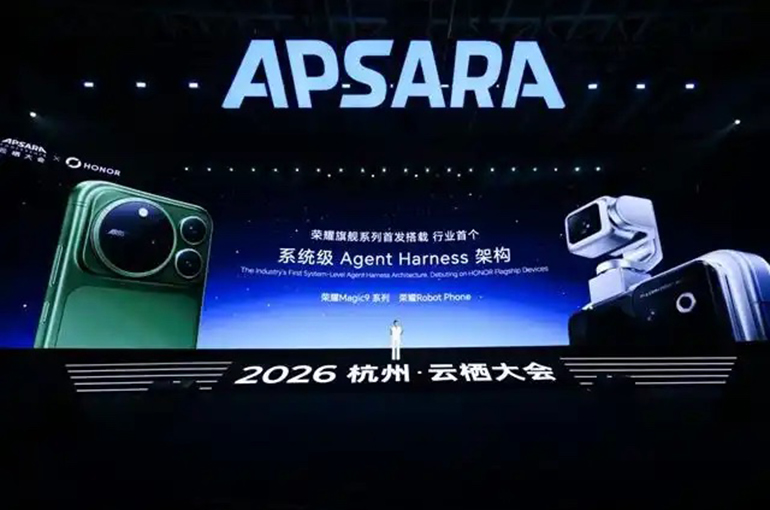
Alibaba launched the full-stack Qwen Intelligence at the opening ceremony of the Apsara Conference yesterday. The tool provides an agent technology platform for phone manufacturers built on the Hangzhou-based company's Qwen large language model.
The Honor Magic 9 series, set to be released in a week, and robot phone will be among the first models to feature Qwen Intelligence, Fang Fei, product line president of the handset maker, announced at the event. Honor is collaborating with Alibaba to define the model's capability boundaries based on its MagicOS and Qwen Intelligence, considering power consumption, memory, latency, and other factors on the smartphone side, Fang added.
The pair are adapting capabilities for edge perception, visual understanding, rapid response, complex reasoning, and graphical user interface operations, aiming to jointly develop domain-specific models and solutions for the next generation of AI smartphones, Fang pointed out.
The AI smartphone competition is shifting from models' capabilities to their execution capabilities once integrated into devices, according to industry insiders. Collaboration between model developers and smartphone manufacturers essentially turns general model capabilities into terminal agents constrained by the phone's hardware, operating system, and application ecosystem, while still able to execute tasks continuously, they noted.
Complex agents cannot be run directly on a model, Fang stressed. "There needs to be a framework that can unify scheduling, perception, planning, tool invocation, and execution."
In co-developing this operational framework, model providers need to address urgent issues, including reducing phone development and integration costs, improving overall operational efficiency, and catering to the differentiated needs of various manufacturers, the insiders said. In addition, smartphone makers need to maintain control over the terminal experience, user data, and product differentiation while gaining access to the models' capabilities, they noted.
"Alibaba will not manufacture phone hardware," Vice President Steven Hoi said at the conference, a statement that highlights the boundary of collaboration between model providers and smartphone manufacturers: model developers do not need to become phone makers and phone makers do not need to create an LLM that covers all scenarios.
The insiders pointed out that model developers and phone manufacturers must align on the interface among model capabilities, terminal systems, application ecosystems, and business models.
Editors: Tang Shihua, Martin Kadiev