



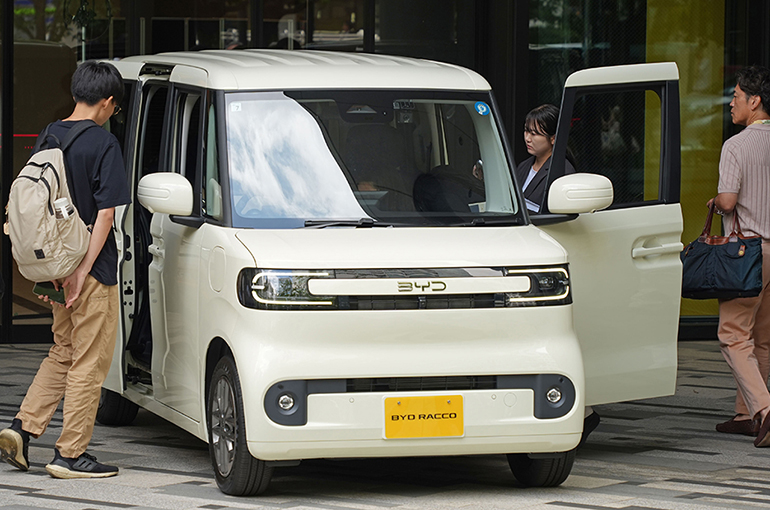
 BYD Secures Over 1,000 Orders for Its Electric K-Car Racco in Japan in Two Weeks Since Launch
(Yicai) Aug. 11 -- Chinese new energy vehicle giant BYD has received more than 1,000 orders for the Racco since the electric kei car model entered the Japanese market at the end of July.
BYD secured more than 1,000 orders for the Rocco in Japan between July 28 and Aug. 9, the Shenzhen-based carmaker’s local subsidiary said on X yesterday. The Rocco comes in three models, priced at between JPY2.1 million and JPY2.5 million (USD13,435 to USD15,680) before subsidies.
The Racco’s sales target is 10,000 units by the end of the year, according to Atsuki Tofukuji, general manager of BYD Japan. For reference, it took BYD nearly three years to achieve total deliveries of 10,000 passenger vehicles in Japan.
In the first half of the year, BYD delivered 2,334 vehicles in the Japanese market. As of July 31, it had 56 retail outlets in the country, just over half of its previously set target of 100. The company will open new satellite showrooms in mid-sized cities to accelerate nationwide channel expansion in Japan, Tofukuji noted.
“Over the past week, I have received an average of eight groups of customers coming for vehicle viewings each day, almost double the usual volume,” Li Jing, a sales consultant at a BYD 4S store in Shibuya, Tokyo, told Yicai.
All Racco units available in-store are demo and display vehicles exported from BYD’s Changzhou plant to Tokyo, Li noted, adding that mass-produced units still require preorders.
“While the Racco is more expensive than local competitors because of Japan’s clean energy vehicle subsidy policy, test drives are already booked for the next three days, and some customers have placed firm orders immediately after the test drive,” Li said.
Under Japan’s CEV subsidy scheme, Japanese electric K-cars, such as Nissan Motor’s Sakura, qualify for JPY580,000 (USD3,640) in government subsidies. In comparison, the Racco only receives JPY150,000 (USD942), as it is mainly equipped with Chinese-sourced components and is imported as a complete built-up unit.
Despite retaining the price advantage, Japanese automakers are paying close attention to the Racco.
Honda Motor’s retail store in a shopping complex in Shibuya has begun studying the Racco, as some employees have taken test-drives, a sales staffer surnamed Tomomura told Yicai. “Honda’s N-Box has been the best-selling K-car for more than 10 consecutive months, yet we cannot afford to overlook the Racco,” Tomomura noted. “No foreign brand has ever competed in this market segment before.”
The new-generation N-Box has a retail price of JPY1.8 million (USD11,1106), while the Racco is priced from JPY2 million (USD12,525) post subsidies, Tomomura said.
The launch of the Racco marks foreign brands’ attempt to breach one of the most formidable bastions of Japan’s automotive industry, Xu Jingbo, president of Asia News Agency, told Yicai.
K-cars are more than a vehicle category, as they represent a distinct Japanese lifestyle and a national cultural and economic symbol, Xu explained. With engine displacement capped below 660 cubic centimeters and strict dimensional constraints, K-cars are workhorses for daily commutes, grocery runs, and school runs.
For the above reasons, K-cars have long functioned as the de facto non-tariff barrier for overseas manufacturers. The vehicles and batteries must be redesigned to meet unique local specifications, demanding heavy investment with uncertain returns. BYD has spent several years to enter this market segment.
Editors: Tang Shihua, Futura Costaglione





