



 CAS Space Launches 18 Satellites for China's Starlink-Like Project
(Yicai) Nov. 3 -- CAS Space Technology, a commercial space firm incubated by the Chinese Academy of Sciences, has put 18 new satellites into space to add to the Spacesail Constellation, developed by Shanghai-based Yuanxin Satellite Technology and also known as the Qianfan project and the G60 Starlink.
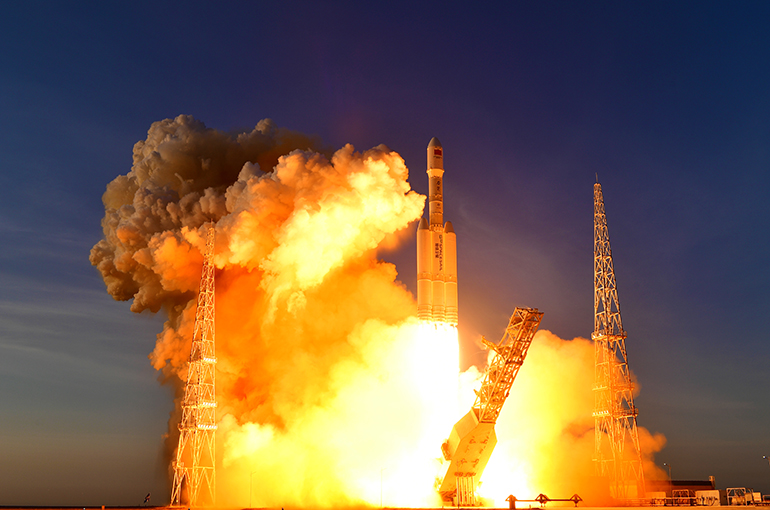
The Kinetica-2 Y2 liquid carrier rocket launched today from the Dongfeng Commercial Space Innovation Experimental Zone in Northwest China on its first large-scale satellite internet networking mission, according to CAS Space. It carried the 21st batch of satellites for the polar-orbit constellation under the Qianfan project.
The Kinetica-2, independently developed by CAS Space, is China's first carrier rocket using a "universal booster core." It has a 500-kilometer sun-synchronous orbit payload capacity of eight tons and a 200-kilometer low Earth orbit payload capacity of 12 tons.
The Kinetica-2 is built for large satellite networking and low-cost cargo transport, said Yang Haoliang, chief engineer and commander of the rocket. The latest mission is a key practical verification of the adaptability of satellite internet networking scenarios, Yang pointed out.
The Qianfan project aims to provide users with satellite broadband internet connections with low latency, high speed, and high reliability. It aims to achieve "global network coverage" by 2027 and is planned to include more than 15,000 low Earth orbit satellites by 2030. So far, it consists of 274 satellites.
China's LEO satellite internet is entering a period of centralized deployment, with heavy satellite networking tasks and strong launch demand, but a large gap remains in the scale of on-orbit deployment, Yang noted, adding that high-density, high-reliability, low-cost transport capacity is key to ensuring steady progress in satellite internet development.
The new mission was also the first combined use of the multi-satellite, satellite-rocket, and inter-satellite separation release mechanism co-developed by CAS Space with the Kinetica-2, said Zhang Yanrui, deputy chief engineer of the rocket. Under traditional methods, the 18 satellites had to be unlocked and ejected one by one, with many intermediate links, but the new mechanism unlocked them all at once, he pointed out.
The new technology can improve rockets' payload utilization rate, reduce failure risk from multiple independent unlocking, and flexibly adapt to different numbers of satellites to meet the diverse launch needs of satellite internet networking, Zhang stressed.
The Kinetica-2 will carry out missions for a multi-satellite network next year, providing flexible payload capacity featuring high cost-effectiveness and strong certainty for the large-scale deployment of space infrastructure, according to CAS Space.
Editors: Tang Shihua, Martin Kadiev





