



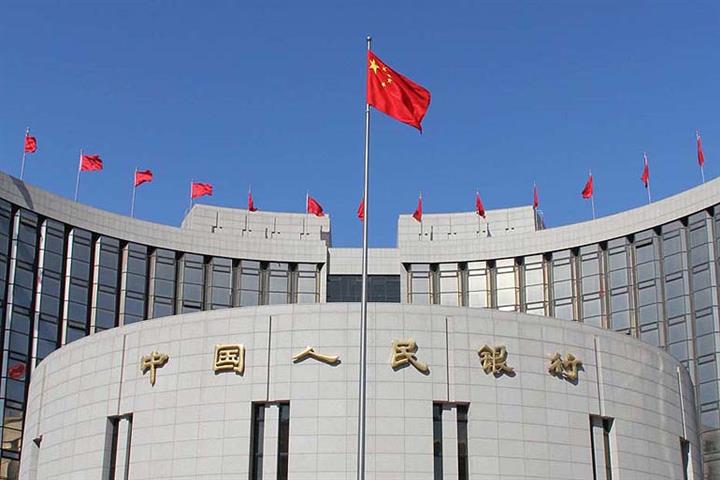
 China’s Central Bank Cuts One-Year MLF Rate by More-Than-Expected 10 Bps
(Yicai Global) Jan. 17 -- China’s central bank has slashed the rate of its one-year medium-term lending facility by a higher-than expected 0.1 percentage point in the first rate cut since April 2020, releasing CNY700 billion (USD110.3 billion) of liquidity into the interbank system to underpin economic growth.
The 12-month MLF rate now stands at 2.85 percent, the People’s Bank of China said. It follows a 0.5 percentage point reduction in the reserve requirement ratio for banks last month.
The 10-basis point reduction was much more than market expectations of 5 bps, credit rater Golden Credit Rating International said. Credit growth was still declining even after the RRR cuts last July and December. The PBOC has thus used another monetary tool to boost credit growth and stimulate the real economy's loan needs, it added.
It is possible that the MLF rate cut was made in the run-up to the week-long Chinese New Year holiday to boost business expectations and stabilize employment, according to the macro-economic analysis team at China Merchants Securities. The PBOC may also introduce various other measures such as another RRR cut and a reduction in the seven-day reverse repo rate to counter the market's weak expectations in the near future, it added.
The rate cut is necessary for four reasons, Huatai Securities said. First, economic growth remains below potential. Second, it will help businesses lower costs and ease the burden on small firms. Third, monetary policy needs to be eased further when taking into consideration the Covid-19 pandemic and the cooling property sector. Fourth, factors that constrained rate cuts, such as the producer price index, have been mitigated.
The drop in the one-year MLF rate is bound to drag down the benchmark lending rate, the Loan Prime Rate, which is reset every month, Golden Credit said. This will substantially reduce financing costs in the real economy and ease the downward pressure on the property market. It could also signal the possible adoption of other easing measures.
The rate cut will drive quicker growth in credit, social financing and M2 broad money for some time to come, Golden Credit said. This round of monetary easing is not likely to end with this rate cut considering how the economy is still under big downward pressure, especially the real estate market, it added.
A relaxation in monetary policy and growth-stabilizing measures could lift the country’s gross domestic product to over 5 percent in the first and second quarters, it added. Close monitoring of economic fundamentals and marginal changes in the housing market is needed to predict which direction monetary policy will take.
Editor: Kim Taylor





