



 China’s Central Bank Eases Cross-Border Financing for Firms, Banks
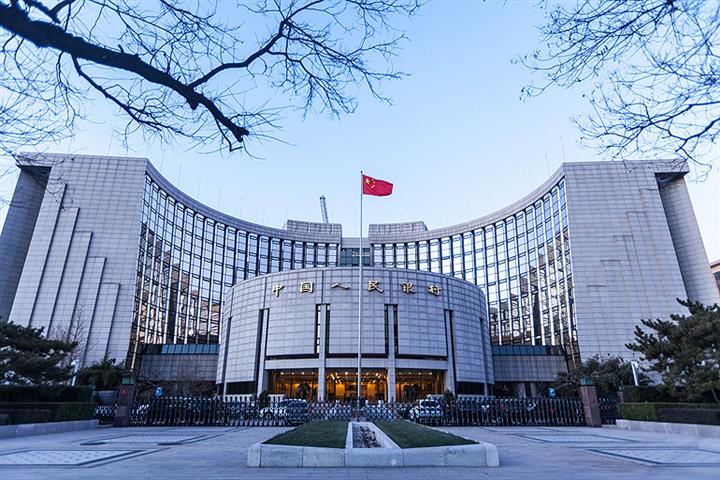
(Yicai Global) Oct. 25 -- China’s central bank has relaxed a key restriction for the first time since the spring of 2020 to allow businesses and banks to borrow more money from overseas.
The People’s Bank of China raised the so-called macro-prudential adjustment parameter to 1.25 from 1, it said in a statement today. China permits domestic firms to borrow abroad based on their net assets.
Following the announcement, the PBOC fixed the Chinese yuan’s central parity rate versus the US dollar at 7.1668, the weakest since 2008, driving the spot exchange rate beyond 7.3 per dollar. The offshore yuan fell to 7.33 as of 11 a.m.
China last raised the macro-prudential adjustment parameter to 1.25 from 1 in March 2020 when the spot exchange rate was about to breach 7 to the dollar. The move was reversed for banks in December that year, and for businesses in January last year.
The upward revision aims to further improve the macro-prudential management of cross-border financing and guide companies and financial institutions to optimize their foreign debt structure, the PBOC added.
The size and structure of China’s overseas debts are reasonable and the risks are generally under control, Wen Bin, chief economist at China Minsheng Bank, was cited by The Paper today as saying. So raising the parameter will allow more funds to flow into China, increasing dollar liquidity in the country, stabilizing market expectations, and keeping the exchange rate largely stable at a reasonable and balanced level, he added.
The PBOC’s move signals that the central bank intends to stabilize the exchange rate, which will steady market confidence and counter excessive expectations for yuan depreciation in the short term, according to a report by Golden Credit Rating International.
The US Federal Reserve is likely to raise interest rates by a further 125 bips before the end of the year, further pressuring the yuan, the credit rating agency predicted, but the Chinese economy is recovering steadily, and the current account is running a big surplus.
Besides, China has an increasing share of monetary policies focused on steadying the exchange rate, so the PBOC is unlikely to cut interest rates by December. The risks of an uncoupling of the yuan and the US dollar and a following quick depreciation of the redback are under control.
The central bank also addressed the yuan’s depreciation last month when it cut the foreign exchange reserve requirement ratio for banks by 2 percentage points and hiked the risk RRR for foreign exchange forward contracts to 20 percent from zero.
Editor: Emmi Laine, Xiao Yi





