



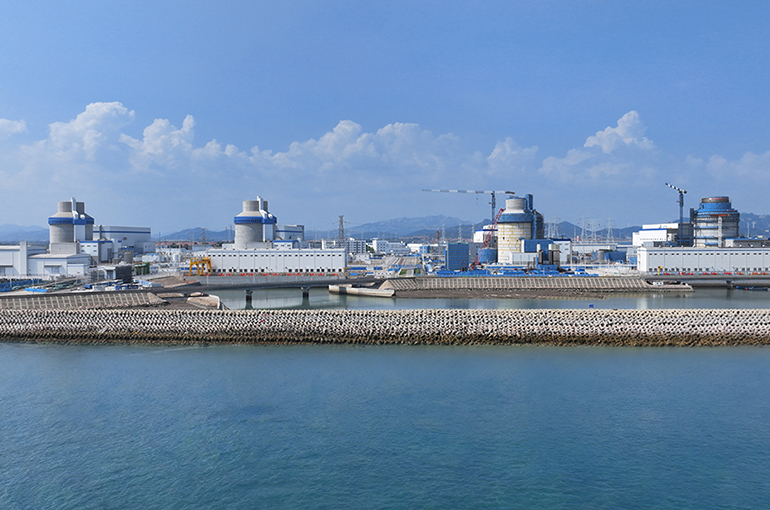
 China Expands Nuclear Energy Use From Power Generation to Heating, Industrial Steam Supply
(Yicai) Oct. 27 -- Several Chinese companies are expanding their use of nuclear energy beyond power generation to residential heating and industrial steam supply to improve energy efficiency and provide low-carbon heat sources to people and industries.
The first phase of Shandong Nuclear Power’s nuclear energy heating project in Haiyang in Shandong province, dubbed Warm-U-Clear No. 1, and China National Nuclear Power’s industrial nuclear steam supply project at the Tianwan Nuclear Power Station in Lianyungang in Jiangsu province, better known as Heqi No. 1, are flagship examples of nuclear energy being used for residential heating and industrial steam supply, respectively.
Powered by two atomic units, Warm-U-Clear No. 1 uses multi-stage heat exchange to transfer part of the reactors’ thermal output to Haiyang's district heating system. The heat source and users are isolated through separate loops, so only heat -- and not the medium itself -- is transferred.
According to Shandong Nuclear Power, the project supplies heating to about 400,000 residents in Haiyang and Rushan, covering 13.5 million square meters of floor space. Over its first seven heating seasons, it has supplied 19.7 million gigajoules of heat, equivalent to saving about 1.8 million tons of raw coal and cutting carbon dioxide emissions by about 3.3 million tons.
As two more atomic units are expected to come online next year, Warm-U-Clear No. 1’s heating coverage will further expand, with its capacity expected to reach 200 million square meters.
Built and put into operation in June 2024, Heqi No. 1 uses secondary-loop steam from two of Tianwan Nuclear Power Station's atomic units to produce industrial steam, which is delivered via a pipeline of more than 23 kilometers to the Xuwei petrochemical industrial base in Lianyungang. The project supplies 4.8 million tons of steam a year, cutting carbon dioxide emissions by about 1.1 million tons annually and saving the petrochemical base 700,000 tons' worth of carbon emissions quota.
To reduce heat loss over the long-distance pipeline, Heqi No. 1 uses a multi-layer composite insulation structure, with independent loops, radiation monitoring, and rapid isolation devices safeguarding its operation.
Nuclear-based industrial steam supply draws secondary-loop steam directly as a heat source, said Yang Futang, member of the Chinese Communist Party committee at Jiangsu Nuclear Power. The thermal efficiency of a conventional nuclear power unit running in power-generation mode is about 35 percent, but it can rise to over 70 percent once the unit switches to supplying industrial steam, he noted.
The Xuwei nuclear energy heating and power plant, which couples a high-temperature, gas-cooled reactor with China’s third-generation atomic technology Hualong One, uses a re-heater to raise the main steam parameters of Hualong One above 300° Celsius, said Yan Xiao, deputy director of the Nuclear Power Institute of China.
This will help the chemical industry pursue deep decarbonization and, against the backdrop of international carbon tariffs, boost the export competitiveness of China's chemical products, Yan pointed out.
The scope of China’s integrated nuclear energy utilization continues to widen, with demonstration projects such as seawater desalination also coming online.
Editor: Futura Costaglione





