



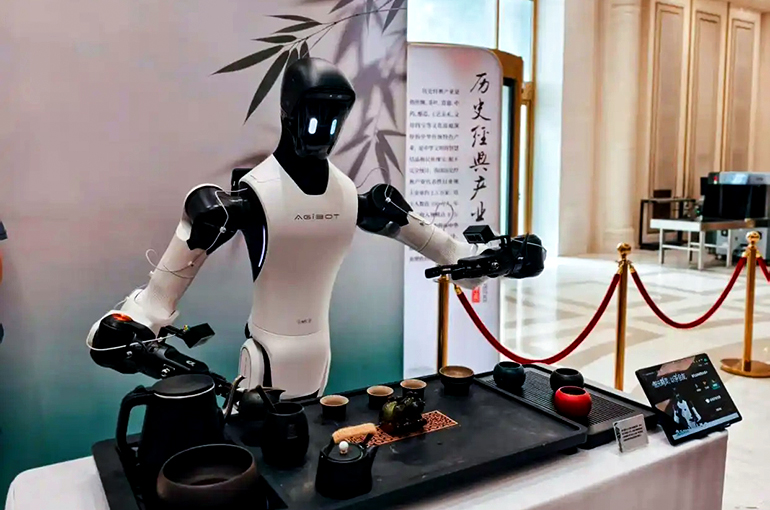
 China Issues First Plan to Take ‘Historically Classic’ Consumer Brands Global by 2030
(Yicai) Sept. 8 -- China has launched its first national policy for “historically classic” industries such as silk, tea, and porcelain, with the aim of developing them into world-renowned consumer brands over the next five years.
The policy aims to cultivate 50 leading businesses valued at tens of billions of Chinese yuan (billions of US dollars) each, 100 world-renowned consumer brands, and several industrial clusters worth hundreds of billions of yuan (tens of billions of dollars) apiece by 2028, followed by a push toward world-class companies and brands by 2030, according to a document released by the Ministry of Industry and Information Technology and five other departments yesterday.
China’s “historical classic” industries are traditional sectors with deep cultural roots, including traditional Chinese medicine, brewing, arts and crafts, and the Four Treasures of the Study (brush, ink, paper, and inkstone), MIIT Vice Minister Xie Yuansheng told reporters at a press briefing.
These industries have about 25,000 companies above a designated size, employ nearly 3.5 million people, and generate annual revenues of CNY8 trillion (USD1.19 trillion), making them important for rural development, employment and income growth., Xie pointed out.
They have long faced issues with brand building and low added value, Feng Haicang, who heads the MIIT’s consumer goods industry department, noted at the briefing. While 90 percent of silk products are exported, for instance, the sector is dominated by raw material processing and contract manufacturing, so domestic brands have yet to establish market influence or competitive advantages overseas, Feng said.
To address the problem, the policy document proposes 20 measures focused on areas such as industrial heritage preservation and innovation, integrated industrial development, and international expansion.
Among the measures, it suggests promoting the integration and innovation of next-generation information technologies, such as artificial intelligence, with traditional crafts, as well as accelerating the transition of technologies like intelligent kiln control, natural dye extraction, and fermentation regulation from the laboratory to industrial application.
Traditional companies are also encouraged to collaborate across industries with leading brands, renowned designers, and artists to develop and cultivate high value-added products, while also promoting modern, fashionable, and global product packaging designs.
Consumption is shifting from "buying more goods" to "getting better services and experience," Xie pointed out, noting that promoting the development of historically classic industries aligns closely with the direction of consumption upgrading, not only meeting consumers' material needs but also bringing emotional resonance, cultural enrichment, and aesthetic enjoyment.
Editors: Dou Shicong, Martin Kadiev





