



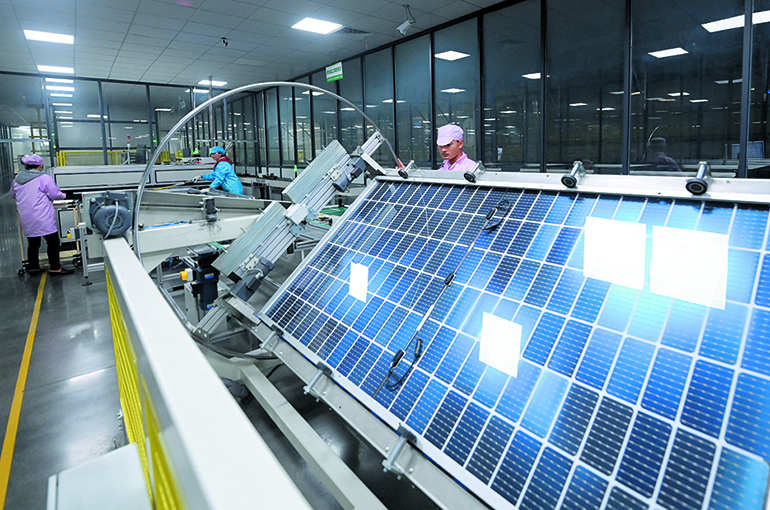
 China Moves to Rein In Solar Industry Price War With New Cost Accounting Rules
(Yicai) July 28 -- China has issued cost accounting rules as a way to curb a destructive price war in the solar industry and restore healthier market conditions.
The new rules are based on corporate accounting standards, the China Photovoltaic Industry Association announced yesterday. They create a cost accounting framework that spans the entire industry chain by standardizing the categories, parameters, and accounting models used to calculate costs for polysilicon, silicon wafers, solar cells, and solar panels, effectively resolving the chaos caused by inconsistent accounting methods across the sector, the CPIA said.
China’s PV industry is mired in severe low-price competition, with profit margins squeezed along the entire value chain and many firms operating at a loss, Gao Jifan, chairman of PV module manufacturer Trina Solar, said in a commentary published the same day.
The sector has seen prices slump since 2024 as a result of excess production capacity, triggering severe industry-wide losses. Of the 26 listed PV companies that have released first-half earnings updates, only four expect to remain profitable, while the rest project combined losses of between CNY18.3 billion and CNY21.4 billion (USD2.7 billion and USD3.2 billion).
Since the second half of last year, Chinese regulators have repeatedly engaged with PV companies to address excessive competition and curb cutthroat competition, urging them to stop selling products below cost. A standardized method for calculating costs is seen as a key step toward achieving this.
The new system enhances the scientific rigor and feasibility of cost verification, said Liu Yiyang, the CPIA’s executive secretary-general, adding that it also provides a basis for businesses to conduct internal cost audits and identify risks related to price compliance, while offering regulators a practical reference for verifying cost data.
The authorities have been making efforts to improve standards within the PV industry. In May, the Ministry of Industry and Information Technology issued two new mandatory national standards, Safety Requirements for PV Modules and Identification Requirements for PV Module Nameplates.
Earlier this month, the MIIT, the National Development and Reform Commission, and the State Administration for Market Regulation jointly issued three additional mandatory national standards for solar energy consumption and efficiency, covering multiple manufacturing segments, including polysilicon, silicon wafers, modules, and inverters.
Together, these standards establish a regulatory basis for managing market access as well as product quality and pricing, thereby establishing a complete, closed-loop governance framework for the PV industry, said Song Zhiping, president of the China Association for Public Companies.
Editors: Dou Shicong, Tom Litting





