



 China Launches Three Test Satellites for Space-Based AI Computing
(Yicai) July 24 -- China has put five new satellites into space, including three experimental orbiters intended to validate technologies critical to the future deployment of space-based artificial intelligence computing constellations.
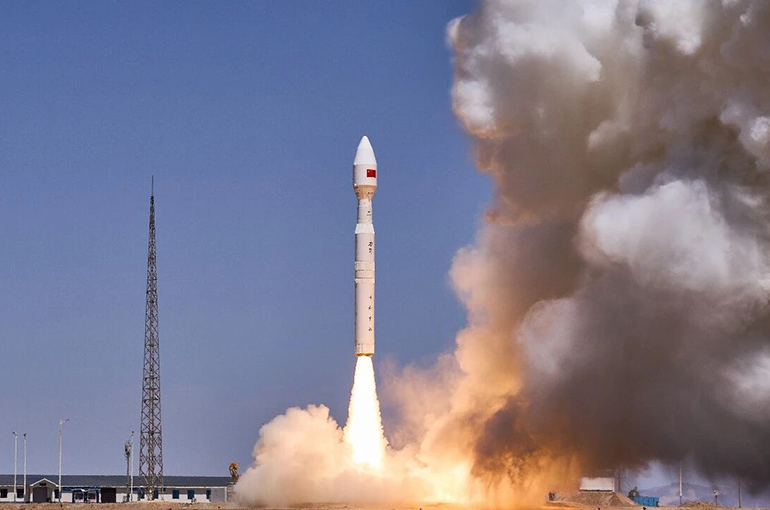
A Lijian-1 Y15 carrier rocket, developed by CAS Space Technology, blasted off from the Jiuquan Satellite Launch Center in the Gobi desert of northwestern China today. It was the 15th launch of a Lijian-1 mission since July 2022.
The Lijian-1 has sent 110 satellites into space, with a total payload of over 16 tons. It is the only Chinese civilian commercial rocket to have borne aloft more than 100 satellites.
China's commercial aerospace industry has entered a new phase of demand-driven, large-scale deployments amid rapid growth in satellite internet services, commercial remote sensing, and space-based computing, Lijian-1 Chief Designer Shi Xiaoning told reporters.
Set up in 2018, Guangzhou-based CAS Space has developed a flexible launch services portfolio that includes dedicated missions, rideshares, and shared-capacity arrangements, allowing clients to put payloads in orbit efficiently through increasingly routine launch operations, Shi noted.
The three experimental orbiters launched today are the Jitian Star A-04, the Chengguang-1, and the Gande-1 01. Their in-orbit operating data will pave the way for the future construction of large space-based AI computing networks.
Jitian Star A-04 is China’s first embodied AI satellite. Its main mission is to validate the in-orbit embodied intelligence operating system, the adaptability of domestically produced graphics processing units in space, autonomous on-board large model inference, as well as autonomous satellite management capabilities.
These tests are aimed at accumulating key engineering data for the future large-scale networking of space-based computing constellations.
In addition, Jitian Star A-04 is equipped with intelligent computing devices based on domestic GPUs, satellite-borne routers, and laser communication machines. It can achieve satellite-borne intelligent computing and high-speed space-ground interconnection, autonomously manage its own health status, and independently complete task planning, command generation, and in-orbit data processing.
Chenguang-1 is a technical test satellite for validating space computing infrastructure. It will test the performance of satellite-borne servers, computing platforms, and thermal control systems in extreme space environments, providing a core technical basis for building stable and scalable space-based computing clusters.
Gande-1 01’s task is to achieve in-orbit intelligent recognition, target extraction, trajectory calculation, and autonomous cataloging of tiny space debris, thereby supporting the safe and stable operation of future low-Earth orbit constellations.
Editors: Tang Shihua, Martin Kadiev





