



 China Puts First Satellite of World’s First Low-Inclination Remote Sensing Constellation Into Orbit
(Yicai) Oct. 22 -- The first satellite of the Wuyang Constellation, the world’s first low-inclination remote sensing constellation, was successfully launched into a 541-kilometer low Earth orbit to monitor the natural environment in low-latitude regions.
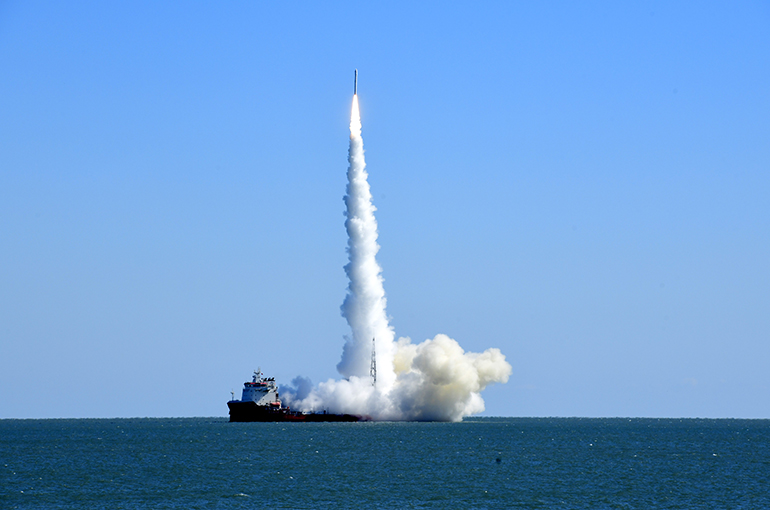
Galactic Energy sent the Xiguang-4 01 satellite, made by Xi’an Institute of Optics and Precision Mechanics CAS Aerospace Science and Technology Group, into space on its Ceres-1 sea-launch rocket from near eastern Shandong province yesterday.
The Wuyang Constellation innovatively adopts a non-sun-synchronous, low-inclination orbit design and provides targeted services to the low-latitude region between 35 degrees north and south latitude, said Gu Xingfa, chief engineer of the project and director of the Institute of Aerospace Remote Sensing Innovations at Guangzhou University. It is designed to have a network of three pioneer satellites and 25 business satellites, Gu added.
The global earth observation industry has long been dominated by sun-synchronous polar orbit satellites, with observation resources and capabilities tilted towards mid to high latitudes, resulting in great shortcomings in remote sensing observations in low latitude regions between 35 degrees north and south latitude, including coverage blind spots and a shortage of quantitative remote sensing data supply, Gu pointed out.
The Wuyang Constellation is expected to become China’s first smart aerospace information service system for low-latitude areas, providing services for regular monitoring, refined management, and rapid emergency response of the natural environment in such regions, Gu stressed.
As the constellation’s pioneer satellite, Xiguang-4 01 will carry out key missions of orbit system verification, remote sensing payload assessment, new technology verification, and multi-scenario application demonstration, according to Xi’an Institute of Optics.
After entering orbit, Xiguang-4 01 will support various scenarios, including natural resource monitoring, agricultural production, ocean observation, ecological protection, flood and typhoon emergency disaster reduction, and urban governance in low-latitude regions in South China and along the Maritime Silk Road. It will likely offer unique monitoring advantages for typhoons, red tides, crop growth, and urban agglomeration expansion, among others.
Editors: Tang Shihua, Martin Kadiev





