



 China Takes Steps to Speed Up Third-Generation Nuclear Power Rollout
(Yicai) Nov. 6 -- China is seeking to accelerate the introduction of its proprietary third-generation nuclear power technology by improving reactor design, digitizing project management, speeding up equipment production, and harmonizing technical standards. The push also involves bringing private investors into projects to widen the funding base and bolster the domestic supply chain.
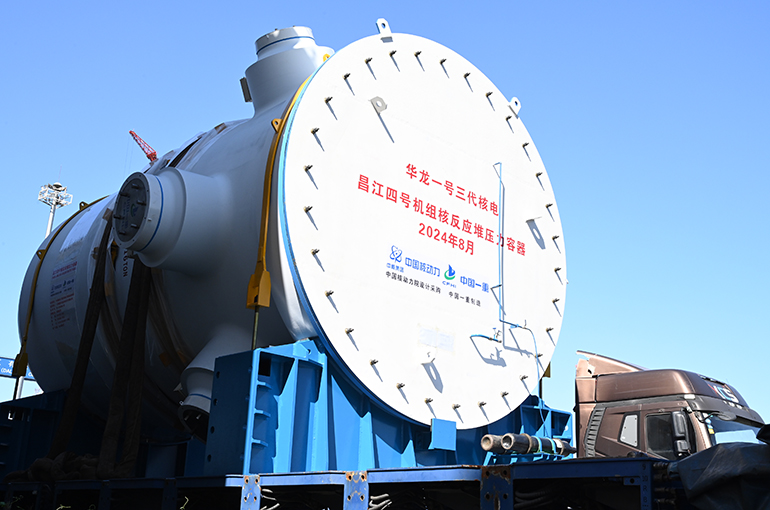
China General Nuclear Power Group unveiled the Hualong One 2.0, a third-generation pressurized water reactor, in September, featuring improvements in safety, cost-effectiveness, and technological performance.
The upgraded reactor design is intended to boost the efficiency of both project management and construction by 20 percent, with the overall building period capped at 54 months, according to Kan Shuo, deputy director of the Project Management Engineering Technology Support Centre at China Nuclear Engineering Corporation.
At the end of last year, the generating capacity of nuclear power units in commercial operation in China was 62.5 million kilowatts, less than 2 percent of the nation’s total electricity production capacity. This leaves a significant gap to cover to reach the 200-million-kilowatt target projected by the China Nuclear Energy Association for 2040.
Addressing the pressure to meet delivery timelines, Kan noted that in February, China National Nuclear Corporation proposed integrating digital engineering concepts into the design-and-construction process. This allows for seamless flow of data across different project sectors, with the goal of achieving a 20 percent improvement in both management and construction efficiency, and capping the total project duration at 54 months.
The initial delivery estimate for a Hualong One 2.0 reactor was nearly 50 months, said Liu Chang, project management director at First Heavy Industries Dalian Nuclear Power & Petrochemical, a firm responsible for equipment manufacturing. But through process refinement, the delivery time is now expected to be just over 40 months, Liu noted.
Private Capital
In terms of capital, China has begun introducing private investment into nuclear power projects. The San'ao Nuclear Power Plant in Zhejiang province is the first to have private equity participation. The plant is set to have six 1,000-megawatt Hualong One units, with a total projected investment of CNY120 billion (USD17.9 billion).
Private investors have a 2 percent stake in the project's first phase, a figure that rises to 30 percent by the third phase, setting a record for the most private funding in China’s nuclear power sector.
"The participation of private capital has become a key prerequisite for the approval of certain nuclear power projects,” said Xu Lingbin, deputy manager of general management at Cangnan Nuclear Power, which is responsible for building and running the San'ao Nuclear Power Plant.
“Private capital helps supplement the substantial equity funding required for these projects, and private enterprises with strong industrial backgrounds can foster synergy across the upstream and downstream supply chains," Xu told Yicai.
Unified Standards
Efforts are also underway to harmonize standards to facilitate faster project implementation. China’s two major nuclear power conglomerates, CGN and CNNC, previously used different technical standards.
Efforts to harmonize standards began in 2017, but the alignment did not include a number of equipment components. As of 2024, atomic power industry regulators have pushed for further standardization, encompassing the entire project lifecycle, from design and construction to operation and decommissioning.
"Promoting the unification of standards is a positive development for the manufacturing sector,” said Gao Dianbao, executive deputy general manager of First Heavy Industries Dalian Nuclear Power, which supplies equipment to both CGN and CNNC. “It streamlines processes and helps unlock production capacity," Gao added.
Editor: Tom Litting





