



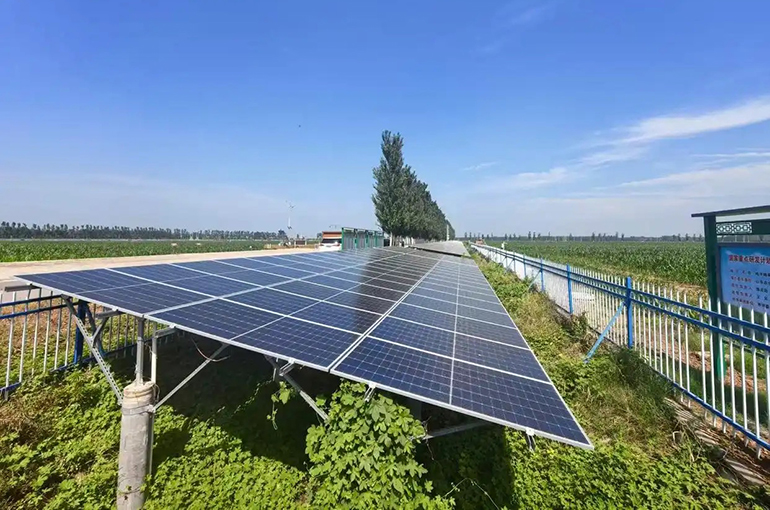
 Wind and Solar Are Set to Make Up Over Half of China's Installed Power Capacity by 2030
(Yicai) July 24 -- China has set a target to increase the installed capacity share of wind and solar power to more than 50 percent from 47 percent within the next five years, with relevant annual electricity generation to account for 30 percent of the total.
By 2030, China's installed capacity of wind and solar power is expected to increase to over 2.8 billion kilowatts from 1.8 billion kW last year, according to a renewable energy development plan jointly released by the National Development and Reform Commission and the National Energy Administration. Wind and solar annual electricity generation should rise to 4 trillion kW-hours from 2.3 trillion kWh.
The installed capacity of all renewable energy sources, including wind, solar, hydropower, biomass, geothermal, and ocean, will likely reach 3.5 billion kW, with electricity generation reaching 6 trillion kWh a year, both figures surging by 50 percent.
China will simultaneously develop centralized and distributed renewable energy models to achieve its goals. Centralized wind and solar projects will primarily be located in the northern desert areas with abundant relevant resources, with an additional installed capacity of over 370 million kW expected to be added within the next five years.
The country will also promote the development of diverse distributed solar and wind power projects across multiple scenarios, focusing on four key sectors: industry and commerce, transportation, construction, and agriculture. An additional installed capacity of over 300 million kW is expected to be added within five years.
In addition, China aims to have a cumulative installed capacity of 100 million kW for offshore wind power projects by 2030, about 410 million kW for conventional hydropower, 15 million kW for solar thermal power, and around 400,000 kW for ocean energy.
It will also focus on enhancing the comprehensive utilization efficiency of renewable energy, with an emphasis on expanding non-electric applications. For example, wind and solar power will be used to produce green fuels, including hydrogen, ammonia, and methane, avoiding losses caused by long-distance electricity transmission.
According to the plan, the non-electric utilization scale of renewable energy in China will reach 150 million tons of standard coal equivalent over the next five years, with the hydrogen production from renewable energy likely to top two million tons.
The plan also introduced reliability indicators for renewable energy for the first time, specifying that the contribution of wind and solar power during peak electricity consumption periods in summer and winter should exceed 20 percent by 2030.
To enhance the reliability of renewable energy, China will actively develop flexible electricity mechanisms that align with the characteristics of new energy generation, including setting virtual power plants capable of power aggregation and intelligent dispatch, as well as developing the green electricity direct connection model that supplies power directly to users through dedicated lines.
Editors: Dou Shicong, Martin Kadiev





