



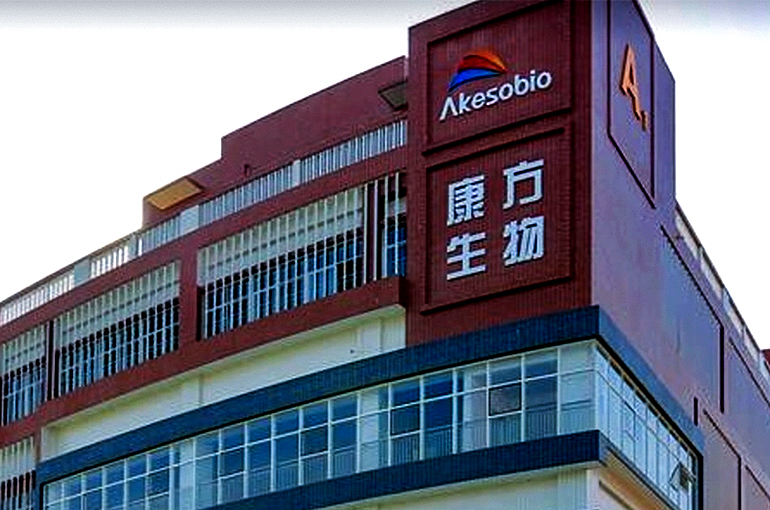
 China’s Akeso Sinks After US FDA Rejects License Application for Its Cancer Drug
(Yicai) Nov. 16 -- Akeso’s shares plunged after the Chinese pharmaceutical company said the Biologics License Application for its cancer immunotherapy was rejected by the United States Food and Drug Administration.
Akeso [HKG: 9926] was trading down 22.1 percent at HKD64.10 (USD8.16) as of 3.30 p.m. in Hong Kong today, after earlier dropping as much as 31.8 percent.
The first US application for ivonescimab was not approved, Akeso’s Chairwoman Michelle Xia said on a conference call yesterday. “This outcome is deeply disappointing for all of us, and it is also the most disappointing moment for me in the 14 years since the company was founded.”
Ivonescimab is a globally first-in-class PD-1/VEGF bispecific immuno-oncology drug independently developed by Akeso. Its clinical progress and commercialization outcomes will determine not only whether it can become a mainstream first-line treatment for lung cancer, but also whether PD-1/VEGF bispecific antibodies can challenge the benchmark status of PD-(L)1 monoclonal antibodies in cancer immunotherapy.
“The FDA determined that substantial evidence of effectiveness is not established in the absence of a statistically significant overall survival improvement,” Akeso’s US partner Summit Therapeutics said in a statement yesterday. “The FDA indicated that the progression-free survival benefit in the absence of a statistically significant overall survival benefit does not support a positive benefit-risk profile in support of approval.”
The BLA was supported by data from HARMONi, ivonescimab’s first global, randomized, double-blind Phase III clinical trial, which served as an extension of the Chinese clinical trial. Xia explained on the call that the FDA clearly required that data from overseas populations meet the predefined statistically significant endpoint.
“The trial was not easy to advance, as there was a time gap between enrolling patients in China and abroad, ivonescimab was little known overseas at the start of the trial, overseas patients had no prior experience using ivonescimab, and enrollment abroad was very difficult,” Xia noted.
At the protocol’s predetermined formal analysis point, the overall survival showed a favorable clinical trend, but it did not reach statistical significance, she added.
Ivonescimab’s failed US approval will have a significant impact on the industry, an investor told Yicai. Overall survival has always been the core standard in oncology trials, and even with impressive progression-free survival benefits, the lack of overall survival support still carries substantial risk, they added.
At a deeper level, Akeso’s original strategy was to validate the drug with data from Chinese patients first, then supplement it with data from European and US patients, hoping the efficacy could be successfully replicated overseas. But directly reproducing results from Chinese patients in Western populations is more difficult than expected.
“This setback is limited to a single indication and does not mean the PD-1/VEGF bispecific antibody field has lost its value,” a drug developer working on PD-1/VEGF bispecific antibodies told Yicai. “The industry’s next focus will be on the results of HARMONi-3, the global Phase III study.”
Editor: Futura Costaglione





