 China's Brain-Computer Interface Developers Reach a Commercial Turning Point
(Yicai) July 31 -- Brain-computer interface companies in China are entering a period of intense commercialization, with the industry's focus shifting from lab demonstrations to whether products can achieve a closed loop of clinical validation, mass production, and sustainable payment, according to multiple executives.
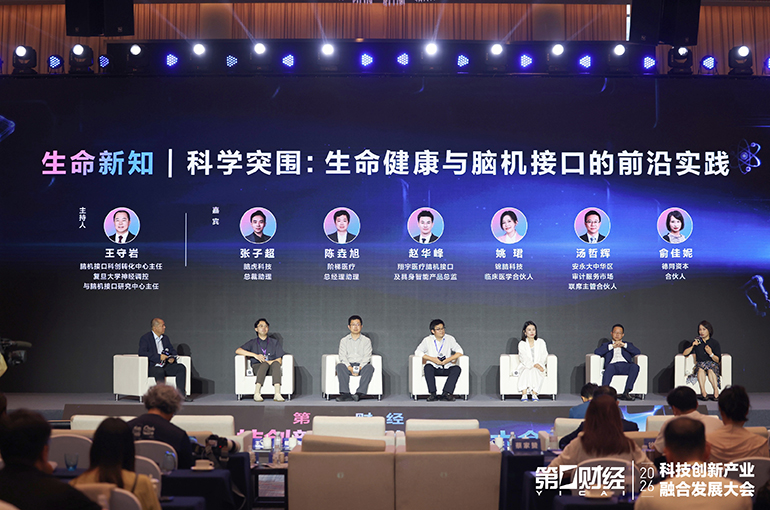
BCI applications can be grouped into three categories for patients who cannot move, speak, or see, corresponding to motor, speech, and visual impairments, Zhang Zichao, assistant to the president at startup NeuroXess, said at a recent forum hosted by Yicai. Motor decoding is the most technically mature direction, he noted.
NeuroXess's fully implantable system has been applied to brain-controlled exoskeleton gloves, smart wheelchairs, and robots, reaching an information transfer rate of about 5.2 bits per second in fully brain-controlled mode, exceeding the average for healthy individuals, he pointed out. The firm achieved full-spectrum Chinese speech decoding last year, though the commercialization timeline lags behind the motor pathway, while visual decoding remains in an early phase, he added.
According to industry players, this year will be the first of BCI commercialization. On March 13, the NEO implantable BCI for hand motor compensation developed by Neuracle Technology Shanghai received Class III medical device registration from Chinese regulators, becoming the world's first approved invasive BCI medical device.
On July 13, NEO was prescribed commercially for the first time at Huashan Hospital, where the first post-approval implant surgery was also completed. NeuroXess's fully implantable, wireless BCI system also began a state-mandated Good Clinical Practice registration trial at the same hospital on July 7.
StairMed's BCI products will remain focused on the medical field over the next three to five years, covering motor and speech disorders, Parkinson's disease, and other neurological conditions, as well as depression, anxiety, and other psychiatric conditions, noted Assistant General Manager Chen Yaoxu. In five to eight years, uses will likely expand to consumers, integrating with embodied intelligence devices, he added.
StairMed bagged CNY500 million (USD70 million) in a funding round in March, bringing its total raised funds to more than CNY2 billion (USD296.1 million), Chen pointed out.
Beyond motor-impairment applications, BCI companies are also taking different commercial paths, with implantable device makers generally treating platform-level engineering capability as their core moat.
"A BCI is different from other medical devices," Chen said. "It's a system that spans electrodes, chips, feedthroughs, batteries, implant design, and software algorithms. The highly engineered system we've built can support the rollout of different application scenarios."
Sunnyou Medical has taken a different route, combining non-invasive BCI with rehabilitation care. The Shanghai-listed company has worked with Tianjin University on brain-signal acquisition and decoding algorithms since 2017, developing seven BCI interaction paradigms covering stroke, Parkinson's disease, Alzheimer's disease, childhood attention-deficit disorders, and other conditions, and building ten BCI-enabled clinical rehabilitation pathways.
"Rehabilitation medicine has entered version 2.0 thanks to BCIs," said Zhao Huafeng, director of BCI and embodied intelligence products at Sunnyou Medical. Passive rehabilitation training is being converted into closed-loop training in which patients actively participate, he said.
JN Medtech has chosen to avoid the hand-motor rehabilitation path already validated by leading peers, instead targeting more vertical clinical indications, noted Yao Jun, a clinical medicine partner at the early-stage firm, adding that the company is focused on product safety and stability while seeking deep collaboration with top neurosurgeons, "letting clinicians become the ones who define the product."
Regulatory approval is only the first step for commercialization, with several other hurdles still needing to be cleared afterward, according to Yu Jiani, a partner at Detong Capital who has invested in the sector for years and closely followed Neuracle's path to approval. China's BCI industry has achieved a major global breakthrough, underpinned by research accumulation, with domestic universities starting related research as early as 1999, putting the country on the same starting line as the rest of the world, as well as clinical translation advantages, including a large patient base and mature neurosurgical resources, she stressed.
But Yu also said that getting a product approved is just the first step and companies still need to manage production capacity and cost control, which is why NeuroXess has began building a mass-production facility targeting tens of thousands of units in annual capacity once approved, as well as clinical adoption, since most doctors remain unfamiliar with the tech, and ecosystem versatility, due to an implant by itself being invisible and intangible. BCI's real value has to be shown through exoskeletons, wheelchairs, robots, and large language models it connects to, she noted.
There are some risks worth watching in early investment, Yu said, pointing to safety issues tied to implant surgery and materials science, and the risk of homogeneous, crowded research and development. For example, deep brain stimulation tech, which, after more than two decades of development in China, is used in only about 16,000 clinical cases a year, she added.
"Any new tech takes time to go from rollout to maturity," she pointed out. "Only once we see more real-world efficacy and safety data will it be able to spread more widely."
Payment is equally critical, with the first commercial prescription for NEO at Huashan Hospital being partly covered by Shanghai's Huhuibao supplementary insurance program.
BCI has been included in the reference scope for the fifth set of listing standards on Shanghai's Nasdaq-style Star Market, said Tang Zhehui, co-leader at EY's China audit services market. As more products are added to the national medical insurance reimbursement list, the industry's addressable market is expected to widen further, Tang added.
Editor: Martin Kadiev