



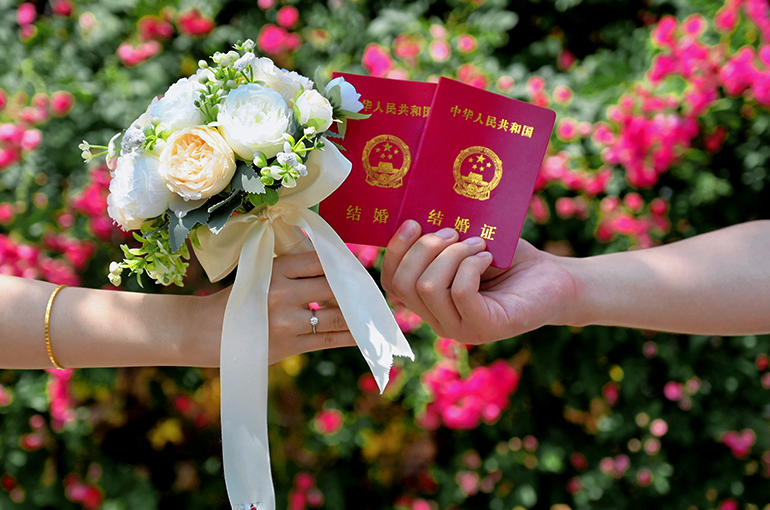
 China's First Marriages Rebound Above 10 Million, But Shrinking Families Strain Care Systems
(Yicai) Oct. 26 -- The number of people marrying for the first time in China rebounded to over 10 million last year, but shrinking households are weakening traditional family support for elderly care and childcare.
The number of first marriages rose by almost 1.3 million from a year earlier to 10.4 million in 2025, returning above the 10 million mark after falling below it in 2024, according to the latest edition of the country's official statistical yearbook. Meanwhile, the average household size fell to 2.52 people, down 0.92 from the fifth national population census in 2000.
Guangdong, a southern economic powerhouse that has topped China's provincial gross domestic product rankings for nearly four decades, led the country with 1.009 million first marriages last year, making it the only provincial-level region to surpass one million.
Authorities have introduced incentives and eased marriage registration requirements to encourage marriage and childbirth, while shrinking households are raising concerns about the ability of families to provide elderly care and childcare.
Policies to Encourage Marriage
To counter declining marriage and birth rates, local governments have introduced incentives such as cash rewards for newlyweds and marriage-related consumption vouchers.
Since May 10 last year, couples have been able to register their marriages anywhere in China, regardless of their registered residence, without presenting their household registration booklets. Many cities and tourist attractions have also launched services combining marriage registration with cultural tourism.
This year's government work report called for promoting positive attitudes toward marriage and childbirth, strengthening housing support for first-time married couples and families having their first child, and helping families with multiple children improve their housing conditions.
Marriage remains closely tied to childbirth in China, where relatively few children are born outside marriage, according to Jiang Quanbao, a professor at Beijing's Capital University of Economics and Business.
Promoting positive attitudes toward marriage and childbirth means extending childbirth support policies to earlier stages, including marriage, Jiang said. Reducing the costs of getting married, having children, raising them and paying for their education is also a key policy priority, he added.
Smaller Households Reshape Family Support
Despite the rebound in first marriages, China's average household size has continued to decline.
Hainan, an island province in southern China, had the country's largest average household size at 3.2 people, according to the yearbook. A total of 12 provincial-level regions had an average household size exceeding 2.6 people, including Xizang, Yunnan and Guizhou, three western and southwestern regions.
Household size is influenced by factors including birth rates, population mobility and living conditions. Nine provincial-level regions recorded birth rates of more than seven births per 1,000 people in 2025, including the western regions of Xizang, Xinjiang, Ningxia and Qinghai, the southwestern provinces of Guizhou and Yunnan, and the southern regions of Guangdong, Hainan and Guangxi.
Migration is another factor reshaping Chinese households, as millions move in search of work and better opportunities. China's migrant population reached about 376 million in 2020, including 125 million who moved across provincial boundaries, according to the country's seventh national census. Guangdong, a major manufacturing hub, was home to 29.6 million migrants from other provinces, up 8.1 million from 2010.
Families with multiple children generally have larger households, so a decrease in the average number of children contributes to shrinking household sizes, Jiang said. Improvements in living conditions have also reduced the prevalence of multigenerational households, he added.
Shrinking households are also putting pressure on traditional family-based elderly care and childcare. Civil Affairs Minister Li Changguan previously warned that smaller families and changing household structures are weakening support between generations, making it harder for families to care for elderly relatives and raise children without outside assistance.
Editor: Emmi Laine





