



 China’s Investment Focus Shifts to Power Grids, Computing Networks From Road and Rail Projects
(Yicai) Oct. 26 -- China’s investment growth in traditional infrastructure such as railways and highways has continued to slow this year, while water infrastructure, next-generation power grids and computing networks are emerging as new potential growth drivers.
China’s fixed-asset infrastructure investment tumbled 4.2 percent in the nine months ended Sept. 30 from a year earlier, with the decline widening by 0.2 percentage point from the previous 8 months, according to data from the National Bureau of Statistics.
The country’s railway fixed-asset investment climbed 1.3 percent in the first three quarters from the year before to CNY601.2 billion (USD90.1 billion), according to data released by China State Railway Group on Oct. 23. However, the cumulative growth rate has declined month by month.
Data from the Ministry of Transport show that investment in highway and waterway construction slumped 9.3 percent in the first eight months from a year ago, while investment in waterway construction alone declined 1.7 percent.
The slowdown in railway investment comes after several consecutive years of high spending. From 2023 to 2025, China’s railway fixed-asset investment grew by 7.5 percent, 11.3 percent, and 6 percent, respectively. Investment reached a record CNY901.5 billion (USD135.1 billion) in 2025.
As China’s high-speed rail network gradually becomes more complete, the focus of railway development is shifting from building new lines towards improving network connections, filling infrastructure gaps and strengthening links across the existing system.
New Infrastructure
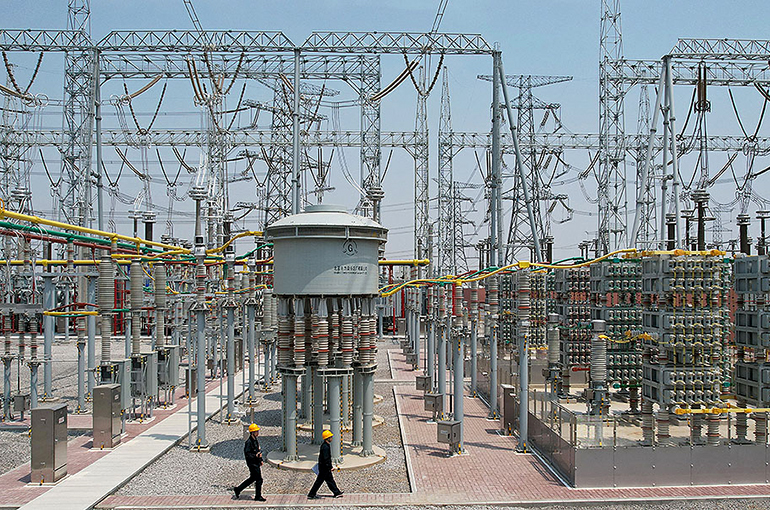
As opportunities for growth in traditional infrastructure investment narrow, a transition toward new infrastructure sectors has already begun. In April, a meeting of the Political Bureau of the Central Committee of the Communist Party of China called for accelerated development of the “six major infrastructure networks,” namely water infrastructure, next-generation power grids, computing networks, next-generation communication networks, urban underground pipeline networks and logistics networks.
According to the plan, investment in the national water network during the 15th Five-Year Plan, which runs from 2026 to 2030, is expected to exceed CNY6 trillion (USD899.6 billion), while investment in new-generation power grids is likely to top CNY5 trillion. Investment in urban underground pipeline networks is projected to reach about CNY5 trillion.
Liao Bo, chief macroeconomic analyst at Northeast Securities, told Yicai that 28 major water conservancy projects began construction in the first nine months. These include the Three Gorges Water Transport New Channel Project and the Liaodong Peninsula Water Resources Allocation Project in northeastern Liaoning province. The number of major projects launched during the period has already exceeded the full-year total for 2025.
Strategic Shift
At the corporate level, China Railway Group is also accelerating its strategic shift toward emerging infrastructure sectors. At the company’s 2025 annual shareholders’ meeting on June 29, Chairman Chen Wenjian called for faster transformation across the firm’s infrastructure business and urged it to seize opportunities in water conservancy and hydropower, energy pipeline networks, intelligent construction and computing infrastructure.
In June and September, Chen also met separately with the Ministry of Water Resources, China South-to-North Water Diversion Group and China Three Gorges Corp., emphasizing that water conservancy should become a key pillar of the company’s business transformation.
However, Liao noted that the impact of these six infrastructure networks on overall infrastructure investment would take time to materialize. Projects must pass through several stages, including feasibility studies, administrative approvals, funding allocation and the commencement of actual construction. As policies are gradually implemented and a wave of major projects get underway, total demand is expected to improve in the fourth quarter.
Editor: Kim Taylor





