


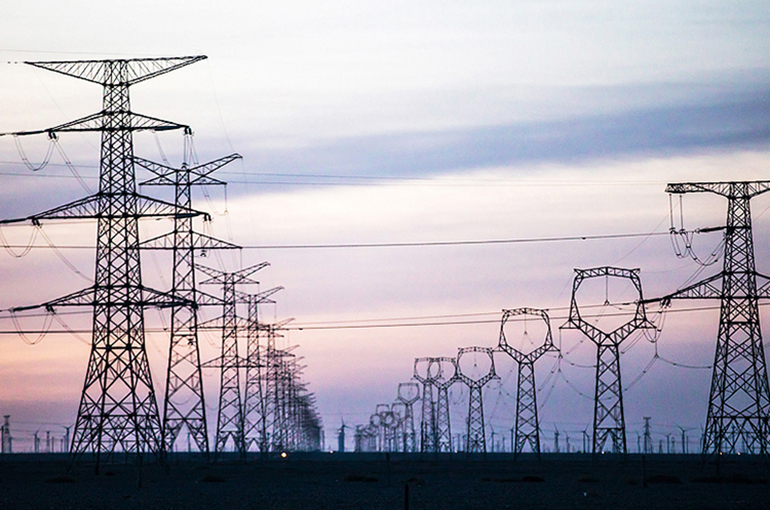
 China's Power-Hungry AI Data Centers Could Help Ease Grid Strain, Experts Say
(Yicai) Nov. 23 -- China should make artificial intelligence data centers more responsive to electricity supply and demand to ease mounting pressure on the power grid as computing capacity expands, according to industry experts.
By shifting non-urgent computing tasks to periods of abundant renewable electricity and participating in grid demand response programs, data centers could help balance power supply and demand while reducing their own electricity costs, the experts said. Pilot projects in northern and central China have already demonstrated the potential of this approach.
China's computing centers consumed 170 billion kilowatt-hours of electricity in 2025, accounting for less than 2 percent of national power consumption, the National Energy Administration said in May. Electricity use at the country's eight national computing hub nodes grew by an annual average of about 40 percent over the past three years, far outpacing overall electricity demand.
The administration expects computing-related electricity consumption to reach 800 billion kWh by 2030, or around 6 percent of the national total. The projected increase is intensifying the need to coordinate computing workloads with available electricity resources.
China and the United States together account for more than half of global data center electricity consumption, but the two countries are taking different approaches to meeting rising demand, according to industry experts.
The US is pursuing a "supply expansion" strategy, while China is focusing on optimizing existing resources, said Wang Zesen, deputy director of the Power System Research Institute at State Grid Jibei Electric Power Research Institute. China's approach involves integrated computing workload scheduling, direct connections to green electricity supplies, and a "compute follows power" strategy that aligns computing facilities with available energy resources.
Some major US technology companies seek to secure their own electricity supplies, said Liao Yu, deputy director of the Carbon Neutrality Committee at the China-Germany Innovation Alliance. Apple, Amazon, Google, and Microsoft have each established teams of 200 to 300 people dedicated to developing energy solutions, he noted.
In China, computing companies generally rely on the power grid to meet their electricity needs and may not even need in-house energy specialists. But that convenience comes at a cost, Liao warned.
"If every household has a good nanny doing the cooking, the family's own cooking skills will inevitably get rusty," he said.
Grid Connections and Stability Pose Challenges
Pressure on the power grid is already evident. Data centers account for more than 10 percent of electricity consumption in the area served by State Grid Jibei, the power grid operator in northern Hebei province, according to Wang.
Although local governments can attract computing projects and get construction underway relatively quickly, connecting them to substations operating at 220 kilovolts or above takes considerably longer. "Even in the fastest case, you still have to wait at least three to five years," Wang said.
The challenges extend beyond the amount of electricity data centers consume. The large-scale integration of power electronic equipment can also affect grid stability, Wang noted.
Another obstacle is the lack of visibility into data center operations. Grid operators can monitor electricity meters and substations at the other end of a connection, but they cannot see how computing workloads are operating inside individual facilities.
How to share this information among grid operators, computing facility investors, and regulators remains an unresolved issue, Wang said.
The increasing power density of artificial intelligence data centers, or AIDCs, is adding to these challenges. Power requirements per AIDC rack are expected to rise from the traditional range of several kilowatts to tens of kW to the megawatt level, while entire data center campuses could require gigawatts of electricity, according to Wang Jun, director of intelligent industry equipment at NR Electric, a Chinese provider of power grid equipment.
Fluctuations in graphics processing unit inference workloads can occur within milliseconds. Combined with variations in renewable electricity generation, these rapid changes pose additional risks to power system stability, Wang said.
Turning Computing Demand Into Grid Flexibility
Data centers could help ease these pressures by adjusting the timing of certain computing tasks in response to electricity availability and prices, provided service quality and operational safety are maintained.
Such flexibility could also reduce operators' electricity costs. Negative electricity prices have already emerged in places including Shandong and Sichuan during afternoon periods of abundant wind and solar generation, Liao said. Data centers could move non-real-time computing tasks originally scheduled for nighttime into these lower-cost periods.
Data centers could also install their own solar power generation equipment to reduce reliance on grid electricity. Liao likened this to major industrial companies such as Baosteel building their own power plants to meet part of their electricity needs, describing on-site solar facilities as "captive power plants for the green energy era."
As China's electricity retail market becomes more open to competition, data centers could further reduce their power costs by buying electricity under more flexible contracts. Instead of paying a fixed price throughout the year, they could negotiate monthly pricing arrangements with electricity retailers to take advantage of changing market conditions, Liao said.
China has already begun testing coordinated computing and electricity demand management. During an evening electricity demand peak in August, 11 computing centers in the State Grid Jibei area released more than 100 megawatts of power supply capacity within about 10 minutes, according to Ding Cong, a senior engineer at Shanghai Post & Telecommunication Design Consulting Institute.
The project marked China's first coordinated computing and power grid adjustment on a scale exceeding 100 MW, Ding said.
In September, two data centers in Wuhan connected 15 MW of flexible electricity demand to Hubei's virtual power plant platform, completing Central China's first market-based transaction involving coordinated computing and electricity demand management.
However, the ability to adjust electricity consumption does not mean computing operations can be interrupted without restrictions. Service level agreements, thermal safety limits, and protection coordination are three boundaries that must not be breached when designing such systems, Ding stressed.
Data center operators also have limited incentives to participate in electricity demand response programs while computing capacity remains in short supply.
Companies currently prefer to maximize token output rather than reduce or shift computing activity to support the grid, said Yang Liu, an executive at Huawei's Electric Power Digitalization Business Unit.
Over the medium to long term, however, as computing capacity becomes more abundant, data centers could begin participating in electricity demand response programs and power trading according to the requirements of their computing workloads, Yang said.
Editor: Emmi Laine