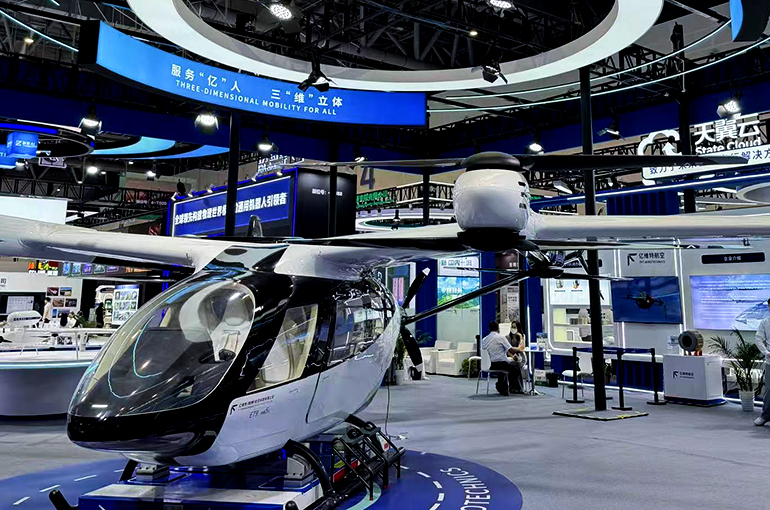
 Chinese eVTOL Makers Unveil New Models at Hangzhou Event in Push for Commercial Takeoff
(Yicai) Sept. 28 -- Blue Vector, EWing and other Chinese developers of electric Vertical Take-Off and Landing aircraft debuted their latest products at the 5th Global Digital Trade Expo in Hangzhou, which concluded yesterday, as they step up efforts to complete technical validation and obtain airworthiness certification ahead of commercial deployment.
Large crowds thronged the exhibition hall where aircraft featuring a range of designs and targeting different markets were on display.
Flight safety remains the top priority for this emerging sector, executives from several participating eVTOL firms told Yicai. Companies must complete a series of technical reliability tests and obtain airworthiness certification before they can begin commercial operations.
Blue Vector showcased the SKYLA V30, a six-seat, 2.5-tonne all-electric aircraft. “It can take off and land like a helicopter as well as cruise like a fixed-wing aircraft,” said Brand Manager Jiang Rui. The aircraft is designed for intercity transportation and can greatly cut commuters’ travel time.
A full-scale technology demonstrator of the SKYLA V30 rolled off the production line at the end of August, and the Hangzhou-based firm plans to conduct its maiden flight by the end of this year, Jiang said.
EWing’s ET9, all-electric compound-wing passenger eVTOL, features a five-person, four-seat configuration. With a maximum range of 240 km, it is primarily designed for urban air mobility, emergency rescue and niche tourism. Ren Wenguang, the company’s founder and chairman, told Yicai that the aircraft’s propulsion system, high-temperature load performance and structural strength technologies have largely been developed in-house.
“Our aviation motor can already generate 650 kilograms of thrust from a single propeller and it has operated safely on a continuous basis for several years,” Ren added.
Zhejiang Dreamchaser Aerospace Technology has adopted a hybrid powertrain for its vertical takeoff and landing aircraft. Its manned DF3000 “Youlong” model has a maximum designed range of 1,000 kilometers.
Youlong is more suited for long-haul transportation, said Song Zeming, a company executive. The aircraft’s engineering prototype has already completed its maiden flight in hybrid mode.
Some firms signed letters of intent with clients during the event. Industry insiders told Yicai that customers penning such agreements are mainly general aviation operators, emergency rescue organizations and financial leasing firms.
Passenger transportation represents the bigger market opportunity for eVTOLs, while cargo deliveries are more suitable for high-value, time-sensitive scenarios, Ren said. Commercialization of eVTOLs remains at an early stage, and product safety performance will be critical to bringing the aircraft to market. A number of companies in the sector are now in the process of applying for airworthiness certification.
Ren expects the industry to see a number of promising pilot demonstration projects within three to five years, followed by broader industrial expansion within five to eight years.
Because large-scale deployment of eVTOLs will take a long time, many firms may struggle to survive until the sector reaches takeoff, particularly if they lack sufficient internally generated cash flow. Industry participants said that, ultimately, only leading players in the industry are likely to remain viable in the long run.
Editors: Tang Shihua, Kim Taylor