



 Chinese Firms' Global Expansion, AI Boom Are Reshaping Intercultural Communication Field, Scholars Say
(Yicai) Nov. 3 -- The growing global presence of Chinese companies and the rise of artificial intelligence are creating new topics and priorities for intercultural communication research, according to scholars speaking at an event marking the 20th anniversary of the Intercultural Institute at Shanghai International Studies University.
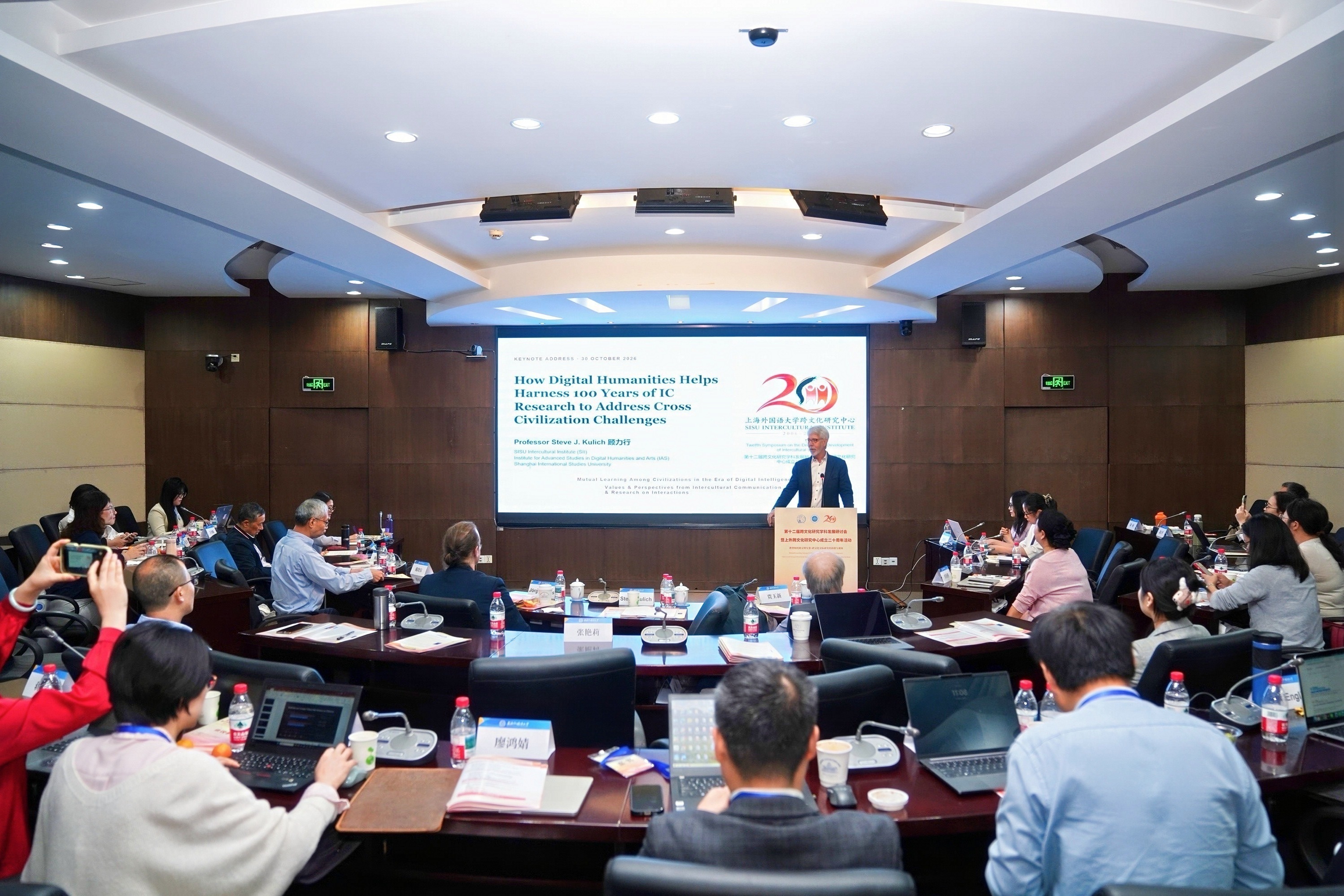
Chinese companies' overseas expansion strategy is highly valued at all levels, Zhang Hongling, director of the Intercultural Institute, told Yicai at the 12th Conference on the Development of Intercultural Studies held at SISU's Hongkou campus under the theme "Mutual Learning Among Civilizations in the Digital Intelligence Era: The Value and Perspectives of Intercultural Communication Research" in Shanghai on Oct. 30.
Intercultural communication research has significant potential, from corporate globalization to international communication and mutual learning among civilizations, because the discipline studies "how people meet and understand each other," Zhang pointed out.
Regarding AI, intercultural communication in this era is shifting from direct interpersonal interaction to AI-mediated communication, Lies Sercu, a professor at KU Leuven in Belgium, said in her video presentation. Intercultural competence is also moving beyond acquiring cultural knowledge toward the ability to discern and evaluate information from multiple sources, she added.
Established in 2006, the SISU Intercultural Institute has trained 334 master's and 35 doctoral students and developed an integrated curriculum spanning undergraduate, master's, and doctoral programs. Its international online MOOC course on the dynamics of intercultural communication has attracted more than 73,000 registered students from over 200 countries and regions. On Sept. 11, the Institute was incorporated with 6 other centers into SISU's newly established Institute for Advanced Study in Digital Humanities and Arts.
From Bringing the World to China to Going Global
Intercultural research has historically focused on many levels of interactions, negotiations, or transitions across and among cultures, as Professor Steve Kulich pointed out. As a field that has consistently prioritized the application of theories into practice, IC scholars have also been involved in the training and coaching of people preparing to adjust to another culture. Though IC previously helped foreign companies and professionals learn how to better navigate China, the direction has now shifted with more and more Chinese companies and employees now needing to go out and interact with colleagues, customers, and communities overseas.
As of the end of last year, Chinese companies operated 58,000 units across 189 countries and regions, employing almost three million foreign workers, compared with about 10,000 subsidiaries in 172 countries and regions in 2006, according to official statistics.
Companies expanding overseas need both awareness and knowledge of local cultures, but they also need individuals equipped with an intercultural mindset, who are willing to be open-minded and empathetic, able to adapt and adjust themselves flexibly across different contexts, Zhang pointed out.
The National College Students' Intercultural Competence Contest was designed to help develop such understanding and skill sets. Jointly organized by the SISU's Intercultural Institute and Shanghai Foreign Language Education Press, the contest may intensify its focus next year toward cases focused on corporate globalization, international communication, and mutual learning among civilizations, she added.
AI Enters Human-to-Human Communication
If people worldwide increasingly rely on a small number of large language models in similar ways, a dominant cultural perspective could become embedded in these systems and treated as universal, which users may find difficult to perceive, warned Jörg Matthes, a professor at the University of Vienna.
Steve Kulich, founding professor of SISU's Intercultural Institute, traced nearly a century of intercultural research in his keynote speech at the conference, exploring how digital humanities could help recover overlooked aspects of the discipline's history, as well as enhance research between cultural communicators in diverse contexts.
However, AI tends to generates answers based on what it assumes users want, he cautioned. Users should constantly question the source of information and devise prompts that generate different perspectives, such as how a French, South African, or Vietnamese person, or people in other contexts might view the situation, adding that otherwise AI tends to mainly deliver mainstream perspectives.
Science and technology alone cannot complete a process, but only assist or enhance it, Kulich said. Individuals and groups need to mobilize their minds, hearts, and hands to connect and promote effective human-AI interaction toward better people to people communication, "which is what the intercultural spirit is focused on," he stressed.
Editor: Martin Kadiev





