



 Chinese Firms Going Global Must Invest in Trust and Time, Experts Say
(Yicai) Oct. 23 -- Chinese companies expanding overseas need to build trust with local stakeholders and commit to long-term investment rather than relying solely on sales, experts said during a roundtable discussion at an event marking the 10th anniversary of Yicai Global, the English-language news service of Yicai Media Group.
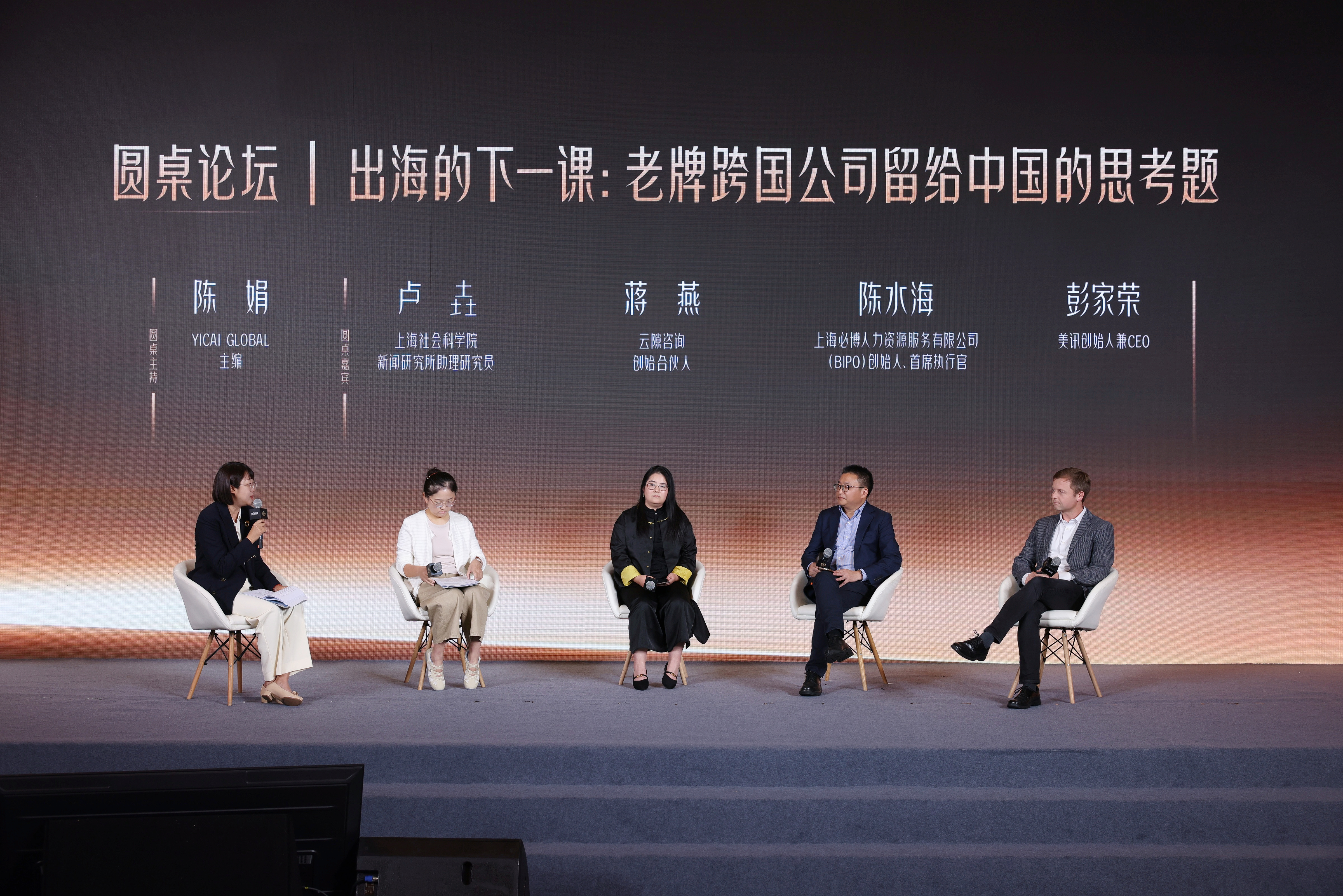
Compared with multinationals that possess nearly a century of international experience, Chinese firms' global journey is just getting started, so there is a lot they can learn, Chen Juan, editor-in-chief of Yicai Global, said at the event held in Shanghai on Oct. 21. This year, Yicai Global reporters followed Chinese supply chains south to semiconductor plants in Penang, nickel projects in Indonesia, and infrastructure sites in Dhaka for the news outlet's series The Southern Journey, she pointed out.
"Older multinationals have paid tuition for decades, and we don't need to pay it all over again," Chen stressed.
Trust Before Exposure
The environment Chinese firms face abroad is fundamentally different from the one foreign companies found when they came to China, said Jiang Yan, founding partner of Nexa Consulting and a veteran international communications specialist. "When foreign companies entered the Chinese market, the timing was very favorable, and the market welcomed them."
However, Chinese brand exports and overall China's product exports face a trust problem, she noted.
Chinese companies face what Jiang called "preemptive identity skepticism" in the current geopolitical climate, making it hard for them to find strong third-party endorsements in host countries. They need to pick topics and communicate via messages different target audiences can understand and resonate, because governments care more about compliance and tax, business partners about joint research and development, local supply chains, and long-term commitment, and consumers about user experience, she pointed out.
Firms should also prepare a reactive plan alongside a proactive one, especially at high-profile moments such as listing overseas, because dodging tough questions makes them look as if they have something to hide, Jiang stressed. "AI is very convenient now. If you don't speak, your competitors will speak for you, and they will define you."
Local partners routinely ask search engines and artificial intelligence chatbots whether a Chinese company is reliable, said Chris Pereira, founder and chief executive of iMpact, which has supported more than 500 Chinese companies in localizing. "AI will give an answer, and that answer will decide whether overseas resources work with the company or not," he noted, adding that such tools draw only on authoritative, credible sources rather than companies' own promotion.
In addition, Pereira rejected the idea that globalization is in retreat, calling that an American view. The overseas expansion of Chinese firms is a feature of a "new generation of globalization," he stressed.
People and Compliance
Chinese firms should distinguish between internationalization and globalization, noted Michael Chen, founder and CEO of human resources and payroll technology provider BIPO, which serves clients in more than 170 markets. Internationalization often means a company going abroad to expand its business, while globalization is seeing every region as part of one market, he pointed out.
"When we look with a more global perspective, we can absorb the good things from every country and every region with a humbler and more inclusive mindset," Chen added.
Chen, who has worked at multinationals such as logistics giant DHL Group in legal and HR roles, said Chinese firms are still building three capabilities that older multinationals have long had: a pool of international talent, a complete global authorization system, and the mechanisms to delegate authority while staying in control.
Work culture is another hurdle, according to Chen. "To keep overseas operations in step with the demands of the boss and management, HR teams often want to hire people abroad who are hyper-competitive, but in fact that is very hard to come by in Europe, the US and Singapore. If you push them to a certain point, they may just quit.'"
Data privacy is the compliance risk Chinese firms should take most seriously overseas, Chen stressed. A wrongful dismissal leads to a simple compensation, but a breach of the European Union's General Data Protection Regulation can bring fines of up to EUR20 million (USD22.5 million) or 4 percent of the previous year's global turnover, whichever is higher, he noted. "Doing well on efficiency gives us an edge in competition, but doing well on compliance lets us go further."
The Value of Time
Lu Yao, an assistant researcher at the Shanghai Academy of Social Sciences' Institute of Journalism, pointed to multinationals' scholarship programs as an example of patient investment.
Chinese firms' overseas investments tend to be project-based and short-term, Lu pointed out, advising them to start small, think long-term, and govern jointly, adding that local partners should be ones they can work with for 20 years or more, with several companies able to jointly fund a program.
However, firms should not expect scholarships to vouch for them, since reputations ultimately depend on operating lawfully and honestly in the host country, Lu said. "The shortest investment is ad placement, and the longest is a person who carries an experience and lives in one place for decades."
All panelists at the roundtable pointed to the same question, Chen Juan said in her closing: "How can Chinese companies become part of local societies, rather than just outside businessmen?"
Editor: Martin Kadiev





