



 China’s Embodied AI Boom Runs Into Data Quality Bottleneck
(Yicai) Sept. 9 -- The development of large models for embodied intelligence hinges on access to high-quality training data. Although China’s supply of embodied-intelligence data is growing rapidly, industry insiders told Yicai that obtaining high-quality data remains a significant challenge.
The quality of data supplied by data-collection companies remains inconsistent, Yicai learned from a series of interviews with robot makers. "Compared to real-world environments, data collection facilities have certain limitations because they lack the atmosphere and complexity of actual factories and commercial settings," said Zhang Yufeng, founder and chief executive officer of Unbounded Dynamics.
As a result, several embodied intelligence companies have set up their own data-collection operations. According to their latest progress reports, the Beijing Humanoid Robot Innovation Center has released and open-sourced the RoboMIND embodied-intelligence dataset, while Maniformer, a subsidiary of AgiBot, said it has accumulated over one million hours of high-quality data without using physical robot bodies.
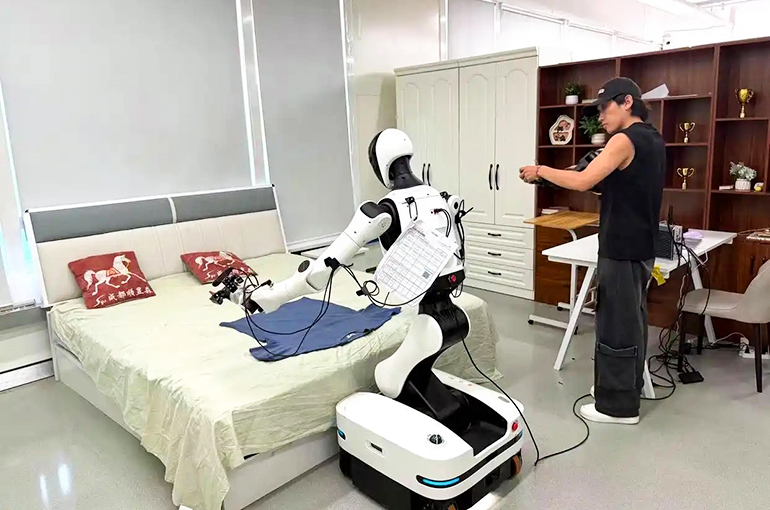
Beijing Humanoid obtains most of its robot training data from its own data-collection facilities. During a recent visit by Yicai, the company's base was found to contain typical application scenarios for industries such as home living, retail, manufacturing and pharmaceuticals, as well as a dedicated optical motion-capture area.
The facility provides data services not only for the Beijing-based firm’s self-developed Tiangong Ultra humanoid robots but also for external clients, said Xia Hualin, head of the base. To date, the facility has delivered nearly 30,000 hours of high-quality data to external parties.
At the second World Humanoid Robot Games held last month, Tiangong Ultra robots set several records, including a time of 8.64 seconds in the 100-meter sprint and a time of 2 minutes and 21.64 seconds in the 1,500-meter run, both of which were significantly faster than human world records.
The facility aims to build a high-quality dataset containing one million hours of data, Xia said. Currently, it has over 150 mainstream robotic systems and more than 100 data-collection devices without physical robot bodies. It has also established a complete end-to-end workflow that covers data collection, cleaning, quality control, annotation, model training, real-machine evaluation, as well as model deployment and data feedback, he added.
Data collected during the day is automatically processed in the cloud at night and can be delivered to clients the next day, Xia said.
Other companies such as Galaxea AI, Lightwheel and JD.com are also developing their own embodied-intelligence data-collection businesses, and producing multimodal datasets at scale for robot model training.
Real-World Deployment
However, obtaining such data is not easy. In Zhang's view, data collection, training and validation must ultimately extend into real-world scenarios. Only by deploying robots in actual operating environments can development teams identify issues related to a model’s generalization capabilities and safety.
Xi Yue, co-founder of Robotera, said that before customers will allow multiple robots to operate in real working environments, the robots must first demonstrate a certain level of operational capability.
Robot developers need to "ensure the robots achieve a capability level of 70 out of 100 before deploying them in real working environments to further improve their capabilities, eventually raising them to a level of 90 or even 100," Xi said.
Xi cited the logistics service robots developed by Robotera as an example. These robots were initially deployed to work in various express logistics scenarios, and the data collected from these real-world settings was then used to progressively improve their capabilities. On their first day of "work," the robots' movement accuracy was relatively low, but after operating for a period of time, their capabilities improved significantly.
He believes that data accumulated in real-world scenarios can accelerate improvements in robot capabilities. For example, it initially took several months for a robot deployed in logistics operations to improve its performance. However, with access to higher quality data, the capability enhancement cycle for robots deployed in similar environments in the future could be reduced to a few weeks.
Editors: Tang Shihua, Kim Taylor





