



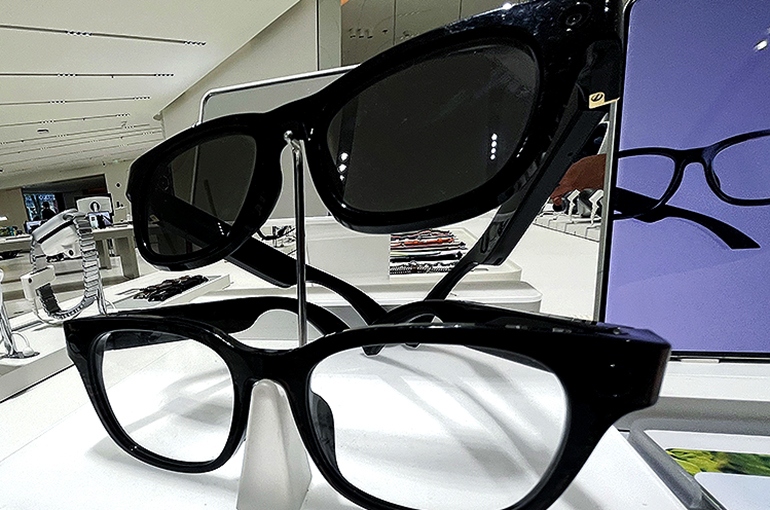
 Chinese Smart Glasses Market Is Still Chasing Breakthrough Moment Despite Rising Sales
(Yicai) Nov. 13 -- China’s smart glasses sales have climbed during the Double 11 shopping festival this year. However, industry insiders warned that no widely accepted consumer application has emerged yet.
The value of smart glasses sales on JD.Com surged 150 percent during this year’s Double 11 shopping gala ended on Nov. 11 from a year earlier, with the value of display smart glasses sales up nearly fourfold, according to data from the Chinese e-commerce giant.
Online retail volume of smart glasses during the first three weeks of Double 11 reached 88,000 units, generating CNY160 million (USD23.8 million) in sales, according to data from market research firm AVC.
Smart glasses demand is concentrated at the two ends of the price spectrum, Li Xiaoxian, analyst at AVC, told Yicai. Cheaper products chase value and high-end products offer upgraded optical performance and office functions, while mid-range products suffer from vague positioning and underperform, he explained.
Display augmented reality glasses priced at around CNY1,000 (USD149) are the current market hotspot, a senior industry insider told Yicai. However, the broader sector remains unprofitable because of the fierce competition despite robust sales growth, they added.
During Double 11, RayNeo launched its 35-gram iO AR glasses, supporting translation, transcription, and navigation, priced at about CNY2,000, Coolpad Group partnered with JD.Com to release artificial intelligence camera glasses priced at around CNY500 (USD 74), and Inmo introduced a binocular full-color smart glasses model.
At the 2026 Baidu World Conference yesterday, Baidu previewed a 38-gram smart cloud AR glasses model co-developed with Antavic Technology, expected to hit the market next month, priced from CNY1,699. The product supports navigation, translation, teleprompter, and meeting transcription functions, Antavic’s Chief Executive Yan Pengfei told Yicai.
Antavic handles the hardware research, development, and manufacturing, while Baidu supplies the AI model and integrates the product into its ecosystem.
“While smart glasses were hot during Double 11, the long-anticipated breakthrough in the market has not arrived yet,” said Liu Chuang, researcher at Runto. He believes one reason is the mismatch between product offerings and users’ genuine, high-frequency needs.
Smart glasses have yet to form a widely accepted value proposition for the public, Liu noted, adding that the main reason is that existing products lack a killer use case ordinary consumers view as indispensable. The value they deliver is auxiliary rather than essential.
Liu believes smart glasses sales over the past two years were heavily tied to promotional campaigns, as organic consumer demand is limited and many orders stem from impulse purchases driven by promotions.
Most smart glasses sold in China target office scenarios, said Li. The sales growth mainly comes from this segment, whose growth potential is relatively limited, he pointed out.
Entertainment represents the biggest potential growth driver for smart glasses, Li believes. Even so, entertainment products remain in the trial stage, with limited supply, high prices, steep learning curves, and long cycles for building the content ecosystem, which will likely prevent rapid penetration in the near term.
Editors: Tang Shihua, Futura Costaglione





