



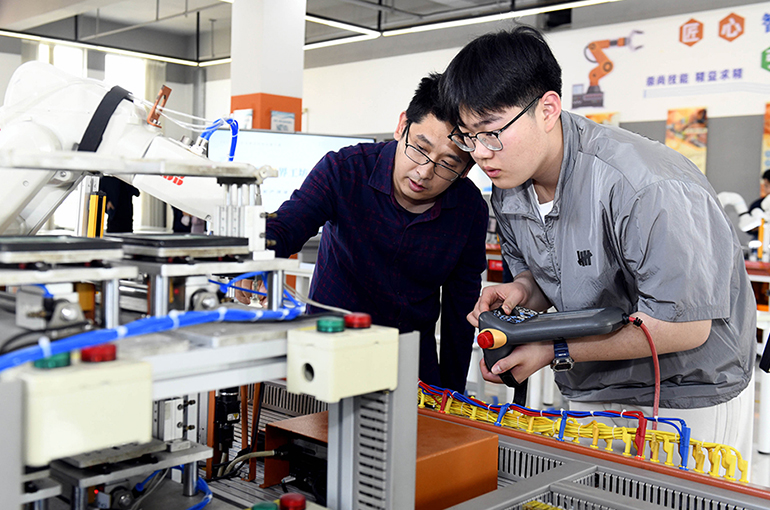
 Chinese Students Increasingly Pick Higher Vocational Schools Over Colleges
(Yicai) Aug. 12 -- More and more Chinese students who score high on the national college entrance examination, known as gaokao, choose to attend higher vocational colleges due to better educational value and employment prospects.
Higher vocational colleges in Sichuan province began accepting students on Aug. 9, with 252 such majors requiring higher gaokao scores than ordinary universities due to the growing number of candidates, according to data released by Sichuan Education on WeChat. Majors meeting national strategic demand, including embodied intelligent robotics, low-altitude intelligent Internet of Things tech, and drone application tech, as well as those focusing on digital economy, artificial intelligence, advanced manufacturing, and modern agriculture and services, are most sought after.
Historically, due to better employment opportunities and more favorable career paths, the admission scores for undergraduate programs have been higher than those for vocational colleges. However, due to more students choosing vocational schools, relevant entry bars have increased.
Hunan, Guangdong, Jiangsu, Hubei, Shandong, and Heilongjiang provinces have also seen an increasing number of students who score high on the gaokao apply for higher vocational colleges.
High school graduates in China need to take the gaokao to continue their studies, with ordinary universities and higher vocational colleges admitting candidates based on their exam scores. Traditional undergrads go through four years of higher education, balancing academic literacy and comprehensive abilities, receiving a diploma and a bachelor's degree certificate upon graduation.
Students at higher vocational colleges take a three-year course that focuses on practical job skills while streamlining academic theories to meet the employment needs of frontline industries. They only get a vocational diploma with no degree certificate upon graduation.
Behind the trend of more and more students who score high on the gaokao giving up on ordinary universities to pursue higher vocational education lies new considerations from candidates and their parents regarding the educational value and employment prospects, according to research institute Mycos.
An important reason for the fact that the admission cutoff lines for some majors at higher vocational colleges exceed those of standard universities is the choice of "certainty." Targeted training programs are the most representative example due to the certainty of "employment upon graduation," having a strong appeal to students and parents.
In addition, China has a great demand for skilled talent. Relevant shortage is particularly prominent in strategic emerging industries, including electronic information, high-end equipment, new energy, smart vehicles, new materials, energy conservation, and environmental protection.
Targeted training programs involve locking in future employment before admission, with students, schools, and employers signing contracts agreeing on all rules for study and employment. Such programs are available at both higher vocational colleges and standard universities.
Majors at higher vocational colleges with higher admission bars than ordinary undergraduate degrees are concentrated in the top-ranked schools and special programs, such as targeted training, Mycos said, noting that not all higher vocational colleges have equal attractiveness.
Some public higher vocational colleges offer practical majors where students will have good employment prospects as long as they become proficient in relevant technologies, Ding Changfa, associate professor at Xiamen University's economics department, told Yicai. These have relatively low tuition fees, providing high cost-effectiveness, Ding said.
Majors, curricula, and training models at some colleges are lagging behind market demand, with a significant gap between the quality of talent training and the need for high-quality development of the Chinese economy, several experts noted. Some standard universities in particular should accelerate innovation and transformation, they stressed.
Editor: Martin Kadiev





