



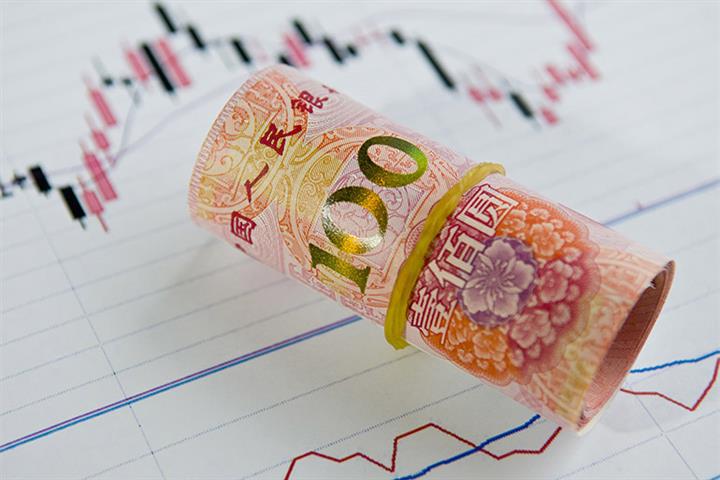
 Chinese Yuan Sinks 2% Against US Dollar in Four Days, May Stay Above 6.5 for Some Time, Analysts Say
(Yicai Global) April 25 -- The Chinese yuan has been depreciating rapidly against the US dollar, sliding around 2 percent in the four trading days from April 19 to April 22, as the latest Covid-19 outbreaks, the US’ monetary tightening policies, ongoing geopolitical tensions and other factors take their toll.
The offshore and onshore yuan softened 1,500 basis points and 1,400 bps versus the greenback respectively to 6.5274 and 6.5017 as of the close of markets on April 22, the lowest level since November last year and the biggest weekly drop since August 2019.
Although China’s policy response is effective and adequate, the possibility that the yuan rate will remain above 6.5 for some time cannot be ruled out, market analysts said.
The recent weakening of the redback is understandable and has come a bit later than expected, Ulrich Leuchtmann, head of FX Research at Frankfurt-based Commerzbank, told Yicai Global. The yuan is unlikely to continue to weaken significantly and it is not unreasonable if it stays above 6.5 for some time.
China is under great economic pressure as the latest Covid-19 outbreaks started in March, just when factories and construction projects were about to kick off full-load operations, said Lu Ting, Nomura Securities’ chief China economist. The Yangtze River Delta region, which is the center of China’s economy, finance and logistics, has been badly hit. And Chinese families as well as private companies may cut back on investment in capital, commodities and properties.
The Fed constantly releases hawkish signals and the efforts to hike the interest rates and shrink the balance sheet are stronger than expected. This also puts pressure on the yuan, analysts said.
The Fed’s interest rate hike is indeed an important external variable, but the essential factors are still China’s own macro fundamentals and market basis, Wang Chunying, spokesperson for the State Administration of Foreign Exchange, said on April 22. China’s foreign exchange market has been constantly strengthening in recent years and it has the resilience needed to adapt to the Fed’s latest round of policy adjustments.
Short Trades
Momentum for short-selling the yuan is gaining in the offshore market because of the narrowing China-US yield spread and the big slump in the yuan-dollar central parity rate, a number of traders said. But short sellers are only sounding things out for now and the yuan will not face huge pressure from dumping.
In the past week, the yield of the 10-year US Treasury Bond closed at 2.905 percent, while China’s 10-year government bond closed around 2.88 percent, with the pair continuing to stay reversed.
The narrowing and reversed yield spread caused by the differentiation of economic fundamentals and monetary policies between China and the US will be hard to turn around in the short term and pressure from the outflow of foreign capital and depreciation of the yuan still exists, said Xie Yaxuan, chief macroeconomic analyst at China Merchants Securities.
The risk exposure from overseas capital reducing their holdings may cause a chain reaction in the domestic markets of stocks, bonds and foreign exchanges, if the Fed’s tightening policies trigger global turmoil, Guan Tao, global chief economist at BOC International China, said recently.
Editor: Xu Wei, Kim Taylor





