


 China's Air Cargo Sector Gets Boost as Int'l E-Commerce Fuels Demand
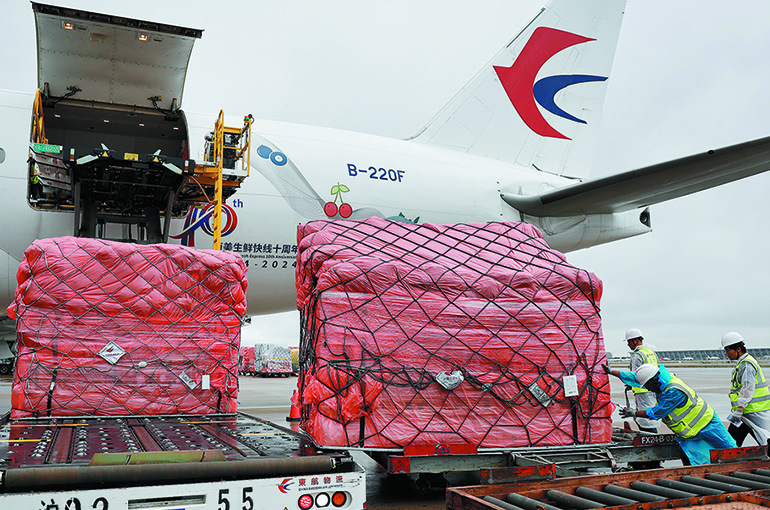
(Yicai) Nov. 25 -- The upgrading of China’s manufacturing sector and the accelerating overseas expansion of Chinese companies are creating new opportunities for the domestic air cargo industry, with cross-border e-commerce emerging as one of the main drivers.
The Chinese air cargo industry’s cargo and mail volume rose 4.4 percent to 7.7 million tons in the first three quarters of the year from a year earlier, with international cargo and mail volume up over 12 percent, according to data from the Civil Aviation Administration of China. Chinese air cargo firms have maintained strong profitability despite high fuel prices.
After China Southern Airlines and Air China launched new cargo routes last year, Glasgow Prestwick Airport has added new Chinese destinations and flight frequencies thanks to robust demand, Colin Dai, the airport’s general manager for Asia, told Yicai. For example, Air China now operates 14 weekly flights between Chinese cities and Glasgow, up from the initial three.
In just 18 months, cargo flights between Glasgow Prestwick Airport and Chinese destinations, such as Guangzhou, Chengdu, Shanghai, and Urumqi, have grown to 20 per week. With each plane carrying roughly 100 tons of cargo, the total weekly cargo volume reaches 2,000 tons.
These flights are adding new capacity, not redirecting cargo from other airports in the United Kingdom, Dai explained. The number of direct cargo flights between China and the UK has now reached a historic high.
Cross-border e-commerce is the main force driving the increase in cargo flights, with Temu and Shein serving as the primary source platforms, even though air transport is more expensive than sea freight.
A phone accessory selling for GBP20 to GBP30 (USD26 to USD39) in the UK might cost only a few dozen Chinese yuan, equal to a couple of US dollars, to produce in China, Dai said. Even with air transport and delivery costs added, it remains price-competitive.
Moreover, goods such as phone cases, cables, and clothes are small and lightweight, so air freight costs per unit are relatively low, he added.
Speed is another factor. For fast-fashion brands, a garment that spends weeks in transit may be out of season by the time it arrives. Although air freight adds to logistics costs, it shortens delivery cycles, accelerates capital turnover, and reduces the risk of inventory overstock.
In the past, exporters had to ship large volumes of goods overseas in advance and stockpile them for local distribution. But cross-border e-commerce allows flexible production and shipping based on actual sales, reducing inventory. Therefore, higher transport costs can be partially offset by savings on other operating costs.
Cargo aircraft flying back to China from the UK are carrying an increasingly diverse range of goods, from Scottish salmon and lobster to whisky and pharmaceutical products.
Editor: Futura Costaglione