



 Ecology at the Core: From Urban Renewal, Industrial Projects to Supply Chain, Waste Management
(Yicai) Sept. 18 -- Ecological considerations are becoming an essential part of urban renewal, industrial upgrades, supply chain governance, and even waste and resource management, experts said at a panel discussion during AT ONE IMPACT WEEK 2026 in Singapore.
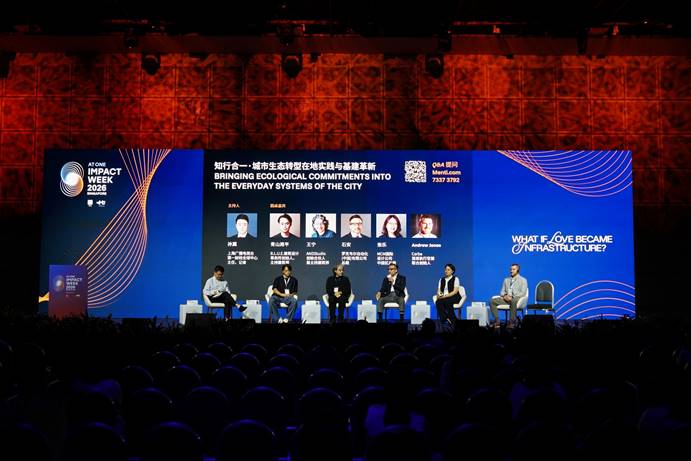
The panel, titled “Bringing Ecological Commitments into the Everyday Systems of the City,” was held during AT ONE IMPACT WEEK, which was co-hosted by TPC (Tsao Pao Chee) Group and NO.17 Foundation from Sept. 8 to 12. It was moderated by Sun Ji, director of Yicai Global.
The speakers explained how ecological requirements are playing a central role in urban renewal and architecture, supply chain, carbon technology, and waste management, among others.
Japanese architect Shuhei Aoyama moved to Beijing in 2005 and founded B.L.U.E. Architecture Studio in 2014. Over the past two decades, his projects have shifted from large developments of 100,000 to 200,000 square meters to renovations of old neighborhoods and city districts.
For Aoyama, renovating old buildings is less about executing a plan than about the designer and the space coming up with an answer together. "It's a sense of creating something together," like designing alongside the building and the city itself, he explained.
Renewing old districts, such as Beijing's hutongs, is not just about repairing the structures but also about restoring their practical use and turning the space into somewhere people can live and work, Aoyama said. Hutongs are narrow alleyways formed by lines of traditional courtyard residences.
Ning Wang, founder of AND Studio, shared the company’s experience developing a 13-hectare whisky distillery in an industrial park in Chengdu, near a linpan, a distinctive agricultural settlement typical of Sichuan province.
The team’s starting point for the project was the natural conditions, such as which trees to preserve and which waterways to restore, Wang said. Only after that did the team lay out the building construction plan.
The project ultimately preserved about 3,000 trees and restored a stretch of river that had previously been cut off, Wang noted, adding that the factory buildings were constructed around the preserved woodland.
A similar approach of prioritizing nature was adopted for the Wudadao park project in Tianjin. Located in the city center, this project is now a meeting spot for children to play outdoors after school on weekdays, said Le Zhang, president of MCM International Group China. On public holidays, the park becomes a tourism hotspot, welcoming more than 10,000 people when hosting a market.
Once ecological thinking reaches supply chains, the picture becomes far more complex.
Rockwell Automation China is moving from a traditional industrial automation service provider toward a “lead integrator” for production-oriented services to meet changing client needs, President Ian Shih said.
He cited the case of a global fast-food company as an example. Its Scope 1 and 2 emissions account for only 1.8 percent of the total, and the remaining 98.2 percent are Scope 3 emissions from its upstream suppliers.
This fast-food chain’s nine largest suppliers operate 97 factories in China and 1,500 factories worldwide, Shih explained. This means that the decarbonization target is not just a single company's facilities and equipment, but its entire supply chain network spanning multiple countries and hundreds or even thousands of factories, he added.
Rockwell Automation China worked with this company to develop a digital assessment standard to reduce upstream emissions and has since carried out similar collaborations with other clients in the global semiconductor and electronic components industries, according to Shih.
For Chinese companies expanding overseas, Shih mentioned a concrete problem: domestic carbon data and certifications are not always recognized in the European market, which can pose practical challenges for market access.
Through the Climate Lighthouse platform it co-built with Shanghai Climate Week, Rockwell Automation China helps companies align their domestic carbon data with internationally recognized standards and certification systems, Shih said.
On the resource side, Andrew Jones, founder of carbon removal company Carba, outlined a technology pathway that turns urban waste into biochar.
Carba's first project in Minneapolis converts wood and vegetation waste generated during utility line maintenance into biochar through pyrolysis. "We take those waste streams and we convert them into valuable products," Jones said. "Some of those are carbon dioxide removal that we can sell to companies who are trying to hit net zero goals."
Under this model, waste that would otherwise need to be disposed of becomes a production input, according to Jones. The biochar produced through pyrolysis can be used in agriculture, landfills, and road filtration, while part of its carbon removal value can be further packaged into products for companies pursuing net-zero targets.
Carba hopes to bring the same project to Singapore next year and explore opportunities in Asia-Pacific Economic Cooperation cities and in agricultural waste streams.
"There are about 700,000 tons of waste streams being produced here," Jones said. "About half of those are burned for energy, but the other half are composted or have nowhere to go."
Editor: Futura Costaglione





