(Yicai) Sept. 15 -- [Editor’s note] With the implementation of international environmental, social, and governance standards, industrial development has entered a new era.
2024 marked the 20th anniversary of the ESG concept. At this important historical juncture, the United Nations Global Compact, the Center for Asia-Pacific at China International Communications Group, and Yicai jointly launched the ‘ESG+20 Sustainable Development Leadership Interview Series.’
This series explores the insights, achievements, and leadership of Chinese businesses in sustainable development and corporate social responsibility through dialogues with Chinese entrepreneurs and on-site visits.
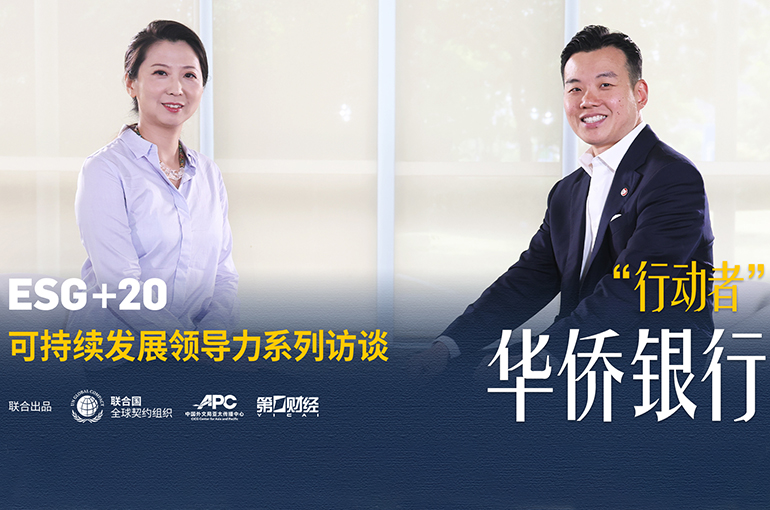
In this episode of the ‘ESG+20 Sustainable Development Leadership Interview Series,’ we spoke with Eng Siong, chief executive officer of the Chinese branch of Singapore-based Overseas-Chinese Banking Corporation, about how OCBC is working to connect China with the Association of Southeast Asian Nations, and green capital with the real economy and advanced sustainable development.
OCBC first established a presence in China in 1925 by opening a branch in Xiamen. During the Great Depression in 1932, OCBC was formed in Singapore by consolidating three banks. Now, the lender has expanded to core markets in Southeast Asia, including Malaysia and Indonesia, which have become key destinations for Chinese companies expanding overseas in recent years.
Ang recently visited customers in Indonesia and Malaysia engaged in the automotive, heavy machinery, telecommunications, and resources sectors. Chinese companies are bringing renewable energy and green technologies to Southeast Asian markets, he noted. For example, one Chinese heavy machinery maker brought electric dredging equipment to the region.
“What we need to do now is work with our teams in Malaysia and Indonesia to jointly build a green ecosystem,” Ang said.
In cross-border green finance, OCBC has actively participated in the Common Ground Taxonomy -- a multilateral framework designed to identify commonalities and differences between different green finance systems -- and helped put related initiatives into practice. One example is its recommendation of a green project in Laos by a Chinese state-owned energy company for Chinese yuan financing.
The electric vehicle sector has many brands and may consolidate in the future, and the power battery sector will remain indispensable for every brand, Ang said about industrial positioning.
OCBC entered the power battery industry at an early stage and has divided the supply chain into segments, including cathodes, anodes, and separators, seeking leading companies and business opportunities in each segment while connecting Chinese companies with Southeast Asian markets, Ang explained.
OCBC has adopted an ‘ABC’ sustainable priority strategy, according to Ang. “A as accelerating the transition to a net-zero future; B as bringing impact to communities; and C as conducting business responsibly.”
The bank has also launched the OCBC 1.5° Celsius loan, linking international green standards, ASEAN network resources, and the needs of Chinese industries. The loan is a financing solution designed to incentivize companies to set and work toward science-based, net-zero decarbonization pathways.
About artificial intelligence, Ang said that AI and ESG can be combined effectively. AI can be closely integrated with the green transition, including by optimizing processes to reduce energy consumption and enabling intelligent power dispatch in electricity transmission, he noted.
OCBC’s recently unveiled corporate strategy, ‘The Next Frontier,’ identifies four strategic shifts: the Asian transformation, technology transformation, net-zero transformation, and business transformation. It places ‘ADD’ -- AI, digital, and data -- at the core of its strategy.
OCBC is actively helping build stakeholder ecosystems, bringing high-quality customers into green cooperation networks and using AI and digital capabilities to drive cross-border green business opportunities, Ang explained.
Editor: Futura Costaglione