



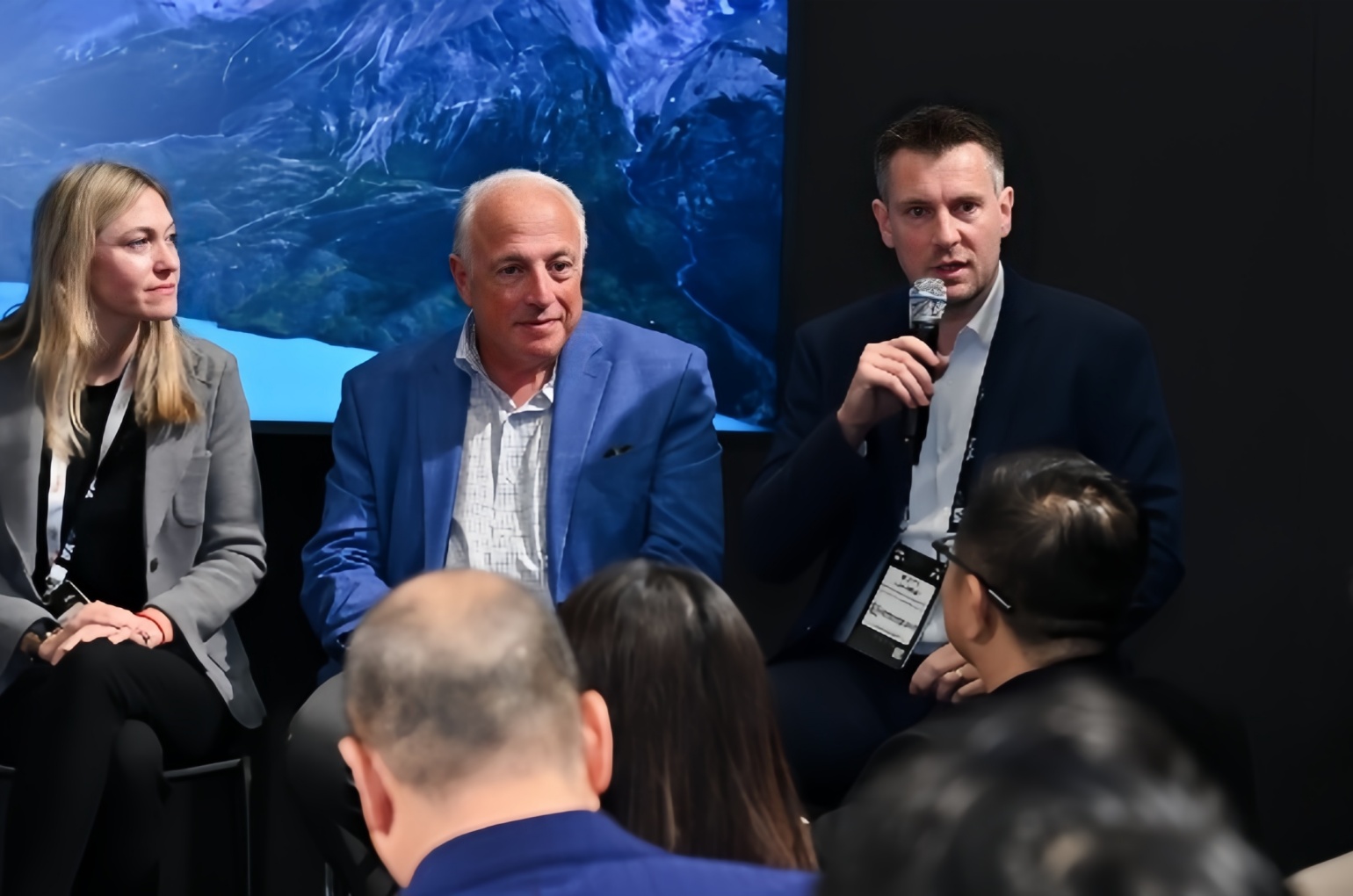
 Experts Debate Barriers to Consumer Adoption of Smart Wearables at IFA 2026
(Yicai) Sept. 8 -- Whether consumers are willing to put their long-term trust in and keep using increasingly intelligent wearable devices was a key topic for solar power, exoskeletons, after-sales services, business event production, and sports science experts at the Internationale Funkausstellung, the world's largest home and consumer technology event in Berlin.
Battery life remains one of the biggest complaints among wearable device users, Ino Prümm, overseas business head at perovskite solar cells supplier Yanhe Solar Technology, said on the sidelines of the IFA 2026 on Sept. 6. When devices like smartwatches lose power, their value drops as they can no longer collect data or provide services, he noted.
The future development of wearable devices will continue to depend on advances in energy tech, including improvements in power architecture and the efficiency of new materials, helping move beyond the "one charge a day" limitation, he stressed.
Global wrist-worn device shipments rose only 2.2 percent in the first quarter of this year from a year ago, with the industry shifting from rapid expansion to a more mature phase, according to data from International Data Corporation. As hardware differentiation becomes more limited, premium product growth is increasingly driven by health monitoring and artificial intelligence functions, making basic features such as battery life a renewed focus of competition.
From a safety perspective, exoskeletons are transitioning from industrial and medical applications to the mass consumer market, said Cody Kou, vice president of wearable robotic exoskeleton maker Ascentiz. Market education is the first major challenge, with safety as the baseline, he noted, adding that every company should assume full insurance responsibility.
Regarding the growing impact of after-sales services on consumer trust, Laura Huddle, chief revenue officer at US e-commerce after-sales platform Seel, noted that while advances in sensors and algorithms have continued to improve product capabilities, consumer expectations for the after-sales experience are also rising. Devices are shifting from merely "recording data" to helping users make decisions, including about their health, she said, adding that this means companies need not only to offer functions, but also build consumer trust in the data and services devices generate.
For data governance, devices like smart glasses and smart scales continuously collect users' information, but consumers still have limited understanding of how companies use it, noted Dave Leon, partner at press and business events production company ShowStoppers, calling for clearer industry rules on data usage.
The European Union postponed the implementation of the high-risk provisions under the AI Act from last month to December next year, while for AI systems embedded in regulated products such as medical devices, the implementation was delayed to August 2028. The industry is closely monitoring how regulatory standards keep pace with rapidly evolving consumer tech.
Another challenge for health-related wearable devices is scientific validation.
The industry still lacks unified validation procedures for wearable devices, said Moritz Schumann, chair of experimental exercise science at the Technical University of Munich's School of Medicine and Health. Research institutions often need to buy devices independently and conduct their own studies, which can take around two years, he pointed out.
Schumann's team is participating in a joint initiative involving several European universities that aims to develop standardized testing recommendations and certification systems for health-related wearable devices, he said, stressing that the industry cannot rely solely on selling devices and adding more features, but also needs to help users better understand and properly use the data generated.
In addition, smart hardware is expanding from personal devices into broader household scenarios. Chinese smart pet brand Neakasa participated in the IFA for the third straight year, showing its smart litter boxes and wet food feeders.
A key reason for attending the event was to connect with European consumers and partners to better understand their needs, Neakasa pointed out.
Discussions at the IFA highlight that competition in wearable devices is shifting from pure technological innovation toward user experience, data governance, and long-term trust-building, according to analysts. For consumer tech companies, the ability to truly integrate smart devices into users' daily lives may become a key factor in the next phase of competition, they added.
Editor: Martin Kadiev





