



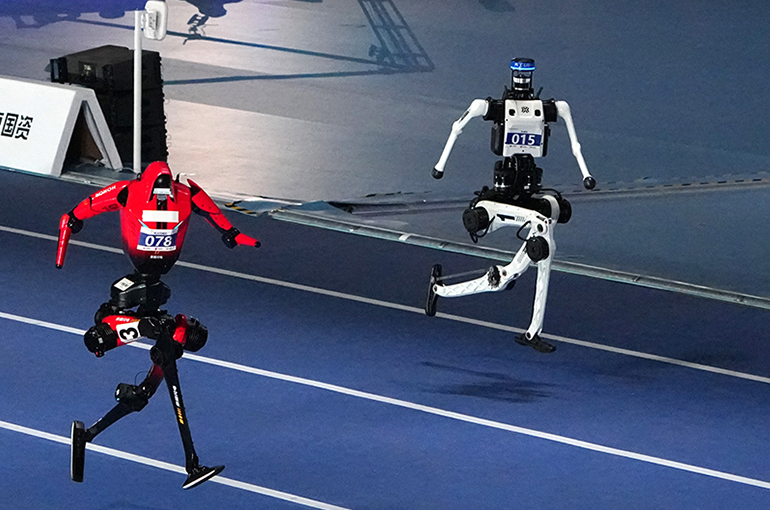
 Falling Costs, Converging Hardware Push Humanoid Robot Race Toward AI
(Yicai) Aug. 31 -- Humanoid robots are becoming cheaper and increasingly alike in hardware, putting the models that control them at the center of the industry’s competitive race, Yicai learned at the second World Humanoid Robot Games.
Humanoid robots delivered significantly better performance at the games, an annual international competition in Beijing that tests their capabilities in sports and real-world tasks, reflecting advances in core components and a maturing supply chain, industry insiders told Yicai.
Components used by competing robots are becoming increasingly similar, while the embodied AI foundation models that serve as their “brains” remain highly diverse. The divergence is also drawing new entrants from autonomous-driving companies and internet giants.
The ability of these foundation models will be crucial to whether humanoid robots can become practical, broadly applicable products, according to Wang He, founder of robotics company Galbot.
Hardware Converges as Costs Fall
Xu Zhiyuan, head of the motion control department at the Beijing Innovation Center of Humanoid Robotics, attributed the significant advances in robots’ competitive performance at the games to progress across the entire industrial ecosystem.
“Against the backdrop of improving performance in core components such as sensors, motors, and reducers, the performance of robot bodies has also improved,” Xu said.
Demand for components is also shifting from highly customized, small-batch orders toward standardized products and much larger volumes, according to Tan Peng, board secretary of Zhuoyu Technology, which supplies motors, joint modules, and other components to embodied AI companies.
Previously, customers required highly customized components that had to be iterated every three to six months, while final orders could amount to only dozens of units, Tan told Yicai. This year has been different: once customers select a proven design, initial orders can be enough to equip 1,000 robots, he added.
The cost of making humanoid robots is also falling sharply as technologies advance and supply chains mature.
A few years ago, it might have cost several million yuan to make a humanoid robot that could run, but with technological progress and a maturing supply chain, the cost has now fallen to around CNY100,000 (USD14,000), and this downward trend is expected to continue, said Zhao Tongyang, founder of humanoid robot developer EngineAI.
Embodied AI Becomes Main Battleground
The growing importance of embodied AI has attracted new entrants from autonomous driving as well as major internet firms, bringing additional engineering expertise and investment into the sector.
For example, the founders and some key technical staff of general-purpose robot developer Anyverse Dynamics and robot world-model developer SynapX previously worked at autonomous-driving computing solutions provider Horizon Robotics.
Autonomous-driving professionals can bring project development experience and engineering capabilities accumulated in that industry, an industry insider told Yicai. But embodied AI presents greater development challenges because robots operate in more complex environments compared with autonomous-driving models that mainly need to avoid collisions on a two-dimensional plane, the person added.
Technology giants such as Ant Group and JD.Com have also entered the field, either by investing in robotics companies or directly developing embodied AI foundation models. Robbyant, Ant Group’s embodied AI unit, has released several models in its LingBot series, while JD.Com has developed the JoyAI-RA model.
Whether humanoid robots can achieve successful real-world deployment will ultimately depend on whether they become useful and broadly applicable products, Galbot’s Wang said. “The capabilities of the foundation models they are equipped with will play a key role,” Wang said.
That makes the choice of technical approach increasingly important. Developers currently have two main options: Vision-language-action models, the more widely adopted and generally less computationally demanding route, and world models, which target more complex and open-ended environments.
VLA models can train robots in specialized work skills for specific scenarios across diverse real-world environments, according to Tang Jian, chief technology officer of the Beijing Innovation Center of Humanoid Robotics.
The world-action model (WAM) approach, by comparison, is suitable for more open environments such as commercial and household settings, where stronger model generalization capabilities are required, Tang added.
Editors: Tang Shihua, Emmi Laine





