


 German Businesses Deepen Involvement in China’s Innovation Ecosystem
(Yicai) Nov. 26 -- Executives at a China-Germany business conference have hailed the progress in industrial cooperation between the two countries.
The relationship used to be primarily a blend of German design and Chinese labor, but now it features closer integration of research and development, deeper technical collaboration, and long-term partnerships with local clients, said representatives at the fourth AHK Greater China Xceleration Days, which is being held in Shanghai.
China is one of the fastest markets for innovation, with an extremely short cycle from research and development, testing, and implementation to market launch, said Martin Hofmann, chairman of the board of directors for North China and Northeast China of the German Chamber of Commerce in China.
German enterprises are deeply impressed by the so-called “China speed," Hofmann added, and are eager to engage deeply with China’s innovation ecosystem and bring the insights gained back to Germany.
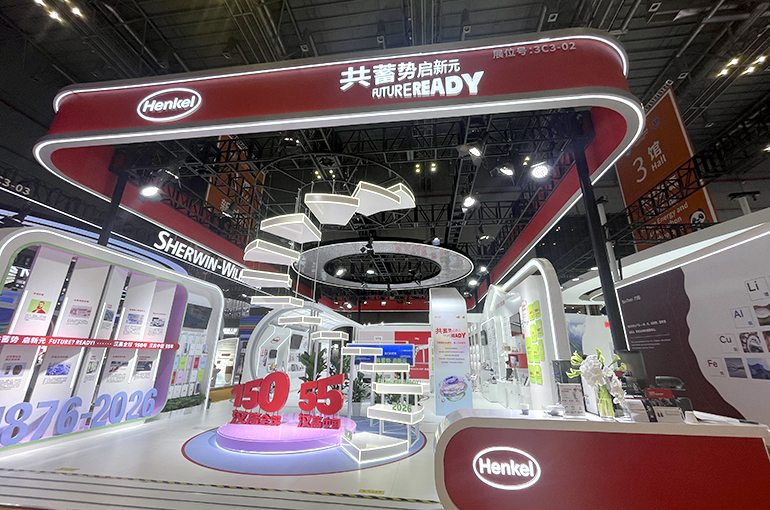
“The pace of the consumer electronics industry is faster than that of semiconductors and automobiles, which is why we established an innovation experience center here in China that is closer to our customers,” Hu Xiaolong, head of product development for Henkel Adhesive Technologies’ electronics division in China, told Yicai during the event.
The company’s Inspiration Center Shanghai, which opened in September last year, is its second-largest globally, after the one in Dusseldorf, Germany, where the firm is headquartered.
German injection molding giant KraussMaffei has also moved beyond simple equipment sales, and is deepening its collaboration with a Shanghai-based manufacturer of reusable logistics containers.
In response to complex challenges related to adjusting material formulations and process optimization during the recycling and reuse of these containers -- covering the entire lifecycle from material recovery and manufacturing to end-use -- the partnership has resolved critical pain points for Chinese clients around full-chain digital logistics management, KraussMaffei said, adding that it also offers a replicable model for green manufacturing on a global scale.
China’s booming robotics sector has likewise captured the interest of German firms. Bavaria-based FMC³ Robotics focuses on embodied intelligent brain solutions and set up its first office in China in Jiaxing, Zhejiang province a year ago. Jiang Nan, chief marketing officer, told Yicai the rise of new energy vehicles and intelligent driving in China has had a huge impact on German companies.
FMC³ Robotics is now working closely with Chinese partners to deploy robots equipped with its “embodied intelligent brain” in European production lines, Jiang said, to connect Germany’s industrial environment with Chinese technologies.
Robotics is a key area that companies need to explore with their Chinese partners, said Ni Kefan, technical head of Henkel Adhesive Technologies’ electronics division for the Asia Pacific region. The solutions required are "not entirely brand new," he said, as technologies previously developed for consumer electronics such as mobile phones can be adapted for this field.
For example, robots rely on numerous sensors for environmental perception, a function with parallels to components such as mobile phone camera modules. Also, the high-speed operation of robot joints generates heat, requiring thermal interface materials to conduct and dissipate that heat, an area that aligns perfectly with Henkel’s existing product portfolio.
Editor: Tom Litting