



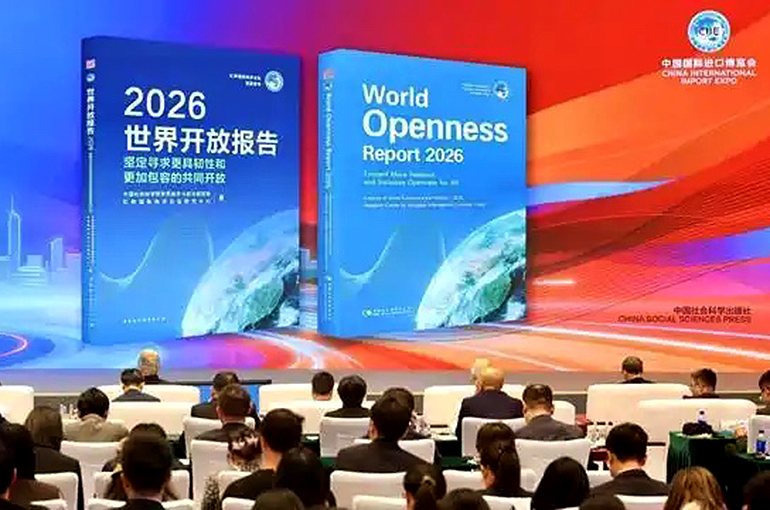
 Global Openness Sees Steepest Drop in Nine Years, China Climbs to 37th, Report Says
(Yicai) Nov. 6 -- Global openness to trade, investment and cultural exchanges fell at its fastest pace in nine years in 2025, while China rose one place in the rankings, according to a report by two Chinese state-affiliated research institutions.
The World Openness Index dropped 1 percent from a year earlier to 0.7453, its steepest decline since 2016, according to the World Openness Report 2026 released yesterday. China's reading fell 1.1 percent to 0.7551, but the country climbed to 37th place among 129 economies from 38th in 2024.
First published in 2021, the report is compiled by the Institute of World Economics and Politics (IWEP) at the Chinese Academy of Social Sciences and the Research Center for the Hongqiao International Economic Forum. Its index tracks economic, social and cultural openness across almost 130 economies using 29 indicators. The latest edition was unveiled at the Ninth Hongqiao International Economic Forum in Shanghai.
For the first time, the index incorporated findings from a public opinion survey of more than 7,550 respondents in 40 economies outside China.
China's overall level of openness remains at a historic high, the report noted. Its index has jumped by more than 28 percent from 0.5891 in 1990, one of the fastest increases worldwide, lifting its ranking by 50 places. Its openness performance sub-index has soared by more than 40 percent over the same period, the largest gain among all economies.
Global trade has remained resilient despite mounting tensions and policy uncertainty. The value of goods and services traded worldwide exceeded USD35 trillion in 2025, a record high, according to data from the United Nations Conference on Trade and Development.
Global Support for Openness Remains Strong
The latest report draws on global expertise, addresses emerging issues, broadens research approaches and highlights opportunities arising from openness, said Liao Fan, director of the IWEP.
Despite obstacles facing global trade, support for openness remains strong, Liao said. “The global economy still shows strong resilience against the backdrop of tense trade relations and rising policy uncertainty,” he added.
For the Global South, openness is not just about expanding exports but also about participating in global value chains, accessing capital, technology and management expertise, and upgrading industries, Liao said. This is the essence of “more inclusive, shared openness,” he added.
Looking ahead, the IWEP chief said the push for greater openness would continue despite the challenges.
“Future openness will no longer focus solely on expanding market access, but will place greater emphasis on balancing openness and security, efficiency and fairness, and development and resilience,” he concluded.
Editor: Emmi Laine





