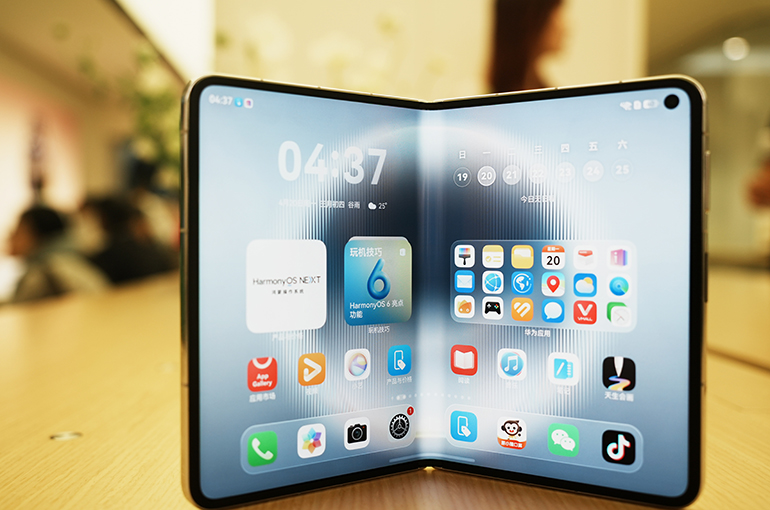
 Huawei Unveils First Phone With HarmonyOS-Based Companion AI Xiaoyi
(Yicai) April 21 -- Huawei Technologies has launched its new Pura X Max smartphone model, equipped with the industry’s first companion artificial intelligence, Xiaoyi Companion AI, which is based on the Chinese tech giant’s self-developed HarmonyOS 6.1.
Unlike the passive interaction mode of traditional AI, Xiaoyi integrates AI capabilities into users’ high-frequency scenarios, such as reading, scheduling, and travel arrangements, aiming to transform mobile phones from mere tools into more proactive assistants, according to Huawei.
Xiaoyi enables precise perception of active scenarios, delivering multimodal real-time question-and-answer and intelligent assistance to users in high-frequency application scenarios, including to-do management, smart travel, and reading support, Richard Yu, chairman and chief executive officer of Huawei’s Consumer Business Group, said at the Pura X Max launch event yesterday.
For example, when users open a long text file, Xiaoyi instantly generates a summary to help them assess its content. It can also activate services such as table recognition, image translation, and document scanning.
Xiaoyi is also capable of cross-app identification and to-do item organization to automatically generate personal and work schedules. In travel scenarios, after recognizing users’ trip information, Xiaoyi links with map and ride-hailing apps on the device to plan routes and bookings and send reminders at key time points.
By embedding AI capabilities into the foundation of HarmonyOS, the operating system has unlocked further potential, as it can now learn based on user behavior and preferences. The AI agent built on such a basis can provide users with more personalized and forward-looking services, becoming a key component in enhancing the AI experience.
“Against the backdrop of increasingly prevalent cross-app execution, the influence of operating systems on AI capabilities is growing significantly,” a developer told Yicai at the launch event. Compared with function optimization within a single application, the system-level scheduling performed by Xiaoyi is closer to users’ actual processes and more likely to create a personalized experience, he added.
As model capabilities become increasingly standardized, the integration depth between AI agents and operating systems, as well as ecological collaboration capabilities, are turning into key factors that distinguish products from competitors, the developer noted.
Editors: Tang Shihua, Futura Costaglione