


 Huawei’s Patent Licensing Deals Top USD6.9 Billion After Earning USD800 Million in 2025
(Yicai) Nov. 26 -- Huawei Technologies, the Chinese tech champion with one of the largest patent portfolios globally, earned around USD800 million from patent licensing deals last year, bringing the cumulative value of its outbound patent licensing to more than USD6.9 billion, according to Vice President Alan Fan.
Huawei filed its first patent application in China in 1995, and received its first patent licensing revenue in 2011, Alan Fan, who is also chief IP officer of the Shenzhen-based firm, said at the seventh Innovation and IP Forum on Nov. 24. Annual licensing income exceeded outbound licensing payments for the first time in 2021, he pointed out.
“At Huawei, a patent represents more than a legal right,” Fan pointed out. “It represents an innovative achievement and a source of pride for the people behind it.”
As of the end of last year, Huawei had signed more than 260 patent licensing agreements with major information and communications technology companies in the United States, Europe, Japan, and South Korea. Fifty-five Fortune Global 500 companies have paid licensing fees to Huawei.
Huawei added 20 new licensees last year, covering seven sectors: network and communications equipment; consumer electronics and computing; the Internet of Things; automotive; streaming; semiconductors; and medical devices. Among the businesses that have obtained licenses directly from Huawei this year and last are Mercedes-Benz and Volkswagen Group companies in Europe, Qualcomm, HP, and Harman in the US, and Seiko Solutions, Mitsubishi Fuso, and Fujitec in Japan.
Huawei has two main licensing approaches: direct bilateral agreements with individual companies and participation in collective patent licensing arrangements. The latter approach allows companies to secure licenses from multiple rights holders through a single agreement. Huawei is the largest contributor to multiple patent pools, including Avanci Video, Sisvel, and Via EVS.
Huawei has also disclosed its licensing programs and royalty rates for standard-essential patents, including those for fifth-generation smartphones, IoT products, and Wi-Fi devices. On June 18, it announced a royalty rate of 50 US cents per unit for consumer-grade Wi-Fi 7 products, unchanged from the corresponding rate for Wi-Fi 6, a decision it said is intended to give the industry predictable licensing costs.
"Global IP institutions set the shared, balanced rules of the road to reward inventors for their investment,” Francis Gurry, former director general of the World IP Organization, told the same forum. “Innovative enterprises, for their part, turn those rules into real-world practice through voluntary licensing, open collaboration, and responsible technology diffusion."
A neutral, fair, and predictable standard essential patent licensing environment benefits both patent holders and users, said Aleš Zalar, director of the Patent Mediation and Arbitration Center of the Unified Patent Court. It protects the value of innovation while reducing barriers to developing and commercializing new technologies, he added.
Patent Portfolio and R&D Investment
More than 3.2 billion 5G devices used Huawei's patented cellular technology as of the end of last year, while over 1.6 billion consumer electronic devices and more than 4.1 billion multimedia devices, excluding mobile phones, used its patented Wi-Fi and video codec tech.
Huawei held more than 165,000 active granted patents worldwide, with those for inventions accounting for over 90 percent, according to Emil Zhang, head of its IP strategic planning and key projects department. Wireless communications accounted for 41 percent of the portfolio, terminal hardware for 16 percent, and artificial intelligence and computing for 13 percent, he said, adding that the company has more than 8,000 AI-related patents.
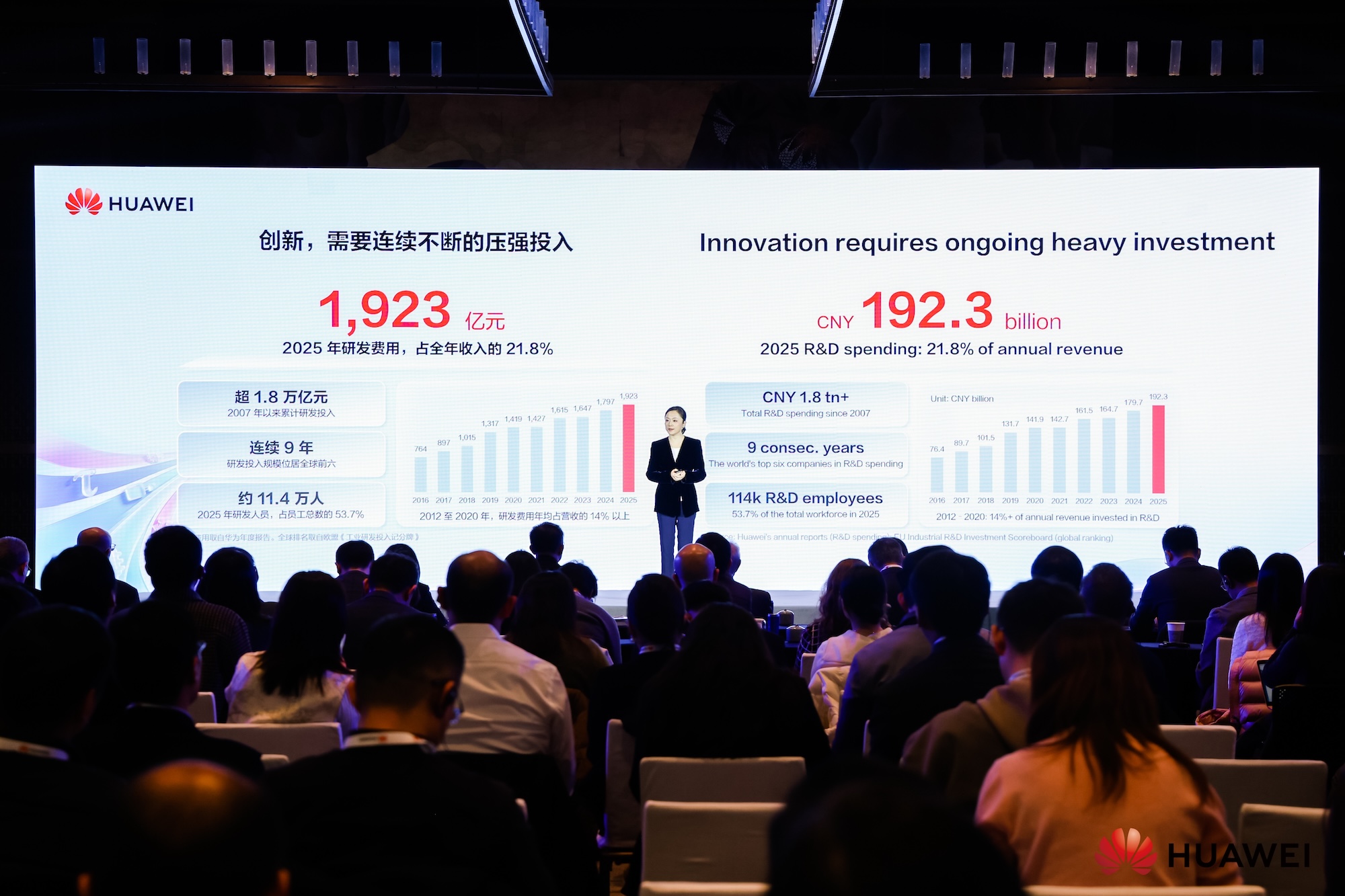
Huawei spent CNY192.3 billion (USD28.9 billion) in research and development last year, the equivalent of 22 percent of its annual revenue. R&D outlays have remained above 20 percent for the past five years, and exceeded CNY1.8 trillion (USD270.1 billion) between 2007 and the end of last year.
Huawei's telecommunications research dates back to the 1990s. When China's telephone adoption rate was only about 1 percent in 1992, the company, with just over 100 employees at the time, devoted half of its workforce to developing the C&C08 digital switching system, before gradually expanding from rural to urban markets following its launch.
In 2004, Huawei expanded into the European market with its distributed base stations, an architecture that has since become mainstream in the industry. It began researching 5G technologies in 2009 and subsequently became a major contributor to 5G standards and one of the world's largest holders of such patents.
In 2011, Huawei further integrated its global R&D resources by establishing the 2012 Laboratories to conduct basic research into frontier technologies, including ICT network architectures, standards, and materials, with a five- to 10-year horizon. The labs focus on building medium- and long-term technological capabilities, with some research areas not subject to short-term commercial return requirements, according to the firm.
Eric Xu, Huawei's deputy chairman and rotating chairman, once likened the company's efforts to strengthen basic research to finding its own "Noah's Ark" amid an impending flood of digital information. Its advances in 5G, autonomous driving, Ascend AI computing, and other areas have drawn on research conducted at the 2012 Laboratories.
About one-third of Huawei's annual R&D spending goes on basic research. The company also operates a non-profit platform for academic exchange, establishing 86 foundational technology labs and more than 180 joint innovation labs as well as drawing on external expertie by publishing technical challenges and supporting academic research.
Tech Advances
At the forum, Huawei presented research advances in LogicFolding, UnifiedBus computing interconnect, near-packaged optics, and other technologies.
The Kirin 9050 Pro project was codenamed "Yellow Crane Tower," with the team drawing inspiration from the traditional Chinese building's multi-level structure, said Liu Yu, a Kirin chipset architect at Huawei. LogicFolding uses a layered circuit design to increase transistor density, Liu pointed out.
The transition from two-dimensional to 3D chip design has also introduced new challenges in design verification, with He Qing, chairman of Phlexing, noting that the chip-design software developer and Huawei have co-developed an electronic design automation tool to verify such multilayer designs.
In data center interconnect, Huawei said its UnifiedBus protocol has entered commercial use, making the protocol and compatibility testing specifications available to partners and open-sourcing supporting software.
Huawei's Hi-One optical engine, based on near-packaged optics technology, has been commercially deployed, the company said, noting that it is used in its previously unveiled Atlas 960E SuperPoD, an AI computing system.
"We look forward to working with partners across every sector to advance technology and industry, and to bring the benefits of innovation to everyone," Fan stressed.
Editor: Martin Kadiev