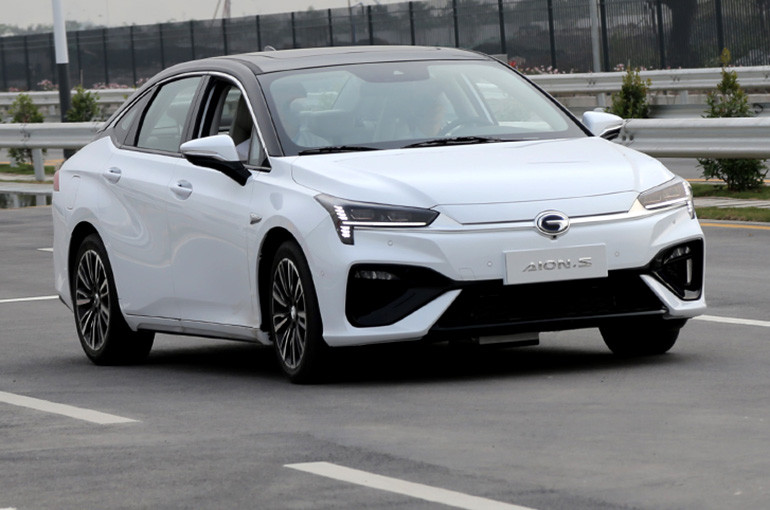
 Hundreds of Owners of 'Ride-Hailing King' Aion S Complain of Battery Failures
(Yicai) July 28 -- More than 100 owners of Aion S autos, the pure-electric compact sedan known as China's "Ride-Hailing King" produced by Guangzhou Automobile Group's new energy vehicle arm GAC Aion, have complained of battery failures after their cars exceed a certain mileage.
Each faulty Aion S unit is used for ride-hailing services with a mileage of between 150,000 and 250,000 kilometers and is equipped with a 177 ampere-hour lithium iron phosphate battery developed by China Aviation Lithium Battery, according to complaints on multiple platforms. The issues mainly include power outages during driving, sudden drops in endurance, or insulation failures, with visible signs of battery swelling or leakage.
Launched in July 2020, the ride-hailing edition of Aion S is one of the most widely used vehicles for ride-hailing services in China because it is more spacious than models of the same class, while its manufacturer offers a long-term warranty. In 2023, over 70 percent of Aion S units produced by GAC Aion entered the ride-hailing market.
Because of the many complaints, GAC Aion has extended the warranty period of the Aion S to eight years or a mileage of 300,000 km from eight years or a mileage of 150,000 km, while also providing free maintenance and battery replacement services. In addition, CALB announced it has launched joint maintenance services with the carmaker's 4S (sales, spare parts, services, and survey) stores.
GAC Aion and CALB have not yet said if the faulty vehicles or batteries will be recalled.
GAC Aion's remedial measures mainly include upgrading quality assurance, free testing, or replacing battery packs, due to the cause of the issue still being under investigation, industry insiders told Yicai. A recall must be filed with the State Administration for Market Regulation in accordance with the law and must be made public, they noted.
"Battery cost accounts for nearly 60 percent of a vehicle, so replacing the pack of a model sold for CNY120,000 (USD17,730) will likely cost CNY70,000 to CNY80,000 (USD10,345 to USD11,825)," a person from GAC's research institute said to Yicai. It will take at least CNY3 billion (USD443.3 million) to replace the batteries of 100,000 EVs, a huge expense for the carmaker and the battery manufacturer, the person stressed.
The issue could be due to a problem with the battery cells, given the appearance of the batteries after malfunctions, a design flaw with the cells, which are widely used without sufficient verification, or defects in the batteries' production process, a relevant expert told Yicai.
Compared to batteries used in personal EVs that only require a driving mileage of 200,000 km to 300,000 km, those for ride-hailing cars must be designed to have a mileage of 500,000 km to 1 million km, the chairman of a member unit of the Guangdong Battery Industry Association said to Yicai. More care must be given to batteries' service life during the design process than blindly pursuing long mileage, he added.
In the early stages of development, the EV industry did not differentiate between vehicles for commercial and personal use and so no targeted battery research and development was conducted, multiple battery makers told Yicai, adding that no performance testing was performed for when the mileage exceeds 200,000 km.
The development standards and quality assurance requirements for batteries for commercial vehicles were no different from those for personal cars in the early stage, an engineer from a leading battery manufacturer said to Yicai. Whether to conduct a longer cycle verification of the performance of commercial auto batteries was "entirely up to the car or battery manufacturer," the person said, adding that this did not begin to change until after 2023.
The Aion S series is the biggest contributor to GAC Aion gaining the largest share in the Chinese ride-hailing EV market, with the carmaker producing 220,000 of the 740,000 EVs used for ride-hailing in China in 2023, according to data from the China Passenger Car Association. BYD ranked second with 190,000 vehicles.
Editors: Tang Shihua, Martin Kadiev