



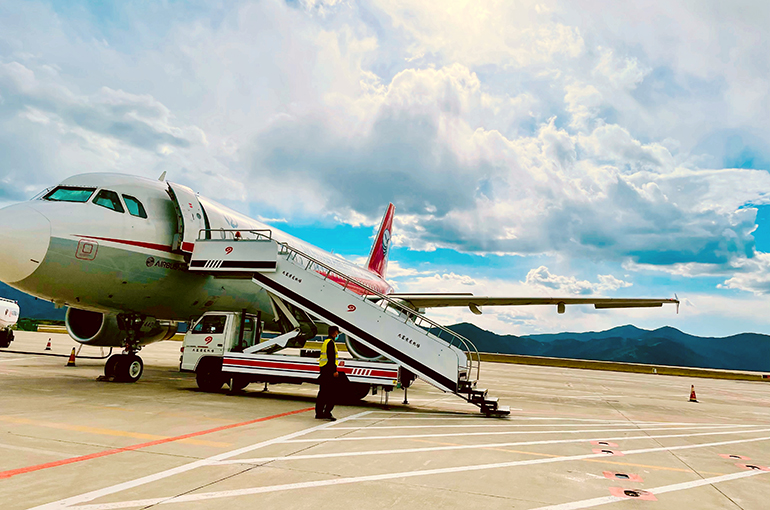
 Jiuzhai Huanglong Airport Suspends Flights as Small Chinese Airports Struggle to Profit
(Yicai) Oct. 27 -- Flights scheduled to and from Jiuzhai Huanglong Airport, which mainly serves famous tourist attractions Jiuzhaigou and Huanglong, have been suspended, despite the operator denying a shutdown. This is mainly due to improvements in China’s high-speed rail network.
The four routes operated by Air China and Sichuan Airlines between Chengdu and Jiuzhai, as well as those operated by West Air between Jiuzhai and Wuhan and between Jiuzhai and Zhengzhou, were canceled in September, and no new routes were added, according to data from the Southwest Regional Administration of the Civil Aviation Administration of China.
No flights are scheduled at Jiuzhai Huanglong Airport after Oct. 25, when the five-month winter and spring flight season began, according to the CAAC.
Jiuzhai Huanglong Airport began operations in 2003, with a passenger throughput of 1.75 million in 2012. However, it began to decline in 2017, reaching 95,000 in 2024, 32,000 in 2025, and only 16,000 in the first nine months of this year.
Given the operational and financial struggles, Jiuzhai Huanglong Airport has been mostly relying on subsidies. The airport received CNY103.7 million (USD15.6 million) in subsidies last year, ranking first among China’s 191 small- and medium-sized airports, securing more than double the amount of second-ranked Ganzi Kangding Airport, according to CAAC data.
Another example is Chongqing Xiannvshan Airport in the Wulong Xiannvshan National Forest Park, which was completed and put into operation in 2020, becoming China’s first airport built in a scenic area. Since its opening, its passenger throughput has never exceeded 100,000, with only 10,488 passengers last year.
There is no flight information and no official statistics on passenger throughput for Chongqing Xiannvshan Airport this year. A staffer told Yicai that the airport has not suspended flights but has no flights in operation. It is still not clear when flights will resume.
Airports such as Jiuzhai Huanglong Airport and Chongqing Xiannvshan Airport mainly serve travelers, so the passenger flow greatly varies based on peak and off-peak tourist seasons, Li Yanwei, deputy director of the China Civil Aviation High Quality Development Research Center at Civil Aviation University of China, told Yicai.
Local businesses and family visits can't make up for the reduced tourist flow, making it hard to maintain stable flight demand year-round, Li noted, adding that improvements in high-speed rail and road transport have further influenced tourists’ travel choices. Therefore, the increase in the number of visitors to scenic areas and the decrease in airport passenger flow may occur simultaneously, he said.
Not only tourist airports, but small- and medium-sized airports in general have been struggling lately. Of China’s 270 licensed airports, 191 of them were small- and medium-sized airports with annual passenger throughput of less than two million at the end of last year. This year, the CAAC will provide a total of CNY2.6 billion (USD386.9 million) in subsidies to these 191 airports, which is double the amount allocated 10 years ago.
The 122 Chinese airports with an annual passenger throughput of less than 500,000 rely entirely on subsidies, reporting annual losses of CNY20 million to CNY80 million (USD3 million to USD12 million) each, according to Li. Once subsidies end or civil aviation development fund policies change, many airports and airlines that cannot generate revenue will face a survival crisis.
Editor: Futura Costaglione





