



 Key DeepSeek Engineer Sees AI Surpassing His Coding Skills Within a Year
(Yicai) Sept. 16 -- Shengyu Liu, a DeepSeek engineer who developed a core component of its newly released V4.1, sees AI catching up with his own coding abilities in a matter of months, highlighting how quickly the technology is reshaping the roles of even top Chinese programmers.
Liu, a machine learning systems engineer at AI unicorn DeepSeek, said in an article posted on his personal WeChat account recently that he probably will not become unemployed because of AI, but he may be forced to change his job.
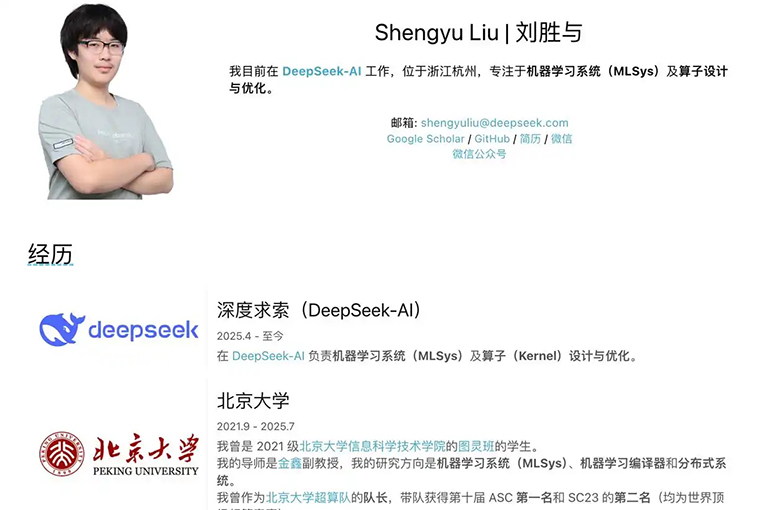
Liu was a member of Peking University’s 2021 Turing Class, an elite undergraduate cohort in computer science, and previously led the university’s supercomputing team, which secured top-two finishes in international university supercomputing competitions.
The star engineer recently delivered the main attention operator, a core component that directly determines inference efficiency, for DeepSeek's newly released V4.1. But within six months to a year, AI-written operators will probably match or even surpass his own, he admitted.
Liu expects he may eventually have to give up the operator design and manual optimization he loves to become a “mech pilot” of AI agents, directing models, breaking down tasks, evaluating results, and taking responsibility for the final system.
From Writing Code to Directing AI
Liu also described what he called a “technological paradox.” “The better operators I write, the faster our new model will be in training and inference, and the faster the model will evolve, and the earlier I will be replaced,” he said.
“AI can think of 300 tokens in one second, write a command in half a second, and finish writing code in 20 seconds, which I can’t," Liu said.
Unlike humans, AI can keep scaling its reasoning, tool use, and ability to handle tasks in parallel, he added. It has evolved from an assistant that merely searches documentation and reads code into one that can independently analyze and optimize operators using Compute Unified Device Architecture, Nvidia’s programming platform for graphics processing units.
Liu’s concerns reflect a broader shift as AI programming tools become embedded in developers’ daily work. According to the 2026 Developer Survey report released by code quality platform Sonar, 72 percent of developers who have used AI programming tools use them every day, while 42 percent of code submitted by respondents is AI-generated or heavily AI-assisted, up from just 6 percent in 2023.
Demand Shifts to Higher-Level Skills
AI is also changing the skills employers seek in programmers, according to the China Software Industry Association.
At a press conference held by China’s industry and information technology ministry last week, Lv Weifeng, secretary-general of the CSIA, responded to discussions about whether AI will replace programmers.
Pure coding skills will become less important, while understanding requirements, designing architectures, integrating systems, and ensuring quality and safety will become more important, he said.
Lv added that collaborating with AI is becoming a core skill for programmers, requiring them to clearly communicate tasks, evaluate AI-generated output, and coordinate multiple AI agents.
Editor: Emmi Laine





