



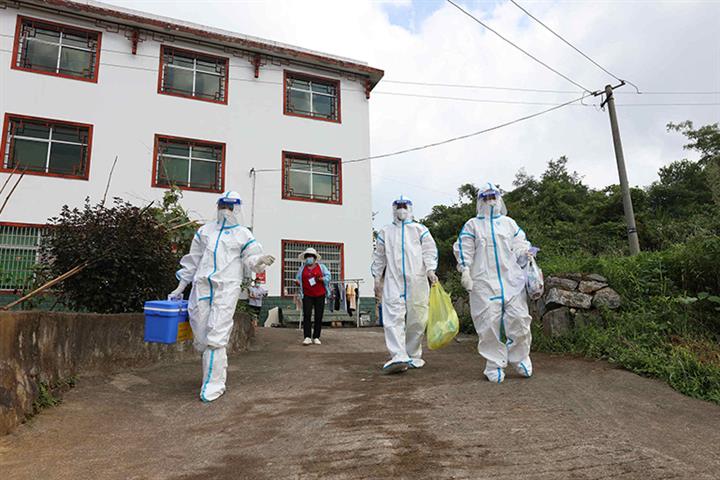
 Local Clinics Keep Covid-19 at Bay in China’s Rural Areas
(Yicai Global) Dec. 16 -- With the rapid spread of Covid-19, China’s countryside is facing a potential shortage of medicines, though hospitals and clinics in counties, villages and towns have been able to manage in dealing with the virus so far.
A Dr. Li working at a rural clinic in the Pearl River Delta told Yicai Global that his clinic only has 50 doctors and nurses, with only one consulting room available for outpatients with a fever, but this has not yet been problematic. If the daily rate rises to about 70 patients, the clinic will need to repurpose the room being used for quarantine and medical observation into a second consulting room, Li said.
More than 10 village clinics in the town where Li lives have started receiving patients with a fever. They offer phone numbers for health consultation services and the villagers’ committee has also opened up a hotline so that villagers can ask committee staff to bring them medicines.
Local healthcare clinics have been providing doctors in the village with regular training sessions, so they are basically familiar with the diagnosis standards and treatment plans for Covid-19, Li said, adding that the symptoms are similar to those of a normal cold or flu and the village doctors are universally experienced in dealing with these diseases. The doctors have also received training in traditional Chinese medicine to help with treatment.
The vaccination rate among elderly Chinese people is relatively high. As of Dec. 13, the number of people aged 60 and above who are fully vaccinated for Covid-19 is 228.6 million, or 86.6 percent. Among those aged 80 and above, 66.4 percent have been inoculated, according to public data.
But many village clinics and county-level hospitals in eastern Shandong and Anhui provinces told Yicai Global that there has been hoarding of medicine since China’s Covid-19 controls were relaxed, so the reserves of drugs to treat fever and cold have sometimes been insufficient.
Ensuring enough medicines for clinics in villages and townships would reduce the number of critically ill Covid-19 cases, as well as allowing home-based treatment for patients with mild symptoms. It would also reduce the risk of putting overwhelming pressure on hospitals, said a person in charge of a county-level hospital in Shandong.
Hospitals in counties, towns and villages as well as rural clinics have become the frontline in Covid-19 treatment. Their medical resources, capability in monitoring the health of high-risk groups, and the mechanism for transporting patients for treatment are critical in controlling the mortality rate among China’s huge rural population.
Last year, China had a rural population of 498.4 million, accounting for 35.3 percent of the country’s total. Medical services for these rural residents are provided by a three-level healthcare system consisting of county-level hospitals, and clinics in towns and villages.
Editors: Zhang Yushuo, Tom Litting





