



 Low-Altitude Tech and Engineering Tops List of China’s Proposed New University Majors
(Yicai) Aug. 25 -- China’s universities are quickly adjusting their undergraduate offerings to align with national strategies, emerging technologies, and labor market needs, with majors in the technology and engineering of the low-altitude economy the fastest-growing area.
As of Aug. 20, 111 universities had proposed more than 630 new undergraduate programs for the new academic year, according to data compiled by My China Occupational Skills. The 10 most frequently proposed additions are low-altitude technology and engineering, digital cultural tourism, embodied artificial intelligence, urban renewal, digital economy, low-altitude economy and management, AI education, digital trade, robotics engineering, and business AI.
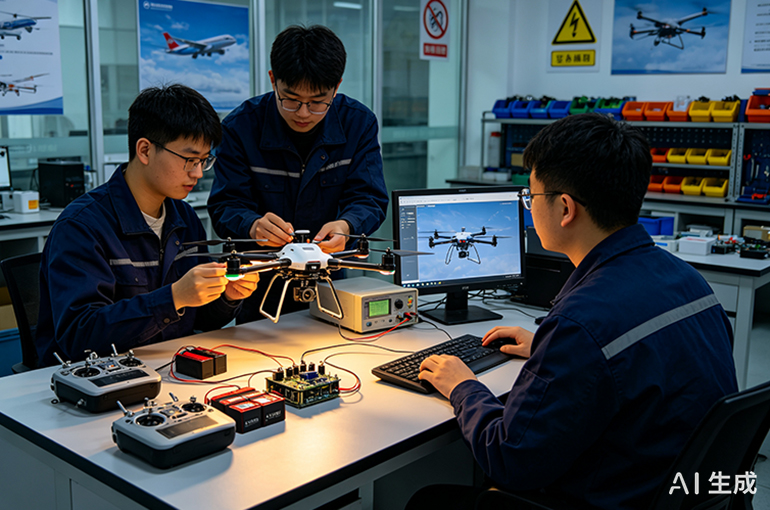
Low-altitude technology and engineering was the first urgently needed major to be fast-tracked, and was added to the national undergraduate majors catalog last year. Two other related majors -- low-altitude economy and management and low-altitude safety management -- were included in the catalog this year.
Chinese universities are swiftly crafting their academic offerings around the industry chain of the low-altitude economy, covering from technology and engineering to operations, management, safety, and security.
In fact, a number of colleges dedicated to this field have been set up, starting with the first opened by Shenyang Aerospace University in April last year. Anhui University announced the creation of a low-altitude economy and engineering college, a robotics college, and a brain-computer interface research institute this April.
Thirty-six percent of the more than 630 proposed new majors are related to intelligence, smart technologies, data, and digitalization, covering multiple fields, such as industry, economics and management, agriculture, and education, according to MyCOS’ data.
This shows that majors are no longer solely focused on digital technology but also on further exploring the deep integration of digital technologies in specific industries and sectors. Communication University of China, for instance, recently set out plans to apply to the Ministry of Education to add four new undergraduate majors: game science and technology, e-sports, branding, and business AI.
AI has changed the ecology of many industries and sectors and spread to various academic disciplines, Ding Changfa, associate professor at the economics department of Xiamen University, told Yicai. AI can be used in areas such as statistics, investment, trade, finance, and business, he noted, adding that combining AI with economics and management disciplines will nurture more interdisciplinary talent.
Among the most proposed additions programs within electronic information, such as AI, integrated circuit design, and integrated systems, and computer science, including cyberspace security and intelligent science and technology. Universities are increasingly centering their engineering majors around strategically important technologies and industrial sectors like chips, AI, robotics, biomanufacturing, and new energy.
Editor: Futura Costaglione





