



 Micro LED Finds New Life as Optical Interconnects for AI Data Centers Boost Demand
(Yicai) Sept. 17 -- Optical interconnects have become increasingly popular as a way of sending signals within integrated circuits through light in artificial intelligence infrastructure. This has given micro light-emitting diodes a new growth prospect.
Shipments of micro LED co-packed optics optical transceiver modules will likely experience a significant increase from the second half of 2028, Wu Yingjie, analyst at market research firm TrendForce, told Yicai. Production of micro LED CPO optical transceiver modules is expected to reach 5.3 million units by 2030, with a related market value of USD848 million.
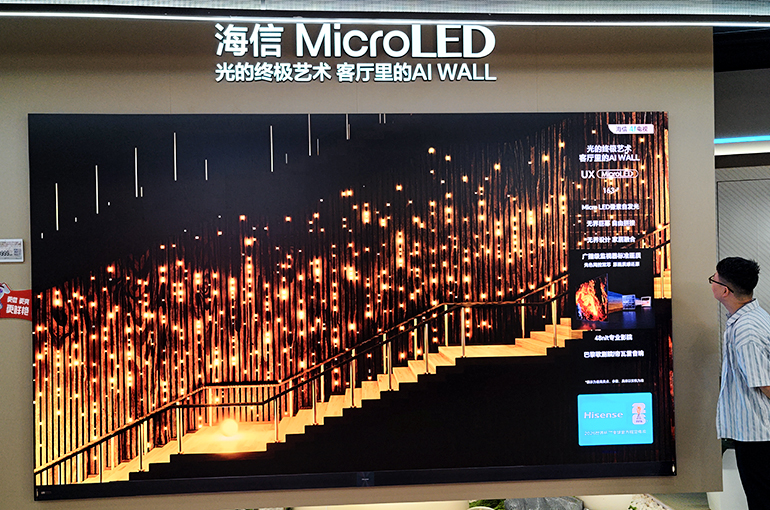
Once regarded as the next-generation display technology, micro LED failed to gain an upper hand against other display technologies such as mini LED and organic LED. In fact, micro LED has only achieved small-volume deployment in high-end commercial large screens and augmented reality display applications.
Nevertheless, surging demand for optical interconnects brought by the AI computing infrastructure boom has opened a new window of opportunity for the technology.
Micro LED is emerging as a promising light source for next-generation, short-reach optical interconnects, thanks to its low power consumption, high data transmission density, and low bit error rate, according to a report by TrendForce. Micro LED is poised to become one of the three core solutions for short-reach, high-speed transmission inside AI server racks in vertically scaled data center networks.
Leading Chinese panel maker BOE Technology Group and LED chip giants, such as Sanan Optoelectronics, MTC Co, and Changelight, have recently unveiled their research and development progress in the micro LED field.
For instance, Sanan said in its semiannual financial report that it has begun validation work with multiple domestic and overseas clients to advance micro LED chip optical interconnect applications. Its micro LED CPO optical interconnect solution for data centers consumes only 5 percent of the power used by traditional copper cables.
Firms along the micro LED optical interconnect supply chain are actively boosting bandwidth, Wu said. Supply chain alliances spanning micro LED, photodiodes, optical fibers, optical components, and optical communication modules are gradually taking shape, she added.
Editors: Tang Shihua, Futura Costaglione





