



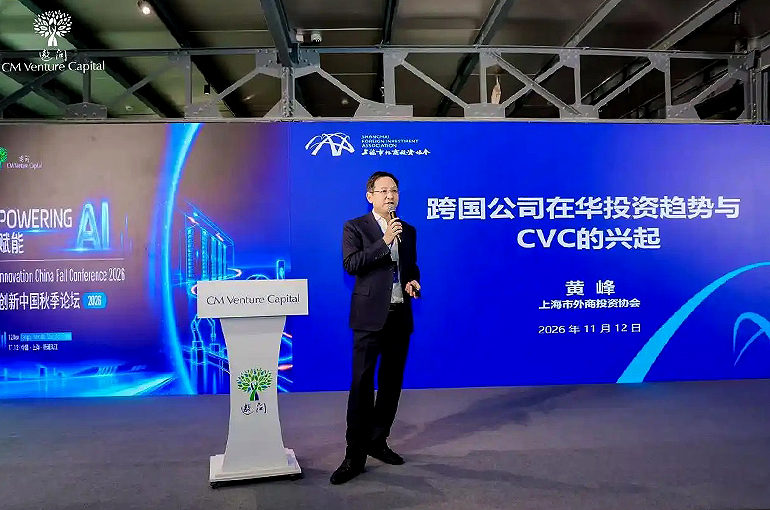
 VC Firms, Local Government Funds Ally to Back Chinese Tech Startups
(Yicai) Nov. 18 -- Foreign investment in China’s booming technology sector is evolving from a model based mainly on offshore US dollar funds toward closer partnerships between multinational venture capital firms and Chinese local government-backed funds.
Domestic and overseas VC firms are taking a growing interest in China’s tech sector, according to Zhou Min, founder of CM Venture Capital. “China’s innovation index has risen substantially over the past decade,” she told Yicai. “Ten years ago, the US led the pack, with Europe and Japan forming the second tier. Now the US is still first, but China has moved into second place.”
CM Venture Capital has struck limited partner deals with the VC arms of several multinational companies to launch offshore US dollar funds, with matching Qualified Foreign Limited Partner onshore vehicles. The funds focus on Chinese early-stage tech startups in areas such as energy, artificial intelligence, and robotics.
The investors working with Shanghai-based CM Venture Capital include GE, Samsung, BASF, Saudi Basic Industries, British American Tobacco, Henkel, Mann+Hummel, and Yokogawa Electric.
Venture capital firms boast international credentials and years of accumulated investment expertise, but while they used to raise capital mainly from overseas investors, they are now setting up Chinese yuan-denominated funds alongside local state capital.
On the day Zhou spoke with Yicai, CM Venture Capital signed strategic framework cooperation agreements with Hohhot Economic and Technological Development Zone in northern China and Liuyang Economic Development Zone in Hunan province in the south. They plan to launch new yuan growth funds and build long-term partnerships to bring hard-tech projects into industrial production and develop the ecosystems around them.
“State capital has become a major force among LPs backing China’s hard-tech venture capital, and we’re stepping up our outreach and deployment,” Zhou said. For hard-tech developers moving from laboratory research to mass production, industrial venture capital firms and local state capital are indispensable, she added. The former offers technical expertise, customer access, and global networks, while the latter provides essential resources, application uses, and “patient” capital.
Zhou noted that Hohhot benefits from relatively low electricity prices, which can draw new-material and semiconductor firms that require a lot of green power and copper, and Liuyang has cultivated a cluster of electronic information enterprises, including those specializing in silicon carbide power devices.
Furthermore, partnering with local government-affiliated entities allows fund managers to tap into new capital sources within a state-backed LP structure, Zhou said. This arrangement serves as a bridge for VC firms to integrate into local industries, while also facilitating the inclusion of the venture capital arms of multinational corporations as collaborative partners in these yuan funds, she explained.
The head of the Hohhot Economic and Technological Development Zone’s administrative committee told Yicai that it chose to partner with CM Venture Capital mainly because of its international reach and professional expertise, and the goal is to develop industries aligned with local resource endowments and development plans.
Editors: Tang Shihua, Tom Litting





