



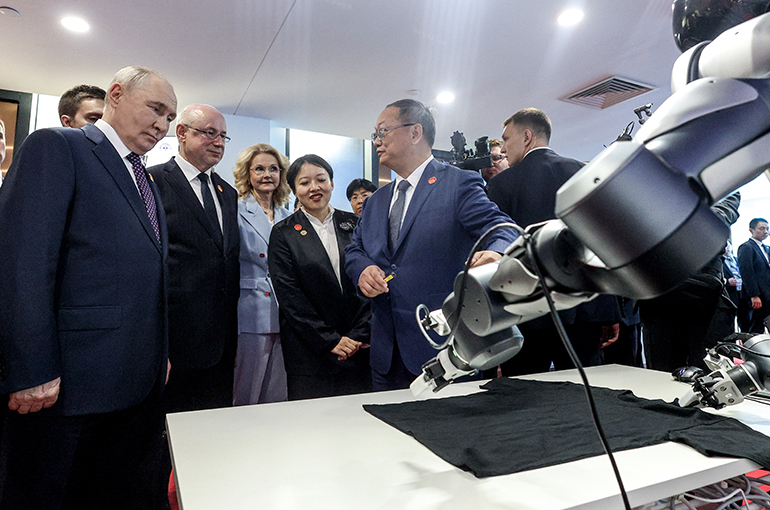
 Russian President Putin Visits New Research-Oriented Shenzhen MSU-BIT University Before APEC Economic Leaders' Meeting
(Yicai) Nov. 19 -- Russian President Vladimir Putin made Shenzhen MSU-BIT University, a rising research-oriented college, his first stop during his visit to China for the 33rd Asia-Pacific Economic Cooperation Economic Leaders' Meeting held in the technology hub.
Shenzhen MSU-BIT University was established in 2016 by the local government, Beijing Institute of Technology, and Lomonosov Moscow State University. It is the largest college in China offering courses in Russian, with over 5,000 students.
Putin arrived in China early yesterday for the two-day APEC Economic Leaders' Meeting, an economic forum established in 1989 to leverage the region's growing interdependence. Chinese President Xi Jinping, US President Donald Trump, Australian Prime Minister Anthony Albanese, and their APAC counterparts also attended the event, which ends today.
Shenzhen MSU-BIT University offers 22 doctoral, 20 master's, and 18 undergraduate degrees in mathematics, physics, chemistry, biology, materials science, geography, electronic information and computer science, instrument science, economics, management, language and literature, and art, according to its website.
Several other research-oriented universities have emerged in Shenzhen in recent years, including Southern University of Science and Technology, Shenzhen University of Advanced Technology, Harbin Institute of Technology, Shenzhen, the Chinese University of Hong Kong, Shenzhen, and Shenzhen Technology University, while Shenzhen Ocean University and Shenzhen Institute of Design and Innovation are being built.
These colleges feature a "high starting point and are small yet refined, innovative, and globally oriented." Although they were established less than 15 years ago and are not well known, they have strong development momentum and are increasingly sought by candidates. Admission scores at many have exceeded those of some 985 universities (a group of 39 elite public universities in China selected for Project 985, which aims to build world-class research institutions).
In this year's National College Entrance Examination, the admission scores of Harbin Institute of Technology, Shenzhen, Southern University of Science and Technology, Tianjin University-Hong Kong Polytechnic University-Shenzhen Institute of Future Technology, and Shenzhen University of Advanced Technology ranked top in Guangdong province. Even more surprising, the minimum score at vocational undergraduate colleges Shenzhen Polytechnic University and Shenzhen University of Information Technology exceeded those of traditional universities such as South China Agricultural University and Guangzhou Medical University.
Behind the rising admission scores is a leap in hard power. In the 2026 Times Higher Education World University Rankings, Southern University of Science and Technology ranked 160th globally and 12th in the Chinese mainland, while four colleges in Shenzhen made the latest ShanghaiRanking's Academic Ranking of World Universities, with Southern University of Science and Technology placing between 101 and 150, Shenzhen University between 151 and 200, and Shenzhen University of Advanced Technology, which has been in operation for only two years, between 801 and 900. In the QS Asia University Rankings 2027, released on Nov. 3, Southern University of Science and Technology ranks 93rd and Shenzhen University 155th, with Shenzhen MSU-BIT University also making the list.
The rapid growth of these "small yet refined" universities is thanks to the extraordinary resource support from Shenzhen. The city has scarce land, so it prioritizes providing the best land for building colleges, vigorously brings in full-time academicians and provides research startups with CNY2 million to CNY5 million (USD300,100 to USD749,875) to attract science and engineering talent, guides new universities to co-establish secondary colleges with local technology companies such as Huawei Technologies, co-cultivates talent with national scientific research institutions, and integrates planning and construction with major scientific and technological infrastructure.
Editor: Martin Kadiev





