



 Shanghai's Chinese, South Korean Neighbors Link Arms to Combat Virus
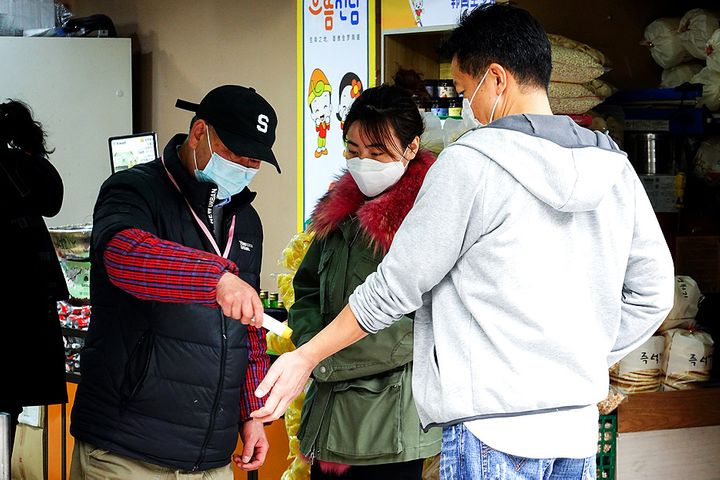
(Yicai Global) March 4 -- Chinese and South Korean neighbors in a residential community in central Shanghai are working hand-in-hand to support each other as epidemic control measures intensify.
Security guards and volunteers in protective gear can be seen checking people entering and exiting so-called Korea Town, the Jinxiu Jiangnan neighborhood in the bustling Hongqiao area of the city's western Minhang district. Almost 40 percent of the 3,200 households in Jinxiu Jiangnan are from South Korea, neighborhood community leader Chen Qinghua told Yicai Global.
Shanghai is home to more than 20,000 South Korean nationals, the third-largest group of foreign permanent residents in the city behind Japanese and Americans. Many of these residents are returning to the municipality to start work after the prolonged Chinese New Year holiday.
With the second-highest number of reported cases of the novel coronavirus outside China, South Korea is regarded as high-risk and anyone travelling from the country is required to self-quarantine for 14 days on arrival in Shanghai, according to new rules issued by the municipal government yesterday.
Many South Koreans have run into difficulties on returning to Shanghai. Language is a big barrier, as most South Koreans do not speak Chinese and vice-versa. They don't know how to report to the neighborhood committees, how to buy daily necessities during quarantine and where to record their temperature every day, Chen said.
Community Effort
Chinese and South Korean neighbors are teaming up to help each other understand and comply with the escalating epidemic control measures, he said. Grassroots community efforts are an important part of the fight to halt the spread of the disease.
Neighborhood volunteers fluent in both Chinese and Korean have set up WeChat Groups to keep South Koreans living in Shanghai up to date about the changing epidemic situation and support them in navigating any difficulties. It is important to give South Korean residents personalized information depending on the date of their arrival in China and their place of residence, Chen added.
Quan Yinghua is one such volunteer. As a student in South Korea during the outbreak of Middle East Respiratory Syndrome, or MERS, in 2015, local institutions and residents looked after her, she told Yicai Global. So she wants to contribute to the positive energy between China and South Korea and has volunteered to help.
The Korean Chamber of Commerce in Shanghai is also in close contact with the municipal government and is regularly updating South Korean residents on the latest anti-epidemic measures and urging them to co-operate, Deputy Director Jin Longde told Yicai Global.
Airport Helping Hand
For those South Koreans arriving in Shanghai help is at hand. Many land without being aware of the latest quarantine requirements and smooth communication is essential, a Korean Air staff member surnamed Kim said.
Part of his duties are to guide South Korean passengers through Shanghai Hongqiao International Airport to have their temperatures taken and to inform them of the latest epidemic control measures.
He distributes a leaflet he prepared with contact information of neighborhood committees and clinics near Korea Town and contact details of the Korean Chamber of Commerce in the city.
"Fortunately, both Chinese and South Korean travelers are willing to co-operate, and some have even written to the airline's headquarters to express their appreciation for our service," Kim said. This makes all our efforts worthwhile, he added.
Passenger counts on flights from Seoul to Shanghai have been on the decrease, he said. The proportion of Korean travelers is small, with Chinese making up over 70 percent of those making the journey. Budget South Korean carriers, Jin Air and Air Busan, have already suspended all flights to China.
Editors: Tang Shihua, Kim Taylor





