



 Shanghai Port Advances Green Shipping Push With Hamburg, Melbourne
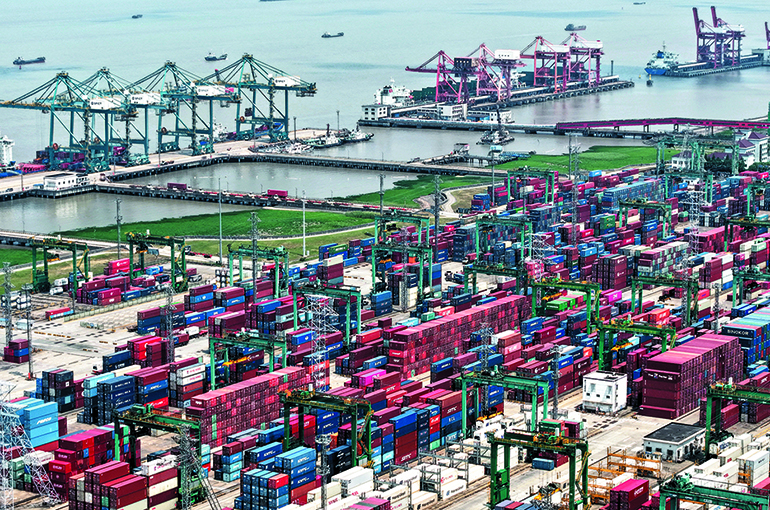
(Yicai) Oct. 22 -- The Port of Shanghai, the world’s busiest container port, is accelerating its green transition by expanding clean marine fuel supplies and developing green shipping corridors with major international ports across Europe, and Australia.
The Chinese port can now provide ship-to-ship bunkering of bonded liquefied natural gas and green methanol, while advancing cleaner shipping routes, Yicai learned at the 2026 North Bund Forum, which ended yesterday.
At the event, Shanghai unveiled development goals and a roadmap for a green shipping corridor with Germany's Hamburg, along with an outline implementation plan for a similar corridor with Australia's Melbourne. The announcements build on its existing cooperation with Los Angeles and Long Beach in California.
Shanghai's initiatives support the shipping industry's push to achieve the International Maritime Organization's target of net-zero greenhouse gas emissions around 2050. Its efforts also include expanding shore power and reducing diesel use at container terminals.
Shipping carries more than four-fifths of global trade by volume, but its vast scale and reliance on fossil fuels make decarbonization a major challenge. The shift to alternative fuels such as LNG, methanol, ammonia, hydrogen, and electricity requires not only new propulsion systems but also changes to fuel infrastructure, ship design, port operations, crew training, and international trade rules.
Shanghai Port Emerges as Global Green Shipping Model
A key part of Shanghai's green transition is reducing emissions from ships while in port.
Shore power allows berthed vessels to draw electricity from port grids instead of running fuel-powered generators, cutting fuel consumption and emissions, particularly when renewable energy is used.
Shore power facilities now cover more than 90 percent of Chinese ports and over 98 percent of ports along the Yangtze River Economic Belt, according to Gu Jinshan, president of the China Ports and Harbors Association, a national port industry group.
Shore power use by ships during port calls has quadrupled compared with 2020, while a green shore power corridor stretching from Chongqing to Shanghai is helping promote cleaner port operations, Gu said.
Shanghai is also shifting away from diesel at its container terminals, moving toward greater use of electricity, LNG, and renewable power. Diesel's share of energy consumption fell to 13 percent at the end of 2025 from 47 percent in 2015, according to Gu.
Beyond port operations, Shanghai is expanding its supply of cleaner marine fuels to help oceangoing vessels cut emissions.
Green methanol bunkering volumes at the Port of Shanghai have approached 40,000 tons so far this year. Bonded LNG bunkering reached 771,000 cubic meters last year, with volumes expected to surpass that level this year.
The port's international partnerships are also taking shape. At last year's North Bund Forum, Shanghai and the ports of Los Angeles and Long Beach unveiled the results of their cooperation on a green shipping corridor. The latest plans for corridors with Hamburg and Melbourne extend those efforts to Europe and Australia.
Eugene Seroka, executive director of the Port of Los Angeles, told Yicai that cutting emissions from ships traveling between Shanghai and Los Angeles by just 10 percent would be equivalent to eliminating an entire year's pollution at the Port of Los Angeles.
Seroka also said the port's business with China has grown steadily since March, accounting for more than 40 percent of its total business. September marked the port's strongest monthly performance in its 118-year history, while container throughput approached three million twenty-foot equivalent units in the third quarter.
Green Transition Reshapes Shipbuilding and Port Industries
The growing adoption of alternative marine fuels is also transforming the shipbuilding industry.
As shipowners turn to alternative fuels, shipyards must adapt engines, storage tanks, pipelines, and safety systems to different fuel requirements. The shift presents both technical challenges and new business opportunities as competing propulsion technologies reshape the shipbuilding market.
Vessel leasing company COSCO Shipping Development owns or has on order more than 100 dual-fuel green vessels with a combined capacity of 14 million deadweight tons, according to General Manager Wang Kunhui.
These include methanol- and LNG-capable vessels, giving the company a more diversified alternative-fuel fleet and orderbook, Wang said.
Existing ships can also cut fuel consumption without replacing their propulsion systems. Brian Adrian Wessel, director general of the Danish Maritime Authority, said targeted efficiency improvements based on assessments of operations and available technologies can deliver significant savings.
For example, a bulk carrier built in 2009 could save almost 1,810 tons of fuel annually, equivalent to about 18 percent of its previous consumption, by optimizing its sailing speed, routes, equipment, and operational management, he said.
The transition could also reshape the role of ports. Gu of the CPHA said developing zero-carbon terminals and port areas will require closer integration of energy supplies, transportation, operations, and management.
As demand for green marine fuels grows, ports could evolve from energy consumers into energy suppliers and service providers, creating business opportunities in fuel storage, transportation, bunkering, safety management, and trading, he added.
Editor: Emmi Laine





