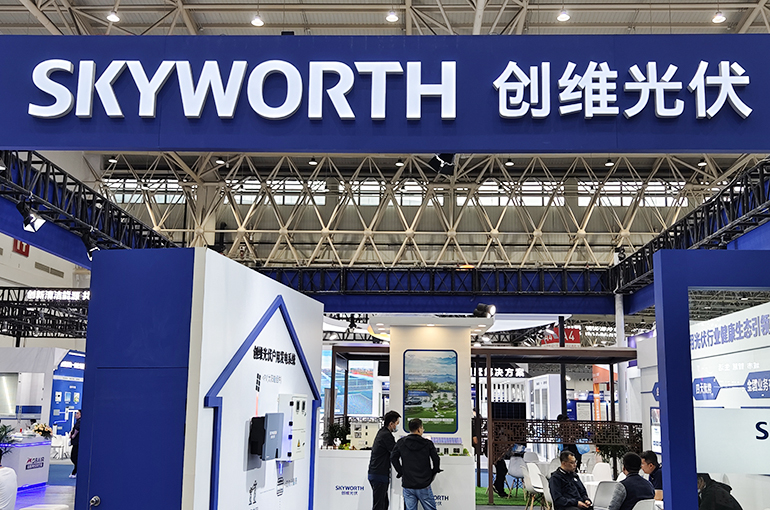
 Skyworth’s Solar Revenue Is Set to Overtake TV Sales for First Time in 2025, Founder Says
(Yicai) Jan. 12 -- Skyworth Group’s revenue from its photovoltaic operations is poised to surpass its television business for the first time last year, marking a major milestone in the Chinese consumer electronics giant’s diversification efforts, the firm’s founder told Yicai yesterday.
Skyworth will further expand into the energy storage sector as the widespread adoption of AI technologies is driving the rapid increase in global demand for green electricity, Huang Hongsheng said.
Skyworth, which built its name on color TVs, entered the solar sector in 2020. It initially focused on the construction of household distributed PV power stations in rural areas and gradually expanded to a number of midstream products in the PV industrial chain, such as solar panels, mounting systems and inverters, while also setting up a digital ecosystem platform for new energy. Today, the Guangdong-based firm’s solar business covers key links of midstream manufacturing as well as downstream applications and service areas.
Overseas markets will be the main growth engine for Skyworth’s solar business, as there is great potential for an increase in demand abroad, Huang said. For example, electricity prices in Europe are around CNY5.60 (USD0.80) per kilowatt-hour, roughly 10 times that of China’s residential rates. And in parts of southern Africa, power supply is tight, with outages lasting for one day a week on average.
Skyworth PV broke ground on its first commercial and industrial solar power station in Thailand’s Chonburi province last month. The plant is expected to generate more than 4.4 million kilowatt-hours of electricity in its first year of operation. The company has also just signed a contract for a 10-megawatt distributed PV power station in Italy.
Skyworth will roll out AI-powered home appliances across the board this year and all of its high-end products will feature built-in AI functions, Huang said. For example, AI TVs will offer smart searches for TV dramas and films, there will be intelligent interconnection between white goods such as air conditioners with services such as AI-generated content and Q&As with AI chatbots. However, due to the sharp rise in the price of memory components, the firm will postpone its plan to add AI features to lower-end products.
Skyworth has secured the operating rights for the Philips TV brand in the North American market, a move aimed at achieving low-cost global expansion and countering pressure from its main rivals Hisense and TCL, which have boosted their profiles by spending a huge amount on sponsoring the World Cup and the Olympics, Huang said.
Future Outlook
Skyworth’s TV shipments are expected to rank among the top five globally this year, Huang said, citing estimates from research firm AVC Revo.
Huang took a cautious stance about the surge of interest in humanoid robots and AI smart glasses at the recently concluded Consumer Electronics Show 2026. It will be a long time before androids replace domestic workers, he said, adding that most of China’s roughly 100 humanoid robot makers are still losing money and the application scenarios for AI glasses remain limited.
AI-powered home appliances, overseas solar operations and energy storage will be the key drivers of Skyworth’s future business growth, he said.
Editors: Tang Shihua, Kim Taylor