



 Tesla, GM, and Ford Showcase Evolving China Strategies at CIIE
(Yicai) Nov. 9 -- It is evident at this year's China International Import Expo how US carmakers Tesla, Ford Motor, and General Motors have moved beyond simply selling imported vehicles in the Chinese market to becoming increasingly integrated into the country's automotive industrial ecosystem.
Since the first CIIE in 2018, the three automakers have shifted from displaying imported vehicles to locally developed technologies, highlighting a shift in cooperation between the two countries, Yicai learned at the ongoing expo in Shanghai.
At the inaugural CIIE in 2018, Tesla displayed imported Model 3 and Model S vehicles. This year, its exhibits include the Cybercab autonomous electric vehicle, humanoid robots, and a dismantled Model Y displayed for the first time at the expo.
Ford initially signaled its entry into electrification by debuting its first all-electric model in China. Last year, it unveiled its first extended-range model equipped with a Chinese intelligent driving solution. This year, it is showcasing several vehicles under its Ford and Lincoln brands.
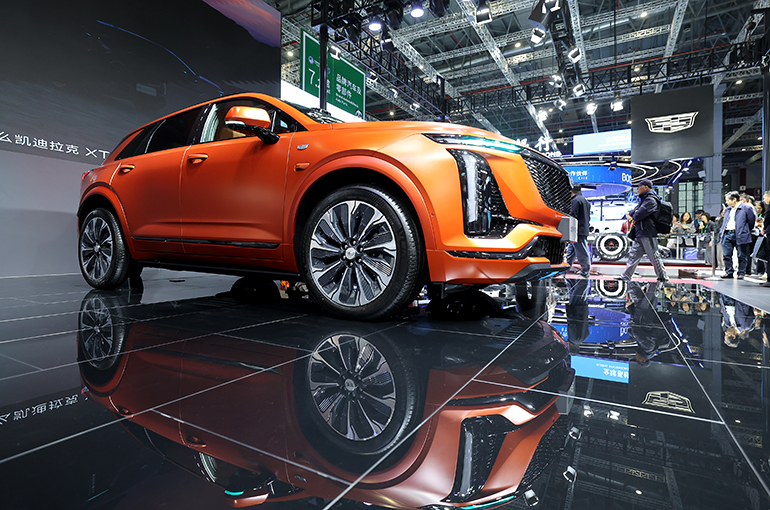
GM, which displayed limousines at the previous eight editions of the CIIE, is exhibiting five production Cadillac models and a Formula One replica racing car this year.
Different Paths to China Localization
The evolution of the three carmakers' exhibits also reflects their different investment strategies in China.
Tesla has pursued greenfield investment, integrating its operations with China's automotive supply chain. The localization rate at its Shanghai Gigafactory has reached 95 percent.
Ford has tapped China's fast-moving supply chain to accelerate its shift toward electric and intelligent vehicles.
GM, meanwhile, has focused on JVs. It established SAIC-GM with SAIC Motor in 1997, and the two companies renewed their JV agreement in August this year, extending their partnership until 2047.
John Roth, president of GM China and Asia, told Yicai during his first visit to the CIIE that this marks GM's ninth consecutive year at the event, which provides an opportunity to build connections and showcase its investments in China.
The five Cadillac models on display reflect GM's strategy of combining global experience with local capabilities to deliver products tailored to Chinese consumers, Roth said.
Nearly 100 percent of the components used in GM's vehicles produced in China are now sourced locally. Cadillac purchases parts from more than 230 Chinese suppliers, with around 98 percent of the major components in some vehicles sourced from China.
GM plans to continue increasing its investment in China while working with Chinese suppliers to expand internationally, Roth said. GM China is also among the largest exporters to the Middle East and South America, he added.
US Leads in Global Automotive Competitiveness
While US automakers increasingly rely on Chinese supply chains, their longstanding strengths in global investment and industry standard-setting continue to give them a competitive edge. This is reflected in the first Global Automotive Competitiveness Report, released by the Shanghai Academy of Social Sciences at the Hongqiao International Economic Forum during this year's CIIE.
The United States continues to rank first in global automotive competitiveness, supported by a relatively balanced industrial system and two significant traditional advantages, Tang Yunyi, deputy director of the Institute of Applied Economics at the SASS and a contributor to the report, told Yicai.
The first is the ability to allocate resources globally, built on extensive international investment experience dating back to the Second Industrial Revolution, a period of rapid industrialization from the late 19th to early 20th century.
The second is their ability to shape global automotive industry standards. "In the original rule system of the global automotive industry, China is a latecomer," Tang said, adding that China is pursuing two approaches: aligning with existing rules while using its emerging strengths to gain a leading role in setting rules in new areas where none have yet been established.
Tang emphasized that the automotive industry relies on extensive and interconnected supply chains, making global cooperation inevitable.
Editor: Emmi Laine





