



 US Home Appliance Orders Flow Back to China Amid Tariff Policy Shift
(Yicai) May 25 -- After the United States Supreme Court blocked President Donald Trump's so-called 'reciprocal tariffs,' home appliance orders began flowing back to China from Southeast Asia, according to Chinese manufacturers interviewed by Yicai.
US clients have recently placed bulk orders of millions of small electric fans back to the company's Chinese factories, Li Mingyang, general manager of Luckyway Home Appliances, told Yicai. Some orders returned to China already in the second half of last year, but just in small volumes, he noted.
After the US Supreme Court ruling in February, even though Trump immediately hiked global tariffs, the comprehensive tariff rate on Chinese electric fans exported to the US dropped to 14.7 percent from 24.7 percent. As a result, the tariff gap between fans made in China and Vietnam at US customs narrowed to 4.7 points from 14.7 percentage points.
And given that overall production costs for electric fans in Southeast Asia are 10 percent to 15 percent higher than in China, it was inevitable that orders would flow back to China, Li explained.
"We have secured orders that were transferred to Southeast Asia before, as production costs in Vietnam are slightly higher than in China," a small home appliance exporter based in East China told Yicai.
The manager of an ice maker company said to Yicai that supply chain costs in Thailand are 10 percent to 15 percent higher than in China, so after the US blocked reciprocal tariffs, the firm scrapped capacity expansion plans at its Thai plant, shifting existing local production capacity to serve markets in Southeast Asia, South Asia, and other overseas regions.
Labor costs in China's southeastern coastal regions are higher than in Southeast Asia, but the country's complete industrial chain, experienced workers, high production efficiency, and reliable quality control, along with the decline in US tariff rates, have driven the reasonable return of some small home appliance orders to China, said Wen Jianping, founder and president of data analytics firm AVI Data.
China's small home appliance exports to the US reached USD1.1 billion in April, up 3.9 percent from a year earlier, according to data from the General Administration of Customs. In the first four months of the year, the figure plunged 21 percent to USD3.8 billion from the same period last year.
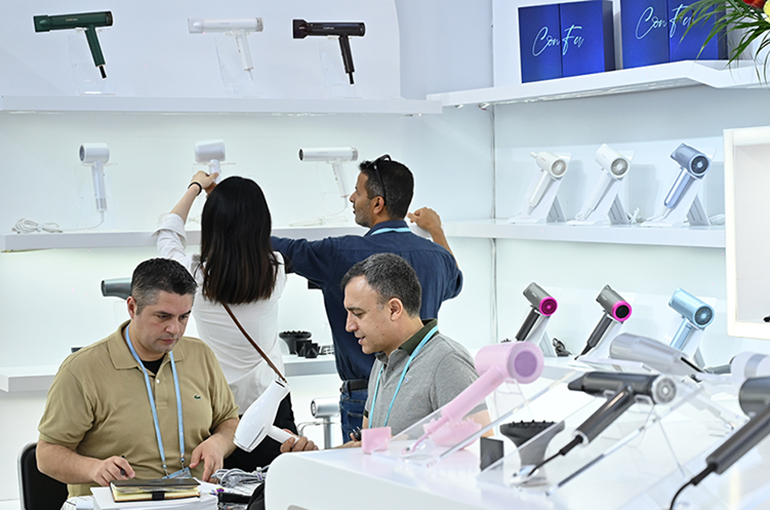
In April, the export value of ceiling and pedestal fans with a power output of no more than 125 watts to the US surged 100 percent and 18 percent, respectively, from a year earlier. Exports of rice cookers, electric ovens, hair dryers, and electric irons to the US also experienced substantial rebounds.
This growth reflects US buyers' improved confidence in China's stable supply chain and their recognition of Chinese product quality and delivery capacity, Li pointed out.
Frequent tariff fluctuations previously prompted US buyers to place only short-term, small orders. But with tariff expectations becoming clearer, major US retailers, brands, and importers have made large-scale orders.
Luckyway Home Appliances' fan and air fryer manufacturing bases in Zhongshan, Guangdong province, are operating at full capacity amid booming export orders in the second quarter, Li said.
Enterprises with factories in China and Southeast Asia have adjusted order allocation. Core component manufacturing, sophisticated processing, and urgent high-quality orders are retained in China, while low-end simple assembly work is completed in Southeast Asia, Yicai learned.
Manufacturing bases are also arranged based on the tariff reduction margins of specific product categories. For example, induction cookers, electric kettles, and rice cookers made in China remain subject to US Section 301 tariffs. Therefore, such products are still predominantly made in Southeast Asia, given the tariff advantages.
Chinese manufacturers should adjust their production layout across China and Southeast Asia based on comprehensive cost changes, said Yang Yuechao, senior marketing director of overseas sales at KingClean Electric.
Still, lingering uncertainties surrounding US tariff policies make overseas capacity deployment in Southeast Asia a necessary strategic move for Chinese small home appliance producers in the long run, he noted.
Editors: Tang Shihua, Futura Costaglione





